
 by
by What is the Trade Credit Insurance Market Size in 2026?
The global trade credit insurance market was valued at USD 13.05 billion in 2025 and is expected to grow from USD 14.53 billion in 2026 to approximately USD 38.24 billion by 2035, registering a CAGR of 11.35% from 2026 to 2035.
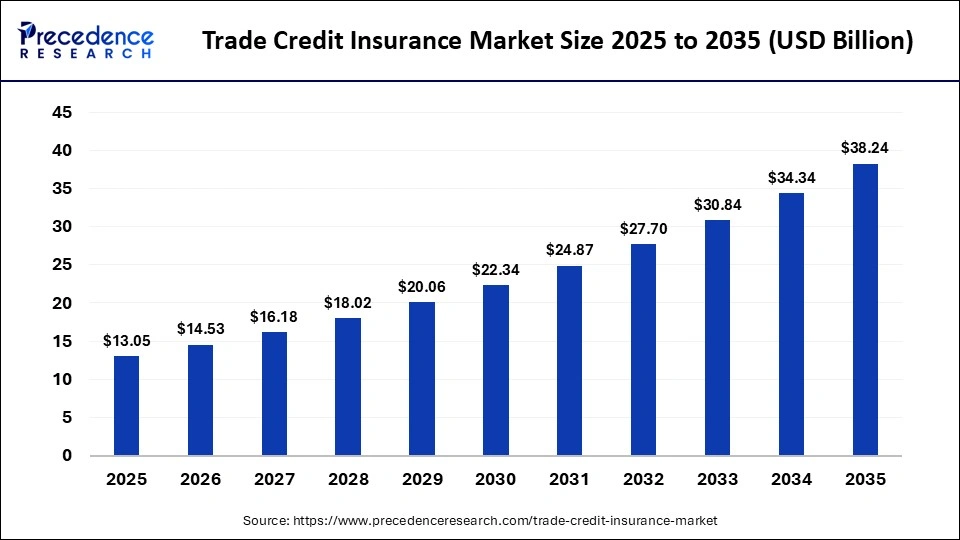
Market growth is fueled by:
-
Rapid globalization and expansion of cross-border trade
-
Increasing number of small and medium-sized enterprises (SMEs)
-
Rising adoption of core banking and digital trade finance platforms
-
Growing need to mitigate non-payment and insolvency risks.
Trade Credit Insurance Market Size 2025 to 2035
Market Overview
Trade credit insurance protects businesses against:
-
Commercial risks (insolvency, protracted default)
-
Political risks (currency restrictions, war, trade sanctions)
-
Non-payment from domestic or international buyers
It safeguards accounts receivable and ensures stable cash flow when customers fail to pay for goods or services sold on credit.
Rising economic uncertainty, global supply chain disruptions, and increasing insolvency risks are accelerating adoption across industries. Additionally, digitalization and data analytics are improving underwriting accuracy and accessibility.
However, high premium costs and limited awareness among SMEs remain key challenges.
Key Takeaways
-
Europe dominated the global market with a 31% share in 2025.
-
Asia Pacific is expected to grow at the fastest CAGR during the forecast period.
-
By enterprise size, Large Enterprises held a 61% share in 2025.
-
SMEs are projected to grow at the fastest CAGR.
-
By coverage, Whole Turnover Coverage dominated in 2025.
-
Single Buyer Coverage is expected to grow fastest.
-
By application, International Trade led in 2025.
-
Domestic Trade is expected to grow fastest.
-
By end-user, Food & Beverages dominated in 2025.
-
Automotive is projected to grow at the highest CAGR.
Impact of AI on Trade Credit Insurance Market Growth
Artificial Intelligence (AI) is transforming trade credit insurance operations by enhancing:
1. Risk Assessment & Underwriting
-
Real-time evaluation of structured and unstructured financial data
-
Early detection of buyer distress signals
-
Dynamic risk scoring models
2. Claims Management
-
Automated documentation verification
-
Fraud detection systems
-
Faster claims triage and settlement
3. Pricing & Portfolio Optimization
-
Personalized premium pricing
-
Improved portfolio performance analytics
-
Data-driven underwriting decisions
AI-driven tools improve transparency, operational efficiency, and reduce settlement timelines, strengthening insurer competitiveness.
Trade Credit Insurance Market Trends
1. Integration with Trade Finance Solutions
Insurance is increasingly embedded into:
-
Supply chain finance
-
Factoring
-
Invoice discounting platforms
This enhances lender confidence and SME credit access.
2. Adoption of AI & Advanced Analytics
Predictive modeling and automated underwriting enable dynamic premium adjustments and real-time risk monitoring.
3. Customized Sector-Specific Policies
Insurers are offering tailored coverage for industries like:
-
Manufacturing
-
Energy
-
Retail
-
Technology
4. Expansion of Domestic Trade Credit Insurance
Beyond exports, businesses are increasingly insuring domestic receivables due to rising local payment risks.
5. Digital Policy & Claims Management
End-to-end digital platforms are streamlining policy issuance, documentation, and claims settlement.
Segment Insights
By Enterprise Size
Why Did Large Enterprises Dominate?
The Large Enterprises segment held a 61% share in 2025 due to:
-
High transaction volumes
-
Extended credit cycles
-
Greater exposure to default risk
-
Large-value financing requirements
Banks and lenders often mandate trade credit insurance for large-scale financing.
Why Are SMEs Growing Fastest?
SMEs are projected to grow at the fastest CAGR because:
-
Higher vulnerability to cash-flow disruptions
-
Growing awareness of receivable protection
-
Government export support programs
-
Digital onboarding via fintech platforms
SMEs increasingly rely on insurance to access working capital and reduce financing risks.
By Coverage
Why Did Whole Turnover Coverage Dominate?
Whole turnover coverage led in 2025 because it:
-
Covers the entire buyer portfolio
-
Reduces administrative complexity
-
Supports balance-sheet level risk management
-
Is preferred for factoring and securitization
Why is Single Buyer Coverage Growing?
Single buyer coverage is expanding rapidly due to:
-
High-value project-based transactions
-
Long payment tenors
-
Exposure to financially uncertain counterparties
-
Need for top-up coverage
By Application
Why Did International Trade Lead?
International trade dominated due to:
-
Higher cross-border payment risks
-
Currency fluctuations
-
Regulatory differences
-
Political uncertainties
Export-focused insurance solutions are driving segment growth.
Why is Domestic Trade Growing Fastest?
Domestic trade insurance is gaining traction because:
-
Payment risks exist in local markets
-
Buyer consolidation increases exposure
-
Expanding credit sales in domestic supply chains
-
Rising economic uncertainty
By End User
Why Did Food & Beverages Dominate?
The Food & Beverages sector led the market in 2025 due to:
-
High transaction frequency
-
Low profit margins
-
Volatile commodity prices
-
Heavy reliance on credit-based sales
Extended payment terms increase exposure to default risk.
Why is Automotive Growing Fastest?
The Automotive segment is projected to grow fastest due to:
-
Complex global supply chains
-
High-value transactions
-
Technological transformation (EVs, automation)
-
Increased credit exposure across manufacturers and suppliers
Competitive Landscape
Key companies operating in the trade credit insurance market include:
-
Allianz Trade
-
Atradius N.V.
-
Coface
-
American International Group (AIG)
-
Zurich Insurance Group
-
Chubb
-
QBE Insurance Group
-
Aon plc
-
Export Development Canada
For inquiries regarding discounts, bulk purchases, or customization requests, please contact us at sales@precedenceresearch.com
