
 by
by 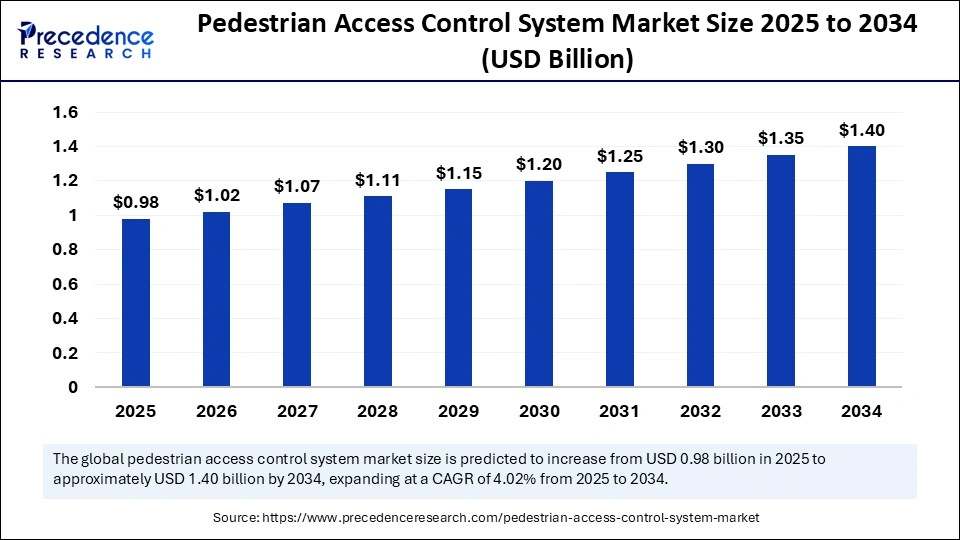
Pedestrian Access Control System Market Key Points
-
North America led the pedestrian access control system market with the highest revenue share in 2024.
-
Asia Pacific is expected to register the fastest growth throughout the forecast period.
-
Based on component, the access type segment accounted for a substantial share of the market in 2024.
-
The services segment, under component, is projected to witness notable growth in the coming years.
-
By operation mode, the automatic segment dominated the market in 2024.
-
The manual segment, under operation mode, is anticipated to expand steadily over the forecast timeline.
-
In terms of vertical, the transportation hubs segment held the leading market position in 2024.
-
The commercial buildings segment, under vertical, is forecasted to grow at a significant pace between 2025 and 2034.
Market Overview and Growth Outlook
Pedestrian access control systems are designed to regulate and manage human movement within buildings, transportation hubs, and urban infrastructure. These systems include technologies such as biometric turnstiles, RFID card readers, facial recognition gates, and automated doors. With urban populations rising and the emphasis on public safety growing, the demand for automated pedestrian control solutions is on the rise globally.
Rapid developments in transportation infrastructure, commercial real estate, and entertainment venues are fueling the deployment of smart access systems. Additionally, the increasing focus on reducing human contact, especially in the post-pandemic world, has accelerated the adoption of contactless and biometric access technologies. Government mandates and investments in securing public spaces have further intensified demand for intelligent pedestrian access solutions.
Role of AI in the Pedestrian Access Control System Market
Artificial Intelligence plays a crucial role in enhancing the capabilities of pedestrian access control systems. AI-powered facial recognition software, behavior prediction algorithms, and real-time threat detection systems are being embedded into access control infrastructure. These smart systems can analyze foot traffic patterns, identify unauthorized access attempts, and respond automatically to security breaches without human intervention.
In transportation hubs and large commercial centers, AI improves efficiency by learning pedestrian movement patterns and optimizing gate operations accordingly. Furthermore, AI integrations with IoT devices allow for seamless connectivity and remote management, transforming traditional access control into intelligent surveillance ecosystems. This fusion enhances both operational security and user convenience.
Market Growth Factors
Several key factors are driving the growth of the pedestrian access control system market. Urbanization is prompting governments and municipalities to invest in high-tech public infrastructure. The rise in commercial office complexes, stadiums, and transit hubs necessitates robust crowd control and monitoring systems. Increasing awareness of workplace safety and building access management is further boosting demand.
Moreover, technological advancements such as integration with mobile credentials, cloud-based access solutions, and AI-powered analytics are encouraging companies to upgrade their legacy systems. The growing trend of smart buildings, particularly in developed and emerging economies, is also supporting market expansion.
Market Scope
| Report Coverage | Details |
| Market Size by 2034 | USD 1.40 Billion |
| Market Size in 2025 | USD 0.98 Billion |
| Market Size in 2024 | USD 0.95 Billion |
| Market Growth Rate from 2025 to 2034 | CAGR of 4.02% |
| Dominating Region | North America |
| Fastest Growing Region | Asia Pacific |
| Base Year | 2024 |
| Forecast Period | 2025 to 2034 |
| Segments Covered | Component, Operation Mode, Vertical, and Region |
| Regions Covered | North America, Europe, Asia-Pacific, Latin America, and Middle East & Africa |
Market Drivers
A significant driver for the market is the increasing need for security and crowd control in public and private spaces. Technological innovations such as contactless biometrics and AI-based monitoring have enhanced system efficiency, encouraging wider adoption. In addition, compliance with regulatory norms and the growing necessity for seamless, integrated building management systems are encouraging both government and enterprise investments.
Market Opportunities
Opportunities lie in the adoption of smart city initiatives, particularly in Asia Pacific and the Middle East. These projects demand intelligent, integrated pedestrian access systems that can work with broader urban mobility frameworks. There is also rising interest in integrating access control with video surveillance and emergency response systems, presenting a new frontier for solution providers.
Additionally, the demand for mobile and cloud-based access control platforms is expanding, offering scalability and remote management capabilities for organizations of all sizes. Startups and established tech companies alike can leverage this trend to offer differentiated services and build recurring revenue models.
Market Challenges
Despite its growth potential, the market faces several challenges. High initial setup costs and infrastructure requirements can deter adoption, especially in cost-sensitive regions. Privacy concerns surrounding biometric data and AI-based surveillance also pose regulatory and ethical issues. Moreover, integration with legacy systems can be complex, requiring significant customization and expertise.
Cybersecurity risks linked to cloud and IoT integrations further complicate implementation, demanding robust protection against data breaches and system hacking.
Regional Outlook
In 2024, North America dominated the pedestrian access control system market, driven by a strong emphasis on physical security and advanced technology integration. The region benefits from extensive implementation across airports, government buildings, and commercial real estate.
Asia Pacific is projected to grow at the fastest CAGR between 2025 and 2034, propelled by rapid urbanization, increasing infrastructure development, and investments in smart city projects. Countries like China, India, and South Korea are leading in deploying access control solutions in mass transit systems and urban commercial districts.
Europe holds a significant share as well, with strong demand across transportation hubs and heritage sites. Meanwhile, the Middle East & Africa and Latin America are gradually adopting pedestrian control systems as infrastructure spending increases.
Pedestrian Access Control System Market Companies
- Royal Boon Edam International B.V.
- Dormakaba Holding
- KONE Corporation
- ZKTECO
- Honeywell
- ASSA ABLOY Global Solutions
- Johnson Control
Automatic Systems - PERCo
- Neptune Automatic Pvt. Ltd
- Gunnebo Entrance Control
- Hayward Turnstiles
- Turnstile Security
- URSA Gates Ltd.
- CAME Group
Segments Covered in the Report
By Component
- Access type
- Entrance gates
- Full-height turnstiles
- Optical turnstiles
- Security doors
- Speed gates
- Tripod turnstiles
- Access control software
- Services
- Consulting and design
- Installation and integration
- Maintenance and repair
By Operation Mode
- Manual
- Automatic
By Vertical
- Commercial buildings
- Government and private offices
- Transportation hubs
- Educational institutions
- Healthcare
- Industrial
By Region
- North America
- Asia Pacific
- Europe
- Latin America
- Middle East & Africa
Future Outlook and Trends
The pedestrian access control system market is set for continued growth, fueled by smart infrastructure investments, increasing automation, and demand for seamless and secure pedestrian movement. Trends include the use of multi-modal biometrics, AI for behavior-based access decisions, and integration with building energy systems to improve overall facility management.
Mobile-based access using NFC and Bluetooth credentials is gaining popularity, while cloud platforms are reshaping how access rights are managed and updated in real time. The convergence of access control with other building automation solutions marks a future where security, convenience, and sustainability go hand in hand.
Read Also: Margarine Market
Get this report to explore global market size, share, CAGR, and trends, featuring detailed segmental analysis and an insightful competitive landscape overview @ https://www.precedenceresearch.com/sample/6135
You can place an order or ask any questions, please feel free to contact at sales@precedenceresearch.com|+1 804 441 9344
