
 by
by 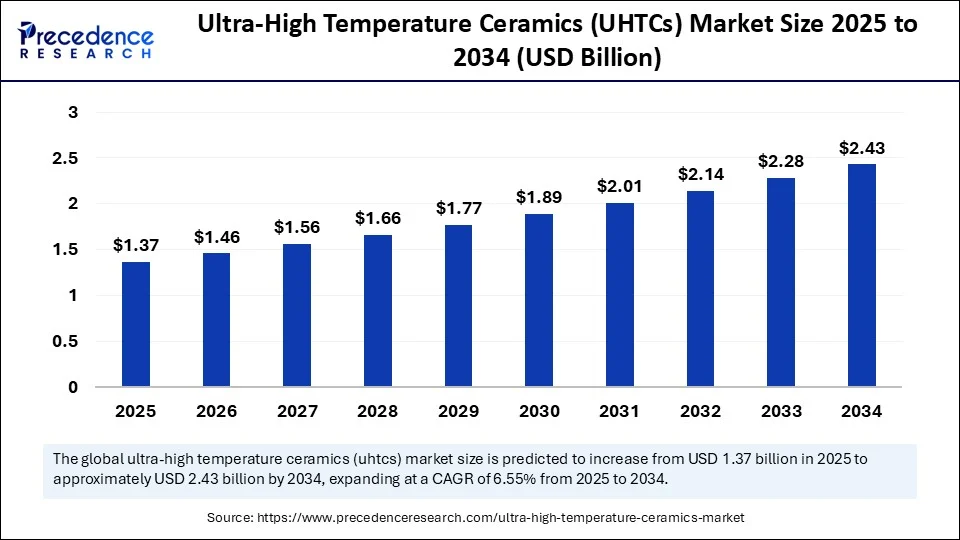
Ultra-High Temperature Ceramics (UHTCs) Market Key Takeaways
- In terms of revenue, the global ultra-high temperature ceramics (UHTCs) market was valued at USD 1.29 billion in 2024.
- It is projected to reach USD 2.43 billion by 2034.
- The market is expected to grow at a CAGR of 6.55% from 2025 to 2034.
- North America dominated the global ultra-high temperature ceramics (UHTCs) market with the largest share of 37% in 2024.
- Asia Pacific is expected to grow at the fastest CAGR from 20245 to 2034.
- By material type, the carbides segment contributed the biggest market share of 38% in 2024.
- By material type, the borides segment will expand at a significant CAGR between 2025 and 2034.
- By form, the monolithic ceramics segment captured the highest market share of 42% in 2024.
- By form, the fiber-reinforced composites segment will grow at the fastest CAGR between 2025 and 2034.
- By application, the hypersonic & aerospace vehicles (thermal protection systems) segment generated the highest market share of 34% in 2024.
- By application, the nose cones and leading edges segment will expand at a significant CAGR between 2025 and 2034.
- By end-user industry, the aerospace & defense segment held the largest market share of 51% in 2024.
- By end-user industry, the research & academia segment will expand at a significant CAGR between 2025 and 2034.
- By manufacturing technology, the hot pressing and sintering segment generated the major market share in 2024.
- By manufacturing technology, the spark plasma sintering (SPS) segment will grow at the highest CAGR between 2025 and 2034.
How Does AI Impacts the Ultra-High Temperature Ceramics Market?
AI simplifies the identification of high-entropy ceramics, improves tribological properties, and optimizes production workflows, expanding the range of UHTC applications. By analyzing massive datasets of material properties and behaviors, AI enables accurate predictions of ceramic performance across demanding environments, leading to more efficient and scalable solutions in aerospace, defense, and energy sectors.
Market Overview
Ultra‑high temperature ceramics market is gaining momentum globally, with the U.S. sector at the forefront of development due to the critical demand in aerospace, defense, nuclear, and energy industries. UHTCs—typically comprising borides, carbides, or nitrides of zirconium, hafnium, or tantalum—are valued for their ability to withstand temperatures above 2,000 °C while maintaining mechanical integrity.
As hypersonic vehicles, advanced turbine engines, and nuclear fusion experiments move from R&D to deployment, UHTCs are becoming an indispensable component. The market is projected to grow at high double‑digit compound annual growth rates over the next decade, fueled by government-backed programs, commercial aerospace expansion, and the rise in high‑temperature testing for next‑generation propulsion technologies.
Market Drivers
One of the strongest drivers is national security and aerospace innovation: U.S. defense initiatives focused on hypersonic weapons and re‑entry vehicle heat shields require materials that survive extreme temperatures and oxidation. UHTCs excel under these conditions, leading to increased government procurement and long-term contracts.
Advances in manufacturing technology—such as spark plasma sintering, additive manufacturing (3D printing), and improved hot‑pressing methods—have significantly reduced defects, improved yield, and accelerated iteration cycles. Energy and nuclear sector growth is another key factor: fusion reactors and next‑generation fission systems (including very‑high‑temperature reactors) require thermal barrier and control materials beyond conventional ceramics. The push for lower carbon emissions and cleaner energy solutions further enhances demand.
Opportunities
There is a rich opportunity in hypersonic propulsion and re‑entry systems, where UHTCs are among the few candidates to handle the thermal and kinetic environment. As the U.S. pursues greater autonomy in defense technologies, domestic production of UHTCs presents both strategic and commercial advantages.
The electrification of aerospace and terrestrial turbines offers another avenue: ceramic matrix composites and UHTC coatings can boost engine performance and lifespan. In the energy sector, as commercial fusion prototypes approach demonstration phases, UHTC components such as divertors and plasma-facing tiles are poised for deployment.
Scaling advanced manufacturing to produce complex shapes via additive techniques opens new product classes and reduces cost. Finally, private–public collaborations—such as national labs working with startups—can accelerate material innovation and certification pipelines.
Challenges
However, multiple challenges persist. Production cost and complexity are high: raw materials like hafnium and tantalum carbide are expensive and scarce, and their processing demands stringent conditions (high temperatures, controlled atmospheres, prolonged sintering). This limits economies of scale and keeps unit costs elevated.
Material brittleness and reliability hinder widespread adoption: UHTCs tend to be brittle at room temperature and require careful microstructural control to avoid catastrophic failure, particularly under thermal shock. Standardization and qualification are slow: aerospace and nuclear sectors require extensive testing, certification, and validation, which slows time‑to‑market.
Supply chain vulnerabilities—including reliance on specialty suppliers for raw powders and sintering equipment—pose logistical risks. Finally, scale‑up challenges remain: transitioning from lab‑scale prototypes to large components is non‑trivial and demands significant capital investment.
Recent Developments
In recent years, several U.S. defense agencies have funded hypersonic materials research centers focusing on zirconium diboride and hafnium carbide composites tailored for ultra‑high temperature use. These centers have achieved record thermal‑shock resistance through novel nanostructured blends. In parallel, aerospace contractor partnerships have successfully tested UHTC‑coated combustor liners in turbine rigs at simulated Mach 5 conditions.
Additive manufacturing breakthroughs now allow printing of near‑net‑shape UHTC blanks, reducing machining waste and enabling complex geometries. Startups in the advanced materials space have secured Series B funding to commercialize hybrid UHTC composites boasting improved toughness.
On the energy front, fusion test beds in the U.S. are integrating UHTC-based components into divertor mockups for experimental reactors. Academic collaborations, particularly between national labs and universities, are fast-tracking process qualification protocols and accelerated life‑testing data.
Get Sample Link@ https://www.precedenceresearch.com/sample/6507
Ultra-High Temperature Ceramics Market Companies
- U.S. Ceramics LLC
- COI Ceramics Inc. (Northrop Grumman)
- General Electric (GE Research)
- Bharat Dynamics Ltd. (India)
- ZIRCAR Ceramics Inc.
- 3M Advanced Materials
- Ultramet
- Refractron Technologies Corp.
- Morgan Advanced Materials
- Ortech Advanced Ceramics
- KT Refractories
- SGL Carbon SE
- Entegris Inc.
- CeramTec GmbH
- TYK Corporation (Japan)
- Mersen Group
- CoorsTek Inc.
- Hunan Rui Yue Industrial and Trade Co., Ltd. (China)
- Advanced Refractory Technologies (ART)
- Saint-Gobain Performance Ceramics & Refractories
Segment Covered in the Report
By Material Type
- Carbides
- Hafnium Carbide (HfC)
- Zirconium Carbide (ZrC)
- Tantalum Carbide (TaC)
- Borides
- Zirconium Diboride (ZrBâ‚‚)
- Hafnium Diboride (HfBâ‚‚)
- Titanium Diboride (TiBâ‚‚)
- Nitrides
- Boron Nitride (BN)
- Silicon Nitride (Si₃N₄)
- Composite UHTCs
- UHTC-Reinforced Carbon Composites
- UHTC-Oxide Hybrids
By Form
- Monolithic Ceramics
- Coatings
- Fiber-Reinforced Composites
- Ceramic Matrix Composites (CMCs)
- Powder/Granular UHTCs (for sintering or additive manufacturing)
By Application
- Hypersonic & Aerospace Vehicles (Thermal Protection Systems)
- Rocket & Missile Nozzles
- Nose Cones and Leading Edges
- Nuclear Reactors & Fuel Cladding
- High-Temperature Furnace Linings
- Cutting Tools & Industrial Machinery
- Aerospace Brake Disks
- Re-entry Spacecraft Components
By End User Industry
- Aerospace & Defense
- Energy & Nuclear
- Automotive (Performance & Racing)
- Industrial Processing (Metallurgy, Refractories)
- Research & Academia
By Manufacturing Technology
- Hot Pressing and Sintering
- Spark Plasma Sintering (SPS)
- Chemical Vapor Deposition (CVD)
- Additive Manufacturing / 3D Printing
- Slip Casting & Cold Isostatic Pressing
By Region
- North America
- Europe
- Asia-Pacific
- Latin America
- Middle East & Africa
Also Visit@ https://www.precedenceresearch.com/
