
 by
by 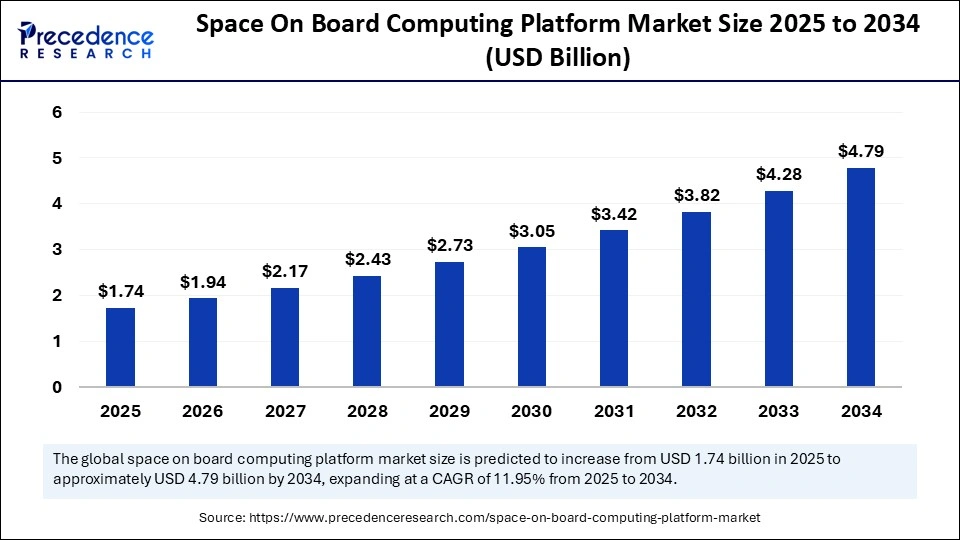
Market Overview
The Space On Board Computing Platform Market refers to the ecosystem of hardware, software, middleware, and services that provide computational, data-handling, and avionics control functions aboard spacecraft and satellites. On-board computing platforms range from ruggedized flight computers for small CubeSats to high-performance, space-qualified processors used in large GEO/LEO satellites and deep-space missions.
These systems perform mission-critical tasks such as attitude and orbit control, payload data processing, on-board autonomy, health monitoring, compression and routing of sensor data, encryption, and in some designs even edge AI inference. Recent market estimates indicate a multi-billion dollar industry with strong compound annual growth expected as satellite constellations expand and missions demand greater on-orbit autonomy and edge processing.
AI and Innovation
Artificial intelligence and machine learning are increasingly embedded into space on-board computing platforms. On-board AI enables real-time processing of sensor streams (imagery, RF signals, LIDAR), autonomous mission decisioning (fault detection and recovery, autonomous rendezvous, adaptive payload scheduling), and intelligent downlink prioritization to maximize limited communications windows. Innovations include hardware acceleration (FPGA and ASIC-based inference engines designed for radiation tolerance), model quantization and pruning to fit constrained power/thermal envelopes, and hybrid architectures that offload heavy training tasks to ground systems while running optimized inferencing models in orbit.
Other technological advances pushing innovation in the market are modular, software-defined avionics stacks, improved flight-grade multicore processors, and middleware that supports containerized payload applications. These developments reduce integration time, allow in-orbit reconfiguration, and support rapid deployment of new capabilities across satellite fleets.
Future Trends of Space On Board Computing Platform Market
Several trends will shape the Space On Board Computing Platform Market over the next decade:
-
Edge AI and Distributed In-Space Processing: More missions will process large volumes of data in orbit to reduce latency and bandwidth usage, including cloud-like services in space that aggregate compute across constellations.
-
Radiation-Tolerant High-Performance Computing: Demand for higher TOPS (tera operations per second) in space is driving novel packaging, redundancy strategies, and radiation-mitigation techniques for HPC accelerators.
-
On-Orbit Reconfigurability and Software Updates: Increased use of secure, over-the-air software and firmware updates will let operators extend mission life and deploy new algorithms after launch.
-
Edge Networking and Cooperative Swarms: Satellites will increasingly collaborate, sharing compute and storage to perform distributed sensing and processing tasks.
-
Commercialization of Space Compute Services: The emergence of space-based cloud and compute service offerings (compute as a service in orbit) will open new commercial models for payload customers and analytics providers.
These trends collectively shift value from raw telemetry downlinks toward on-board value extraction and real-time decisioning in the Space On Board Computing Platform Market.
Rising Demands of Space On Board Computing Platform Market
Demand for advanced on-board computing is rising across multiple end markets: Earth observation (real-time target detection and compression), telecom (in-orbit beamforming and traffic routing), defense and intelligence (autonomous sensing and rapid reaction), scientific exploration (autonomous navigation and data reduction), and commercial space services (edge compute and platform hosting).
The explosion of smallsat constellations, coupled with higher-resolution sensors and growing appetite for low-latency services, has made on-board processing essential to manage data volumes and deliver differentiated services. Additionally, national space agencies and commercial actors are pursuing more autonomous and resilient spacecraft to reduce dependence on ground intervention, further driving uptake of capable on-board platforms.
Key Market Highlights
-
Market valuations from recent industry reports place the space on-board computing market at over a billion dollars with projected double-digit CAGRs in coming years, reflecting sustained investment in satellite constellations and advanced missions
-
Technological leadership is transitioning to mixed ecosystems that combine COTS (commercial off-the-shelf) components hardened or qualified for space with custom radiation-tolerant designs to balance cost and performance.
-
Edge AI and in-orbit data processing are now strategic priorities for both commercial and government operators seeking to reduce downlink costs and accelerate decision cycles.
-
High-visibility programs (including initiatives to deploy distributed space compute fabric and space-based supercomputers) signal a long-term shift toward orbitally distributed compute infrastructures.
Market Growth Drivers
-
Proliferation of Satellite Constellations: The large number of planned smallsat and broadband constellations increases demand for affordable, capable on-board computing that can be mass produced and quickly integrated.
-
Data-Intensive Payloads: Higher sensor resolutions and new payload modalities (hyperspectral, SAR, wideband RF) generate volumes of data that make in-orbit pre-processing and analytics economically necessary.
-
Need for Autonomy and Resilience: Military, commercial, and deep-space missions require autonomous fault handling and adaptive mission management to operate with reduced ground support.
-
Advances in Component Technology: Improvements in low-power processors, space-qualified FPGAs, and radiation-mitigation design techniques enable higher performance in constrained mass, power, and thermal budgets.
-
Commercial Business Models: Demand for on-demand in-space compute and analytics services from third-party payloads and downstream customers creates new revenue opportunities tied to on-board platforms.
Restraints
-
Radiation and Thermal Constraints: Harsh space environments impose limits that make designing high-performance, reliable compute systems more expensive and complex than terrestrial equivalents.
-
Long Qualification Cycles and Certification Costs: Space qualification and regulatory compliance add time and cost to platform development, slowing innovation cadence compared to terrestrial IT.
-
Supply Chain and Sourcing: Securing flight-grade components and maintaining long-lifecycle supply chains is challenging, especially when using specialized processors or custom ASICs.
-
Power and Mass Budgets: On-board compute systems must operate within strict spacecraft power, mass, and volume constraints, limiting achievable peak performance.
-
Cybersecurity and Software Assurance: As systems become more software-defined and remotely reconfigurable, ensuring secure update mechanisms and robust cyber defenses becomes essential and costly.
Opportunities
-
Modular, Scalable Architectures: Developing modular on-board compute stacks (plug-and-play compute modules, container orchestration suited for space) can accelerate integration and reduce unit costs across constellations.
-
Space Compute as a Service: Commercial offerings that lease on-board compute cycles, storage, or AI inference capabilities to third parties (scientists, analytics firms, defense customers) represent a new market frontier.
-
Radiation-Tolerant Accelerators: There is a sizable opportunity for suppliers who can deliver power-efficient, radiation-hardened (or tolerant) AI accelerators tailored for common space workloads.
-
Software Ecosystems and Toolchains: Platforms that provide secure, standardized toolchains for deploying, testing, and updating in-orbit applications can unlock developer ecosystems and accelerate innovation.
-
Partnerships Between Ground and Space Cloud Providers: Integrations that make on-orbit compute appear as an extension of terrestrial cloud stacks will drive adoption by enterprises accustomed to cloud consumption models.
Regional Insights
-
North America: A leading region driven by strong investment from commercial space firms, defense programs, and established aerospace companies. The US market benefits from a mature supply chain for space components and active innovation in edge AI and software-defined spacecraft.
-
Europe: Active in industrial and scientific missions, Europe focuses on high-reliability designs and partnerships between space agencies and private firms to develop robust on-board computing solutions.
-
Asia-Pacific: This region is experiencing rapid growth in satellite manufacturing and constellation deployment driven by both commercial startups and state programs; demand for affordable, scalable on-board computing is high.
-
Rest of World (Latin America, Middle East & Africa): Emerging markets show interest for earth-observation and communication services; regional growth will follow improvements in local manufacturing, partnerships, and investment in space infrastructures.
Competitive Landscape & Strategic Players
The market includes traditional aerospace avionics suppliers, specialized space electronics firms, FPGA and ASIC design houses, and software platform providers. Competitive differentiation revolves around radiation-hardening expertise, integration support, software ecosystems, and the ability to supply at both smallsat volumes and large platform scales. Partnerships and vertically integrated offerings (compute + payload processing + analytics) are increasingly common as customers seek turnkey solutions.
Space On Board Computing Platform Market Companies
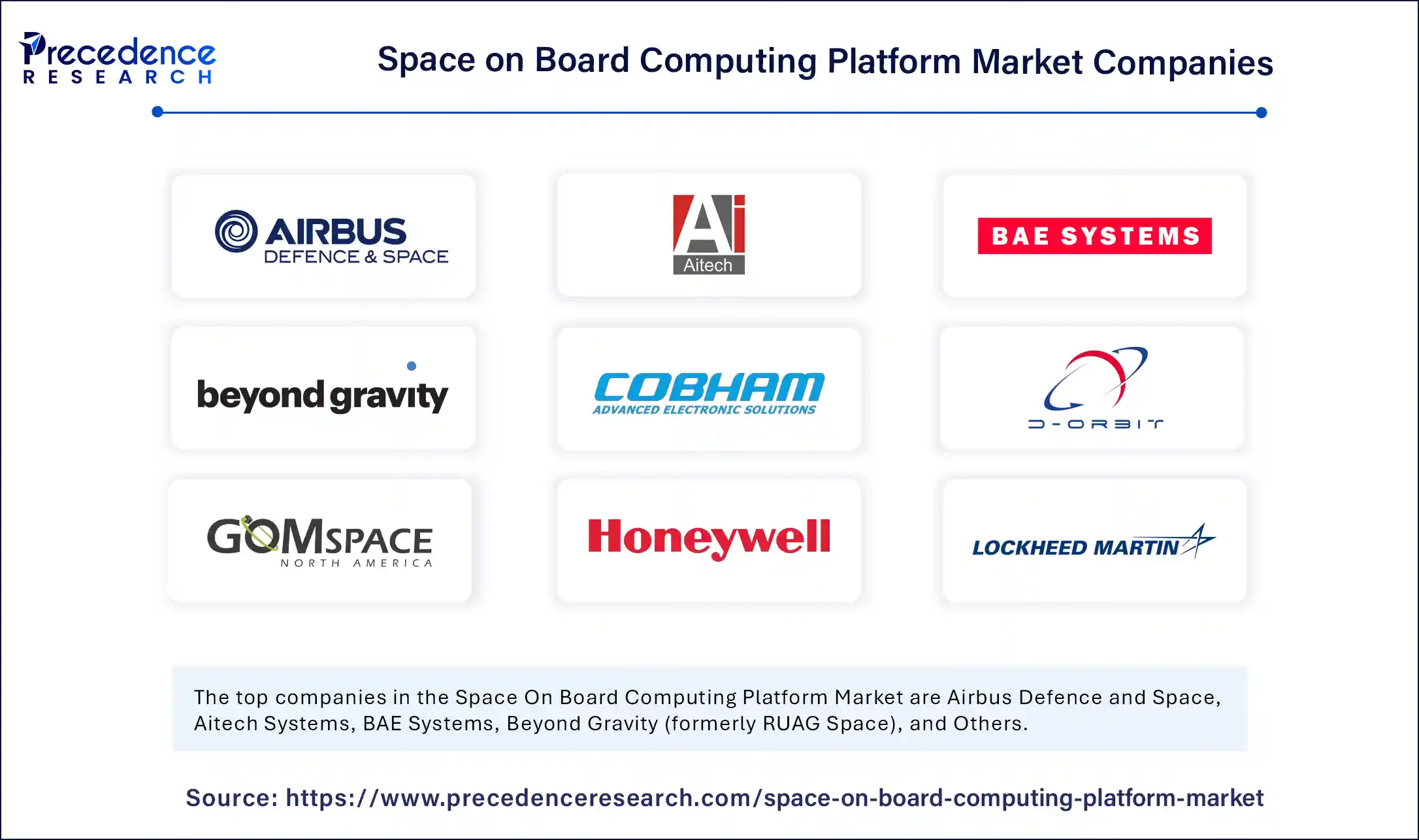
- Airbus Defence and Space
- Aitech Systems
- BAE Systems
- Beyond Gravity (formerly RUAG Space)
- Cobham Advanced Electronic Solutions (CAES)
- D-Orbit
- GomSpace
- Honeywell Aerospace
- Leonardo S.p.A.
- Lockheed Martin
- Northrop Grumman
- Raytheon Technologies
- Safran Electronics & Defense
Get Free Sample Link @ https://www.precedenceresearch.com/sample/6806
