
 by
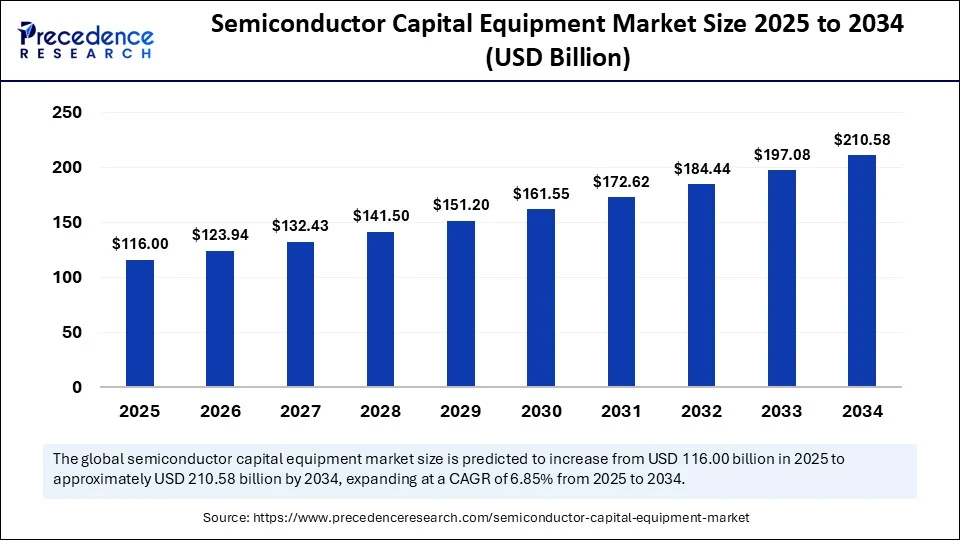
by According to the latest research by Precedence Research, the global semiconductor capital equipment market size is estimated at USD 116.00 billion in 2025 and is predicted to surpass around USD 210.58 billion by 2034, at a CAGR of 6.85% from 2025 to 2034. This upward trajectory is driven by relentless technological advancement, rising global demand for consumer electronics, 5G integration, and the surging need for high-performance computing and memory chips.
As the backbone of semiconductor fabrication, capital equipment encompasses photolithography tools, etching systems, deposition machines, and wafer handling technologies, all crucial for manufacturing the increasingly miniaturized and complex chips powering the digital economy.
Market Key Points
- In terms of revenue, the global semiconductor capital equipment market was valued at USD 108.56 billion in 2024.
- It is projected to reach USD 210.58 billion by 2034.
- The market is expected to grow at a CAGR of 6.85% from 2025 to 2034.
- Asia Pacific dominated the global semiconductor capital equipment market with the largest share of 47% in 2024.
- North America is expected to grow at a notable CAGR from 2025 to 2034.
- By equipment type, the front-end equipment segment held a major market share in 2024.
- By equipment type, the lithography sub-segment is projected to grow at a significant CAGR between 2025 and 2034.
- By application, the foundry operations segment contributed the biggest market share in 2024.
- By application, the OSAT segment is expected to expand at a significant CAGR between 2025 and 2034.
- By technology node, the ≥28nm segment led the market in 2024.
- By technology node, the 3nm and below segment is expected to grow at a significant CAGR over the projected period.
- By wafer size, the 300mm segment generated the major market share in 2024.
- By wafer size, the 300 mm and 450 mm segment is expected to grow at a notable CAGR from 2025 to 2034.
- By end-use industry, the consumer electronics segmwnt held the biggest market share in 2024.
- By end-use industry, the automotive segment expected to grow at a notable CAGR from 2025 to 2034.
- By distribution channel, the direct sales segment accounted for the remarkable revenue share in 2024.
- By distribution channel, the system integrators segment is projected to grow at the highest CAGR between 2025 and 2034.
Get a Sample: https://www.precedenceresearch.com/sample/6474
What’s Fueling the Semiconductor Capital Equipment Boom?
“Can Next-Gen Chip Demand Keep Up with Equipment Innovation?”
Yes—and it’s pushing the limits of precision engineering.
As industries race toward AI, autonomous systems, and quantum computing, chipmakers are under pressure to build smaller, faster, and more power-efficient semiconductors. The development of 2nm and even sub-2nm nodes requires unprecedented accuracy, spurring investment in extreme ultraviolet (EUV) lithography, atomic layer deposition (ALD), and advanced metrology tools.
Meanwhile, fabless giants like NVIDIA, AMD, and Qualcomm continue to fuel demand for foundry services, compelling TSMC, Intel, and Samsung to scale their fabrication capacity, which directly boosts the capital equipment supply chain.
Expert Insight
“The capital equipment market is no longer cyclical—it’s strategically indispensable. As nations pour billions into domestic semiconductor ecosystems, OEMs that support high-volume precision manufacturing stand to gain the most,”
— Dr. Amara Bhosale, Principal Consultant – Semiconductor Innovation, Precedence Research
Market Scope
| Report Coverage | Details |
| Market Size by 2034 | USD 210.58 Billion |
| Market Size in 2025 | USD 116.00 Billion |
| Market Size in 2024 | USD 108.56 Billion |
| Market Growth Rate from 2025 to 2034 | CAGR of 6.85% |
| Dominating Region | Asia Pacific |
| Fastest Growing Region | North America |
| Base Year | 2024 |
| Forecast Period | 2025 to 2034 |
| Segments Covered | Equipment Type, Technology Node, Wafer Size, Application, End-Use Industry, Distribution Channel, and Region |
| Regions Covered | North America, Europe, Asia-Pacific, Latin America, and Middle East & Africa |
Regional Analysis: Asia Pacific Remains Unrivaled
China, 🇰🇷 South Korea, and 🇯🇵 Japan Drive Equipment Procurement
Asia Pacific captured the largest market share in 2024, thanks to the presence of mega-fabs, robust R&D ecosystems, and state-backed chip sovereignty policies.
-
China is aggressively ramping up semiconductor manufacturing under its “Made in China 2025” initiative, investing over $150 billion to localize equipment sourcing.
-
South Korea, home to giants like Samsung Electronics and SK Hynix, is heavily investing in EUV and advanced memory fab upgrades.
-
Japan is staging a resurgence through precision metrology and materials innovation, backed by leaders like Tokyo Electron and Canon.
North America is poised for a second wave of growth, driven by the CHIPS Act in the U.S., which earmarks over $50 billion to revive domestic chip production. Europe, led by ASML and Infineon, is also realigning to become a high-tech manufacturing hub.
Segment Insights – Deep Dive into Market Components
Equipment Type: Front-End Equipment Takes the Lead
The semiconductor capital equipment market is broadly segmented by equipment type into front-end equipment, back-end equipment, and others. Among these, front-end equipment captured the largest share of revenue in 2023 and continues to dominate the segment throughout the forecast period. This equipment includes tools used for critical processes such as photolithography, ion implantation, etching, chemical vapor deposition (CVD), and physical vapor deposition (PVD). As chipmakers push the limits of Moore’s Law, the demand for front-end systems capable of operating at sub-5nm and even 2nm process nodes is intensifying.
Advanced EUV lithography systems, atomic layer etching tools, and precision metrology systems are increasingly necessary to manufacture next-generation chips used in AI accelerators, 5G modems, and automotive-grade processors. The growing adoption of heterogeneous integration and 3D chip stacking is further pushing front-end complexity, leading fabs to invest in new capital equipment to maintain throughput and yield. Meanwhile, the back-end equipment segment—which includes assembly, bonding, dicing, and packaging tools—is gaining traction due to the industry’s shift toward chiplet architectures, fan-out packaging, and advanced testing requirements, especially in edge computing and automotive environments.
Application: Semiconductor Fabrication Plants Remain the Backbone
In terms of application, semiconductor fabrication plants (foundries) accounted for the largest market share in 2023. These are the cornerstone of chip production globally, with major players such as TSMC, Samsung Foundry, Intel, and GlobalFoundries spearheading investments in new giga-fabs across the U.S., Taiwan, South Korea, and Europe. Fabrication plants rely on a vast array of highly specialized capital equipment to manufacture integrated circuits at nanoscale geometries. The push toward sub-3nm and 2nm nodes, driven by demand for high-performance computing, AI processing, and low-power IoT chips, is forcing fabs to adopt more advanced and more expensive equipment—which directly contributes to market growth.
As semiconductor devices grow in complexity, fabs are increasingly relying on AI-powered yield management systems, digital twins for predictive maintenance, and cleanroom robotics, all of which expand the scope of capital equipment usage. The capital intensity of these facilities—often exceeding $10 billion per fab—ensures a consistent demand pipeline for equipment vendors. Outside of fabs, integrated device manufacturers (IDMs) and outsourced semiconductor assembly and test (OSAT) providers are also investing in specialized tools to maintain competitive manufacturing capabilities. These players are especially important in customized SoC development and advanced packaging innovations, reinforcing the diverse use cases and expanding the market’s scope.
Read Also: Orthopedic Braces and Support Casting and Splints Market Size to Surpass USD 14.75 Bn by 2034
Latest Industry Developments and Breakthroughs
Key Players Pushing Boundaries:
-
ASML is now shipping its High-NA EUV tools, critical for 2nm and below nodes.
-
Applied Materials launched Centura Sculpta, enabling reduced patterning steps—cutting costs while enhancing throughput.
-
Tokyo Electron has introduced new coater/developer platforms designed for next-gen litho integration.
-
Lam Research is exploring selective etching at the atomic level, vital for 3D NAND and DRAM advancements.
Challenges Ahead: Cost Pressures and Global Fragmentation
Despite the bullish outlook, the industry faces formidable challenges:
-
High CAPEX Requirements: Setting up an advanced fab requires upwards of $15–20 billion. Equipment suppliers need to balance innovation with cost-efficiency.
-
Global Geopolitical Tensions: Export controls on high-end lithography tools (e.g., ASML’s EUV systems) are reshaping supply chains and vendor relationships.
-
Talent and Component Shortage: Complex mechatronics and optics require specialized engineering talent, which is in global shortage.
Ready to Dive Deeper?
To explore full segmentation, revenue charts, player strategies, and region-specific forecasts, download a sample report or schedule a personalized walk-through with our lead analysts.
Sample Report Download:
https://www.precedenceresearch.com/sample/3480
Book a Meeting with Our Research Team:
https://www.precedenceresearch.com/contact
About Precedence Research
Precedence Research is a globally recognized market research and consulting firm serving Fortune 500 clients across industries. Known for delivering actionable intelligence, granular segmentation, and long-range market modeling, we equip decision-makers with insights that lead to real-world business transformation.
Our industry coverage spans semiconductors, advanced manufacturing, healthcare, mobility, AI, and green technologies.
📍 Headquarters: Pune, India
📧 Email: sales@precedenceresearch.com
🌐 Website: https://www.precedenceresearch.com
