
 by
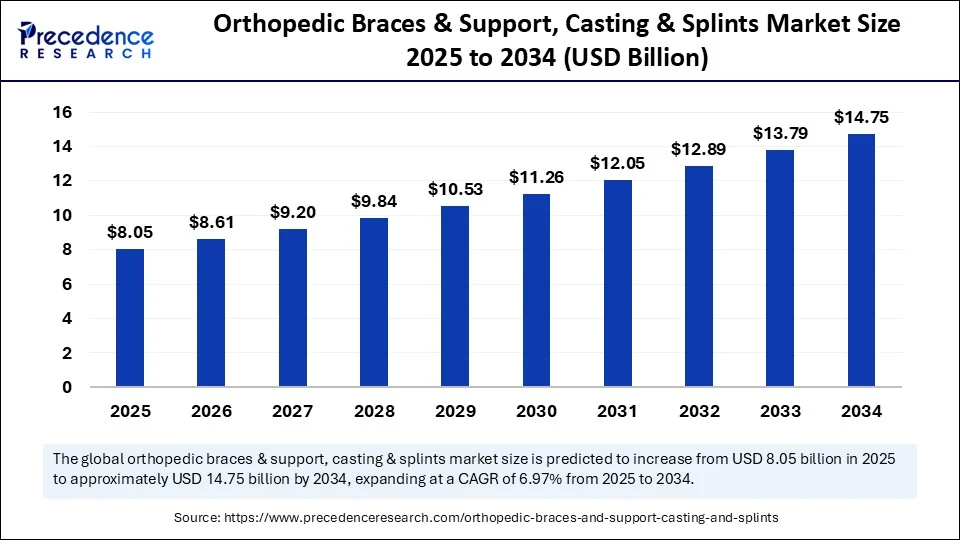
by The global orthopedic braces and support, casting and splints market size is estimated at USD 8.05 billion in 2025 and is predicted to surpass around USD 14.75 billion by 2034, at a CAGR of 6.97% from 2025 to 2034. This market expansion is fuelled by a rising incidence of musculoskeletal disorders, an aging global population, increasing sports-related and road‑accident injuries, and an elevated focus on non‑invasive preventive care and reha bilitation.
Orthopedic Braces and Support, Casting and Splints Market Key Points
- In terms of revenue, the global orthopedic braces and support, casting & splints market was valued at USD 7.53 billion in 2024.
- It is projected to reach USD 14.75 billion by 2034.
- The market is expected to grow at a CAGR of 6.97% from 2025 to 2034.
- North America led the orthopedic braces and support, casting and splints market with the highest revenue share of 37% in 2024.
- Asia Pacific is expected to expand at the fastest CAGR of 7% between 2025 and 2034.
- By product type, the orthopedic braces and supports segment held the highest market share in 2024.
- By product type, the casting supplies & equipment segment is expected to grow at approximately 7.1% CAGR between 2025 and 2034.
- By material, the metal segment led the market in 2024.
- By material, the thermoplastic segment is expected to expand at a notable CAGR over the projected period.
- By application, the fracture management segment captured the highest market share in 2024.
- By application, the post-operative care segment is expected to expand at the highest CAGR over the projected period.
- By distribution channel, the hospitals / ortgopedic clinics segment generated the major market share in 2024.
- By distribution channel, the e-commerce / online sales segment is expected to grow at a CAGR of approximately 8.3% during the forecast period.
Market Breakdown Table
| Segment | Detail |
|---|---|
| Product Types | Orthopedic Braces & Supports; Casting Supplies & Equipment; Splinting Supplies & Equipment |
| Top Product Category | Knee braces & supports – largest share due to osteoarthritis and sports injuries |
| Application Focus | Osteoarthritis fastest-growing application; fracture management and ligament support also significant |
| Materials | Thermoplastic, metal, fabric among common choices for braces/casts/splints |
| Distribution Channels | Orthopedic clinics, hospitals, OTC retailers, e‑commerce |
| Geographic Scope | North America (largest share), Asia Pacific (fastest growth), Europe, Latin America, Middle East & Africa |
Why This Market Is Growing – Key Drivers
-
Rising musculoskeletal conditions: The burden of osteoarthritis, osteoporosis and ligament injuries continues to grow globally, particularly in aging populations and active youth.
-
Trauma and injury incidence: Increasing sports activities and road accidents drive demand for braces, splints and casts.
-
Preventive & non-invasive care: Greater awareness of rehabilitation protocols is boosting non-surgical interventions, including braces and supports.
-
Expanding healthcare infrastructure: Growth in orthopedic clinics and e‑commerce platforms enhances access, especially in Asia-Pacific
Opportunity & Trend Section: Where Are the Biggest Market Gaps?
Table of Contents
Could advanced, patient‑adaptable bracing solutions redefine non‑invasive orthopedic care?
Manufacturers that deliver lightweight, custom‑fit, and smart braces, especially for osteoarthritis support and post‑operative rehabilitation, are well‑positioned to capitalize on unmet needs. The trend toward digital health‑enabled wearables, adjustable compression technology, and modular splint systems offers compelling opportunity pathways. Integration with tele-rehab platforms and remote monitoring could elevate care standards and enable proactive interventions.
Expert Quote
“We are observing strong momentum within the orthopedic braces and splints segment—driven by the convergence of demographic pressures and innovations in material science and wearables,” says Dr. Priya Verma, Principal Consultant, Precedence Research. “Products such as lightweight joint unloading knee braces powered by advanced thermoplastics and 3-D fitting tools are transforming patient compliance and outcomes, particularly in Asia-Pacific markets where access is expanding rapidly.”
Regional & Segmentation Analysis
North America
Dominating the market in 2025, with approximately 42% share, North America continues to lead due to high per‑capita healthcare spending, elevated prevalence of musculoskeletal ailments, and strong reimbursement frameworks. The U.S. braces & supports market alone is projected to grow steeply, reflecting rising demand from orthopedic clinics and increasing sales through online channels.
Asia‑Pacific
Forecast to grow at the fastest CAGR through 2033—often estimated between 6.8% and 9.1%—Asia‑Pacific benefits from massive population bases, rising healthcare expenditure, expansion of orthopedic centers, and rising medical tourism demand in India and China.
Europe, Latin America & MEA
These regions reflect steady uptake, driven by aging demographics and Government investments in orthopedic infrastructure. In countries such as Germany and Brazil, orthopedic clinics increasingly prescribe braces and splints as part of standard rehabilitation protocols.
Market Scope
| Report Coverage | Details |
| Market Size by 2034 | USD 14.75 Billion |
| Market Size in 2025 | USD 8.05 Billion |
| Market Size in 2024 | USD 7.53 Billion |
| Market Growth Rate from 2025 to 2034 | CAGR of 6.97% |
| Dominating Region | North America |
| Fastest Growing Region | Asia Pacific |
| Base Year | 2024 |
| Forecast Period | 2025 to 2034 |
| Segments Covered | Product Type, Material, Distribution Channel, Application, and Region |
| Regions Covered | North America, Europe, Asia-Pacific, Latin America, and Middle East & Africa |
Segments Insights: In-Depth Market Perspectives
By Product Type
The orthopedic braces & support, casting & splints market is primarily segmented into orthopedic braces & supports, casting supplies & equipment, and splinting supplies & equipment. Among these, orthopedic braces and supports dominate the revenue share due to their widespread use in managing musculoskeletal conditions, post-surgical recovery, and injury rehabilitation. Within this category, soft and semi-rigid braces are especially popular for knee, ankle, wrist, and spinal support. The increasing demand for comfort-focused and home-usable products has led to a significant rise in the adoption of elastic braces and neoprene-based wraps. Meanwhile, casting products remain vital in trauma cases and acute orthopedic injuries. These include traditional plaster casts as well as modern fiberglass alternatives that offer improved durability and patient comfort. Splinting products are also experiencing steady growth, particularly in emergency care settings and outpatient procedures where quick immobilization is essential.
By Application
From an application perspective, the market is segmented into ligament injury, preventive care, osteoarthritis, compression therapy, post-operative rehabilitation, and fracture management. Among these, osteoarthritis treatment is witnessing the fastest growth, driven by the rising global burden of degenerative joint diseases and an aging population. Patients with mild to moderate osteoarthritis increasingly rely on braces and supports to delay surgical interventions and maintain mobility. Similarly, post-operative rehabilitation represents a major revenue contributor, as orthopedic surgeons and physical therapists recommend braces and splints to aid in healing and reduce complications. Fracture management continues to rely heavily on casting and splinting systems, especially in developing regions with high road accident and trauma incidence. The ligament injury segment, which includes anterior cruciate ligament (ACL) tears and sprains, is notably growing due to the increase in sports-related injuries among young adults and athletes.
By Material Type
In terms of materials, the market comprises thermoplastics, metal alloys, fiberglass, elastic fabrics, and composite foams. Thermoplastics are widely used in custom-molded braces due to their flexibility, lightweight nature, and patient comfort. Their ability to be reshaped at high temperatures allows for personalized orthopedic solutions. Fiberglass, known for its high strength-to-weight ratio, is preferred in modern casting applications over traditional plaster. Elastic and neoprene fabrics dominate soft support braces, offering breathability and easy mobility for chronic conditions like arthritis and ligament instability. Increasing R&D into biocompatible materials and smart textiles is further pushing the boundaries of comfort and functionality in this segment.
By Distribution Channel
The distribution landscape is segmented into orthopedic clinics, hospitals, retail pharmacies, over-the-counter (OTC) channels, and e‑commerce platforms. Among these, orthopedic clinics account for the largest share, driven by their specialist expertise and direct prescription of braces and splints. Clinics often serve as the first point of consultation for patients suffering from injuries or chronic joint issues. Hospitals follow closely, especially for post-surgical rehabilitation and emergency trauma care. The increasing integration of orthopedic departments in multi-specialty hospitals boosts the segment’s reach. E‑commerce and online medical platforms are emerging as key growth enablers, especially for soft braces and compression products. Patients with chronic conditions prefer the convenience, range of options, and discreet delivery that online platforms offer. OTC channels and pharmacies remain vital in emerging economies, where accessibility and affordability drive consumer behavior.
By End-Use
The key end-users of orthopedic braces, supports, casting, and splints include hospitals & surgical centers, orthopedic & physiotherapy clinics, home care settings, and rehabilitation centers. Among these, hospitals and surgical centers lead the market in terms of volume, especially for acute care and trauma-related applications. However, homecare settings are growing rapidly due to the rise of chronic orthopedic conditions and an increased preference for at-home recovery and rehabilitation solutions. Rehabilitation centers and sports medicine clinics also play a pivotal role in prescribing and managing long-term usage of orthopedic supports.
Breakthroughs and Innovations
Recent developments are reshaping the market:
-
In February 2025, Icarus Medical launched the Adonis Knee Brace, a lightweight device with advanced joint‑distraction technology designed to unload medial/lateral knee compartments for osteoarthritis patients.
-
Other global firms—including DJO, Bauerfeind, Ossur, and Otto Bock Healthcare—are investing in 3D‑printed custom braces, thermoplastic adaptive materials, and smart sensors for wearable compliance tracking.
Challenges & Cost Pressures
Despite growth, the industry faces headwinds:
-
High cost of premium braces, especially those leveraging smart materials or adjustable mechanics, limits widespread adoption in lower‑income markets.
-
Lack of reimbursement in some regions hinders patient access.
-
Competition with pharmaceuticals and analgesic therapies: many patients prefer medication instead of investing in non-surgical support devices.
-
Supply chain constraints in materials like thermoplastic, fiberglass, and metals can increase production costs.
About Precedence Research
Precedence Research is a global, full‑service market intelligence firm delivering deep‑dive reports and strategic consulting across healthcare, technology, and industrial sectors. Our expert-led research helps decision-makers identify growth opportunities, monitor competitive landscapes, and support go‑to‑market strategies.
Contact Information:
Precedence Research
Email: sales@precedenceresearch.com | Phone: +1 650‑460‑3308
Website: precedenceresearch.com
