
 by
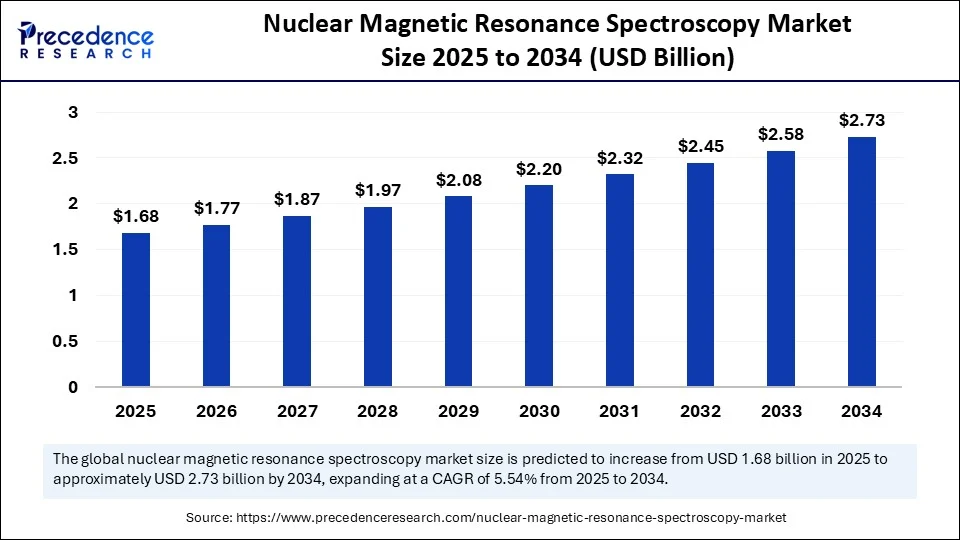
by The global nuclear magnetic resonance (NMR) spectroscopy market is forecast to expand steadily from USD 1.68 billion in 2025 to USD 2.73 billion by 2034, representing a compound annual growth rate (CAGR) of 5.54 percent. Precedence Research’s latest report notes that the market, valued at USD 1.59 billion in 2024, is benefiting from growing demand for high‑resolution molecular analysis in pharmaceuticals, materials science and biotechnology. North America currently holds the largest revenue share (approximately 46 percent in 2024) thanks to its robust research infrastructure and concentration of key players, while the Asia‑Pacific region is expected to post the fastest CAGR through 2034.
Nuclear Magnetic Resonance Spectroscopy Market Quick Insights
- Market value: USD 1.59 billion (2024), rising to USD 1.68 billion (2025) and projected to reach USD 2.73 billion by 2034.
- Growth rate: CAGR of 5.54 percent for 2025–2034.
- Top region: North America captured about 46 percent of global revenue in 2024, driven by strong R&D funding and established pharmaceutical and biotech sectors.
- Fastest‑growing region: Asia‑Pacific, fuelled by expanding research infrastructure, government funding and rapid industrialization.
- Leading product type: High‑field NMR spectrometers dominated the 2024 market due to their high sensitivity and resolution. Benchtop NMR spectrometers are projected to post the fastest growth thanks to portability and affordability.
- Top application: Drug discovery and development accounted for the largest revenue share in 2024, while metabolomics & biomarker research is expanding quickly.
- Primary end user: Academic and research institutes held the largest share; pharmaceutical & biotech companies will experience the fastest CAGR.
- Major players: Bruker Corporation, Thermo Fisher Scientific, Oxford Instruments, Nanalysis Corp., Magritek Ltd., Anasazi Instruments and Q.One Instruments.
U.S. Market Performance
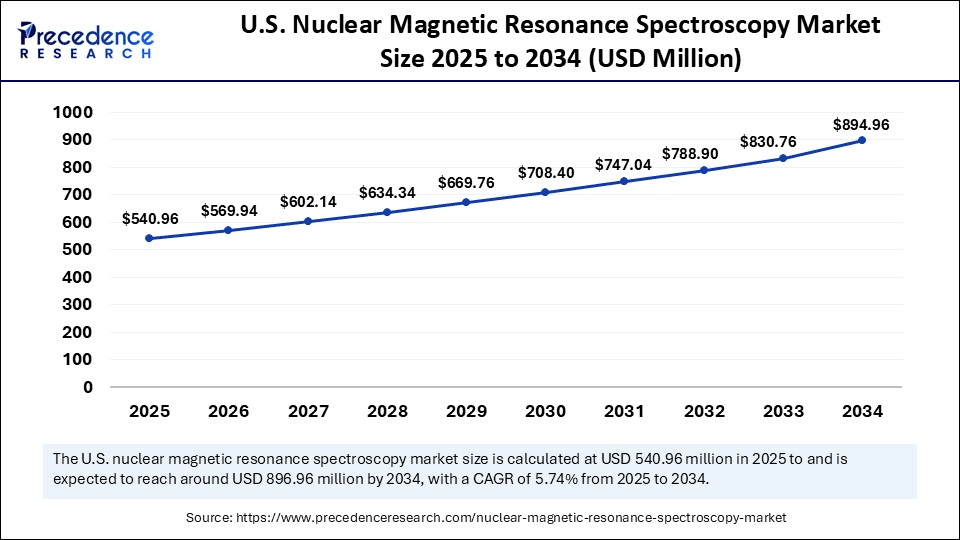
The United States remains the nucleus of NMR innovation. According to Precedence Research, the U.S. NMR spectroscopy market stood at USD 511.98 million in 2024 and is projected to reach approximately USD 894.96 million by 2034 at a CAGR of 5.74 percent. North America’s dominance stems from established pharmaceutical and biotechnology industries, robust R&D infrastructure and strong government funding. However, trade tariffs have increased costs for high‑field NMR components, emphasizing the need for supply‑chain diversification.
What is Driving the Nuclear Magnetic Resonance Spectroscopy Market?
Several catalysts are propelling NMR’s steady expansion:
- Broadening Applications: NMR adoption is rising in materials science (for structural and property analysis) and food safety, where it detects adulteration and contamination.
- Personalized Medicines: The shift toward personalized medicine is increasing demand for NMR‑based metabolic profiling to identify disease biomarkers.
- Chemical & Petrochemical Analysis: NMR’s ability to elucidate chemical structures and monitor reaction mechanisms drives uptake in chemical industries.
- Government Initiatives: Robust investments and research funding are promoting innovations and enabling novel NMR techniques.
- Technological Advancements: High‑field NMR, multi‑nuclear spectroscopy and dynamic nuclear polarization (DNP) technologies are boosting sensitivity and resolution.
Read Also: Net-Zero Pharma Supply Chain Market Size, Share, Report by 2034
Market Dynamics: Drivers, Challenges and Opportunities
Driver – Increased R&D Funding: Funding for NMR instrumentation and applications in pharmaceuticals, biotechnology and academic research is accelerating innovation and making advanced instruments more accessible.
Restraint – High Instrument Cost: High‑field systems and superconducting magnets entail significant upfront and maintenance costs, and operation requires specialized expertise. Recent U.S. tariffs on NMR supply chains have compounded cost pressures.
Opportunity – Emerging Applications: NMR is expanding into metabolomics, food science, materials science and clinical diagnostics. Researchers are integrating NMR electronics onto silicon chips; Harvard scientists recently demonstrated a portable 4 mm² NMR spectrometer that could make high‑quality analysis more affordable for structural biology, metabolomics and pharmaceutical screening. Such innovations are opening new revenue streams.
Product Type Outlook
High‑field NMR spectrometers (500–700 MHz and above) held the largest share in 2024 due to superior sensitivity and resolution for complex biological structures. Advances such as cryogenically cooled probes continue to enhance performance. Benchtop NMR spectrometers are expected to deliver the fastest growth; their portability, ease of use and lower cost make them attractive for small laboratories, food‑quality testing and academic institutions.
Application Outlook
Drug Discovery & Development: This application dominated the market in 2024 as NMR is vital for fragment‑based screening, metabolomics studies and structural analysis. Pharmaceutical and biotech firms increasingly invest in NMR for candidate identification and validation.
Metabolomics & Biomarker Research: The second‑largest segment will expand rapidly due to rising demand for biomarker identification in diseases like type 1 diabetes and preeclampsia. The growing focus on personalized medicine is accelerating this trend.
End‑User Outlook
Academic and research institutes were the largest end users in 2024; universities rely heavily on NMR for structural biology and molecular chemistry and play a crucial role in training the next generation of scientists. The pharmaceutical & biotech companies segment is projected to grow fastest, leveraging NMR to enhance drug safety and efficacy.
Regional Insights
- North America: Dominates with 46 percent share in 2024 due to strong research infrastructure, technological advances and strategic collaborations. The U.S. benefits from sizeable NIH and NSF funding and a robust biotech ecosystem.
- Asia‑Pacific: Fastest‑growing region thanks to expanding research infrastructure, an increasing number of NMR installations (China has deployed over 1,000 spectrometers) and strong government support for pharmaceutical R&D.
- Europe: Home to leading biotechnology and chemical industries, Europe is experiencing notable growth. Germany, with its strong manufacturing and academic sectors, is a key market leader. Collaborative research initiatives and funding programs in Europe foster innovation.
Latest Industry Developments
- Superconducting Breakthroughs: In May 2025, Bruker installed a state‑of‑the‑art 1.2 GHz NMR spectrometer at the University of Warwick, funded by a £17 million grant from UK Research and Innovation. This instrument promises transformative advances in energy storage, pharmaceuticals and biomaterials.
- Portable Benchtop Innovation: Bruker also unveiled its “multi‑Talent” Fourier 80 multinuclear benchtop FT‑NMR spectrometer at the 2025 ENC‑ISMAR conference, offering advanced permanent‑magnet technology for academic and industrial users.
- Helium‑Free MRI Systems: Siemens Healthineers earned FDA clearance in June 2025 for a virtually helium‑free 1.5 T MRI system that drastically reduces helium consumption.
- Time‑Domain NMR Systems: Oxford Instruments launched the MQC‑R benchtop research system in March 2025, enabling non‑destructive analysis of gels, liquids and solids.
These innovations underscore the industry’s shift toward high‑field performance and portable, sustainable solutions.
Case Study – Toward Portable NMR
Harvard University researchers recently integrated NMR electronics into a tiny 4 mm² silicon chip, creating a portable spectrometer that operates with a compact permanent magnet. This design promises cost‑effective NMR analysis for structural biology, metabolomics and pharmaceutical screening, illustrating how miniaturization could democratize access to advanced spectroscopy.
Expert Comment
“NMR spectroscopy is quietly revolutionizing how scientists interrogate molecules,” said Dr. Ayesha Bhandari, Principal Consultant at Precedence Research. “Our research shows that the technology is moving beyond traditional lab benches into portable, high‑field systems that can unlock insights in drug discovery, personalized medicine, materials science and food safety. While high capital costs remain a hurdle, the steady adoption across academia and industry and the pipeline of novel benchtop instruments suggest sustainable growth over the next decade.”
Call to Action
To explore the comprehensive insights, tables and forecasts contained in the full report, download a sample or schedule a meeting with our analysts:
- Sample pages: Get a Sample
- Consultation: Schedule a Meeting
Browse related market intelligence on Precedence Research:
- Nuclear Medicine Market Size to Surpass USD 35.04 Billion by 2034
- Magnetic Resonance Imaging (MRI) Market Report, 2034
- Portable MRI Market Size, Report by 2034
- Transcranial Magnetic Stimulation System Market Size
For press queries, custom research requests or to purchase the full report, please contact Precedence Research.
About Precedence Research
Precedence Research provides cutting‑edge industry insights, market sizing and strategic consulting services across healthcare, technology, energy and consumer sectors. Our analysts combine primary research, proprietary data models and deep industry expertise to help clients navigate disruptive markets and make informed decisions. Learn more at .
Contact Information
Precedence Research
USA: +1 804 441 9344 | APAC: +61 485 981 310 or +91 87933 22019 | Europe: +44 7383 092 044
Email: sales@precedenceresearch.com
