
 by
by 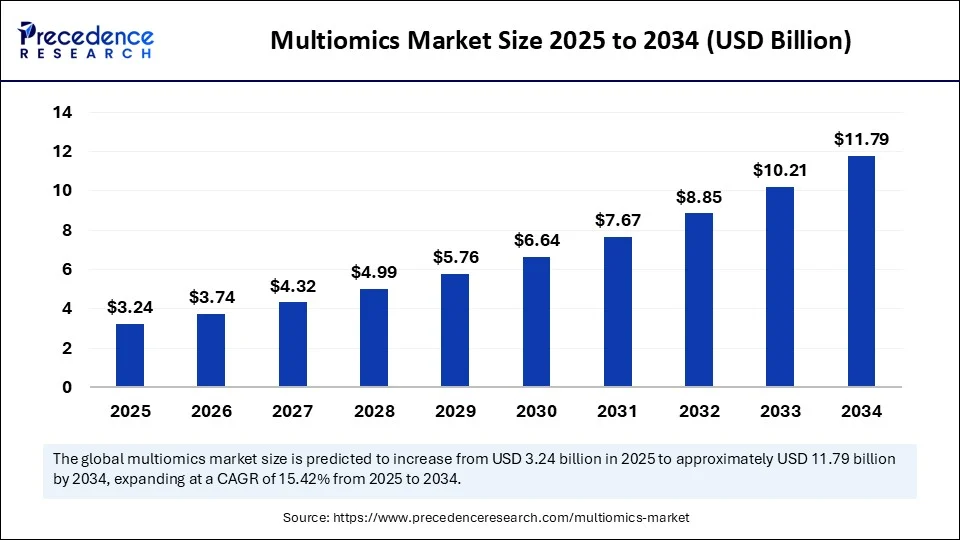
Multiomics Market Key Takeaways
- In terms of revenue, the global multiomics market was valued at USD 2.81 billion in 2024.
- It is projected to reach USD 11.79 billion by 2034.
- The market is expected to grow at a CAGR of 15.42% from 2025 to 2034
- North America accounted for the largest revenue share of 49% in 2024.
- Asia Pacific is expected to grow at a significant CAGR of 18% from 2025 to 2034.
- By omics type, the genomics segment held a 42% share of the market in 2024.
- By omics type, the metabolomics segment is expected to grow at the fastest CAGR over the projected period.
- By application, the drug discovery & development segment captured the largest market share of 39% in 2024.
- By application, the precision medicine and personalized therapy segment is anticipated to grow at a significant CAGR from 2025 to 2034.
- By technology, the mass spectrometry (MS) segment held the biggest market share of 34% in 2024.
- By technology, the multiomics integration platforms (AI/ML-based) segment is projected to expand at a significant CAGR from 2025 to 2034.
- By offering, the software and services segment held the major market share of 51% in 2024.
- By offering, the instruments segment is projected to grow at the highest CAGR between 2025 and 2034.
- By end-user, the pharmaceutical and biotechnology companies segment led the market share of 46% in 2024.
- By end-user, the hospitals and clinics segment is expected to grow at a significant CAGR over the projected period.
How AI Is Transforming the Multiomics Market
Artificial intelligence is revolutionizing the multiomics market by enabling the rapid, integrated analysis of large-scale datasets across genomics, proteomics, metabolomics, and more. AI-driven tools facilitate deeper insights into complex biological systems, paving the way for breakthroughs in disease understanding, biomarker discovery, and precision medicine.
By analyzing and correlating multiomics data, AI algorithms can identify disease subtypes, predict treatment responses, and uncover novel drug targets with unprecedented speed and accuracy. In drug discovery, AI enhances the design and optimization of therapeutics by predicting efficacy, toxicity, and patient stratification—ultimately improving diagnostic outcomes and accelerating development timelines.
At the ESGCT Congress in October 2024, Whitelab Genomics showcased how its AI-powered platform is transforming genomic medicine. Using extensive datasets, the platform runs in-silico simulations to streamline AAV vector design and optimization, reducing development time while enhancing target specificity—highlighting AI’s role in unlocking the full potential of gene-based therapies.
Market Overview
The multiomics market focuses on the integrated analysis of data from various omics disciplines—such as genomics, proteomics, transcriptomics, metabolomics, and epigenomics—to provide a holistic understanding of biological systems. By combining these diverse molecular datasets, multiomics enables deeper insights into disease mechanisms, therapeutic targets, and patient-specific responses.
This approach is fueling transformative advancements in personalized medicine, biomarker discovery, drug development, and clinical diagnostics. The market’s growth is further propelled by the rising burden of life-threatening diseases, increasing demand for precision healthcare, and continuous innovation in next-generation sequencing and bioinformatics technologies.
Key Trends in the Multiomics Market
- Rising Prevalence of Chronic Diseases: The increasing incidence of chronic illnesses such as cancer, cardiovascular disorders, and diabetes is fueling demand for multiomics approaches. These integrated methods enable a deeper understanding of complex disease mechanisms, supporting the development of more accurate diagnostics and personalized treatment strategies.
- Surge in Single-Cell Multiomics Adoption: Single-cell multiomics is gaining momentum as it allows researchers to analyze cellular heterogeneity and dynamic processes at the single-cell level. This innovation is proving critical in uncovering novel biomarkers and therapeutic targets, particularly in oncology and immunology, thus driving market expansion.
- Growing R&D Investments: Pharmaceutical and biotechnology companies are ramping up investments in multiomics R&D. This financial support is advancing the translation of multiomics research into clinical applications, accelerating drug discovery, and enhancing the precision of patient care.
- Technological Advancements: Cutting-edge technologies such as next-generation sequencing (NGS), mass spectrometry, and powerful bioinformatics tools are improving the efficiency and depth of multiomics analysis. These advancements enable the generation and interpretation of massive, complex datasets, fostering faster and more cost-effective multiomics research and diagnostics.
Opportunity
Rising Demand for Personalized Medicine and Precision Diagnostics
A major growth opportunity in the multiomics market stems from the increasing demand for personalized medicine and precision diagnostics. By integrating data across genomics, transcriptomics, proteomics, and metabolomics, multiomics enables a deeper understanding of individual disease profiles. This empowers clinicians to tailor treatments, predict patient responses, and improve therapeutic outcomes. Additionally, the ability to identify novel biomarkers enhances early disease detection and prognosis, driving the adoption of multiomics in both clinical and research settings.
Technology Insights
Why Did the Mass Spectrometry (MS) Segment Dominate the Market in 2024?
In 2024, the mass spectrometry (MS) segment led the multiomics market, accounting for approximately 34% of the market share. This dominance is attributed to MS’s exceptional sensitivity, specificity, and adaptability in detecting diverse biomolecules such as proteins, metabolites, lipids, and nucleic acids—even within complex biological matrices. Its seamless integration with other omics platforms and data analysis tools makes it indispensable for comprehensive multiomics workflows. Technological advancements, including High-Resolution Accurate Mass (HRAM) analyzers and Orbitrap systems, have significantly improved MS performance in terms of resolution, speed, and accuracy.
A notable application emerged in October 2024, when researchers utilized MS-based multiomics to study Hepatocellular Carcinoma (HCC). By conducting proteomics, phosphoproteomics, metabolomics, and lipidomics analyses, they successfully identified molecular pathways and biomarker panels linked to both early and advanced stages of HCC—demonstrating MS’s crucial role in disease characterization and therapeutic discovery.
Recent Developments
- In March 2024, Beckman Coulter Life Sciences introduced the CytoFLEX nano flow cytometer for research purposes, capable of detecting nanoparticles as small as 40nm. The new instrument offers increased sensitivity for detecting, quantifying, and characterizing nanoparticles, providing a solution that lowers detection limits and enhances resolution for analyzing low-abundance targets in heterogeneous extracellular vesicle populations, ranging from 1µm to 40nm, with consistent performance and reproducibility.
- In January 2025, Thermo Fisher Scientific Inc. announced that the UK Biobank Pharma Proteomics Project (UKB-PPP) selected its Olink Explore Platform for the largest human proteomics study to date, aiming to analyze over 5,400 proteins from 600,000 samples to identify new biomarkers for disease prediction and treatment.
- In April 2023, biomodal, formerly known as Cambridge Epigenetix, launched its new duet multiomics solution, demonstrating the combined power of genetic and epigenetic information from a single low-volume sample. This hardware-agnostic product delivers more epigenetic data from a single low-input DNA sample without complex, resource-intensive bioinformatics or harsh chemical treatments.
Multiomics Market Key Players
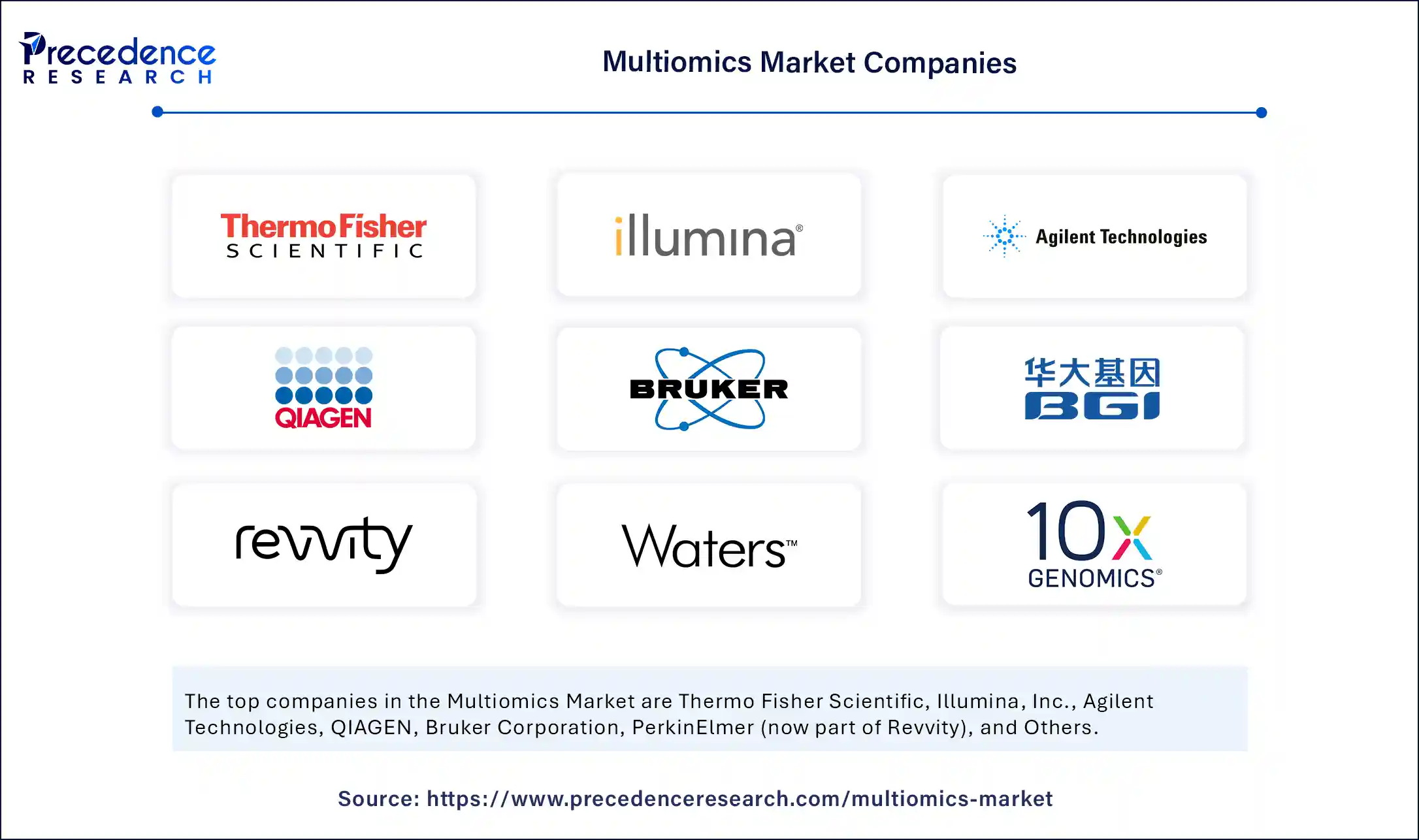
- Thermo Fisher Scientific
- Illumina, Inc.
- Agilent Technologies
- QIAGEN
- Bruker Corporation
- BGI Genomics
- PerkinElmer (now part of Revvity)
- Waters Corporation
- Bio-Rad Laboratories
- 10x Genomics
