
 by
by 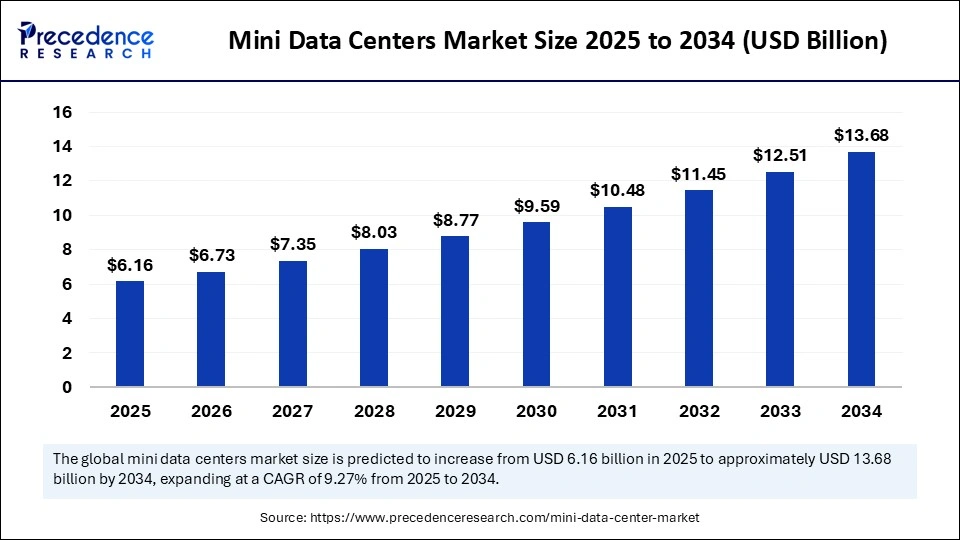
Mini Data Centers Market Overview
The Mini Data Centers Market is a fast-growing segment of the broader data center ecosystem that focuses on compact, self-contained systems deployed close to the point of use. Mini data centers typically combine racks, power, cooling, and management software in a smaller footprint than traditional hyperscale facilities, enabling enterprises, telcos, edge providers, retail locations, and industrial sites to host compute and storage resources locally.
As applications such as edge computing, IoT, real-time analytics, and latency-sensitive services proliferate, the Mini Data Centers Market is becoming essential to delivering distributed infrastructure with lower latency and improved reliability.
AI and Innovation
AI is both a major use case driving demand and a core enabler within the Mini Data Centers Market. On the customer side, mini sites host AI inference and model-serving workloads for real-time decisioning — for example, video analytics in retail, autonomous vehicle telemetry, or AI-driven predictive maintenance at manufacturing sites. Internally, innovation in mini data centers includes AI-powered infrastructure management: predictive cooling, power optimization, and anomaly detection reduce operating costs and increase uptime. Manufacturers are also innovating with modular designs, liquid cooling options, and integrated hardware accelerators (GPUs, NPUs) tuned for on-prem AI workloads.
Future Trends of Market
The future of the Mini Data Centers Market will be shaped by further decentralization and specialization. Expect to see: standardized, containerized mini modules for rapid deployment; higher adoption of liquid and immersion cooling as compute density increases; edge clusters orchestrated as extensions of cloud regions; and integrated security fabrics to protect distributed assets. Another trend is increased convergence between telco edge deployments (for 5G/6G) and enterprise mini data centers, creating hybrid ecosystems managed through unified orchestration layers.
Rising Demand of Market
Demand for the Mini Data Centers Market is rising due to multiple converging factors: real-time applications requiring low latency, regulatory or data sovereignty requirements that push data processing onshore, growth of IoT and sensor networks, and the need to reduce backhaul traffic to central clouds. Vertical industries — manufacturing, healthcare, retail, transportation, and energy — are increasingly deploying mini sites to support local analytics, compliance, and resilience.
Key Market Highlights
-
Rapid deployment: plug-and-play modular units shorten time to value.
-
Edge enablement: supports latency-sensitive AI/ML and streaming workloads.
-
Energy and cooling innovations: from micro-freezers to liquid cooling.
-
Vendor diversification: from hyperscalers offering micro-edge racks to specialized OEMs and system integrators.
-
Managed services: growing trend for mini data center as a service (MDCaaS).
Market Growth Drivers
Major growth drivers for the Mini Data Centers Market include the spread of 5G networks (bringing compute closer to users), rising enterprise need for on-prem data processing, expansion of smart city and industrial IoT initiatives, and improvements in modular manufacturing that lower unit costs. In addition, sustainability goals — reducing long-distance data transport and optimizing energy use at the edge — are motivating organizations to adopt mini data center architectures.
Restraints
Key restraints include the challenge of managing numerous distributed sites (monitoring, patching, security), higher per-unit operational cost compared to centralized hyperscale economies of scale, and limited space/power in some deployment locations. Standardization and interoperability gaps between vendors can complicate multi-site rollouts. Regulatory fragmentation and varied local permitting or power availability can also slow deployments in certain regions.
Opportunities
Opportunities in the Mini Data Centers Market are strong. Managed services providers can offer turnkey MDCaaS packages that remove operational burden from customers. There is room for specialized mini systems optimized for specific verticals (e.g., ruggedized units for oil & gas, sterile designs for healthcare). Software opportunities include lightweight orchestration, zero-trust security stacks for edge fleets, and chargeback/telemetry tools to monetize local compute. Partnerships between telcos, cloud providers, and systems integrators will unlock bundled edge offerings.
Regional Insights
-
North America: Early adopter market with many enterprise and telco edge pilots; strong vendor ecosystem.
-
Europe: Focus on data sovereignty and industrial edge use cases; regulatory emphasis on energy efficiency.
-
Asia-Pacific: Fastest adoption rate driven by telecom investment, smart city projects, and dense urban edge needs.
-
Latin America / MEA: Emerging opportunities but constrained by infrastructure gaps; potential for greenfield MDCaaS growth.
Mini Data Centers Market Companies
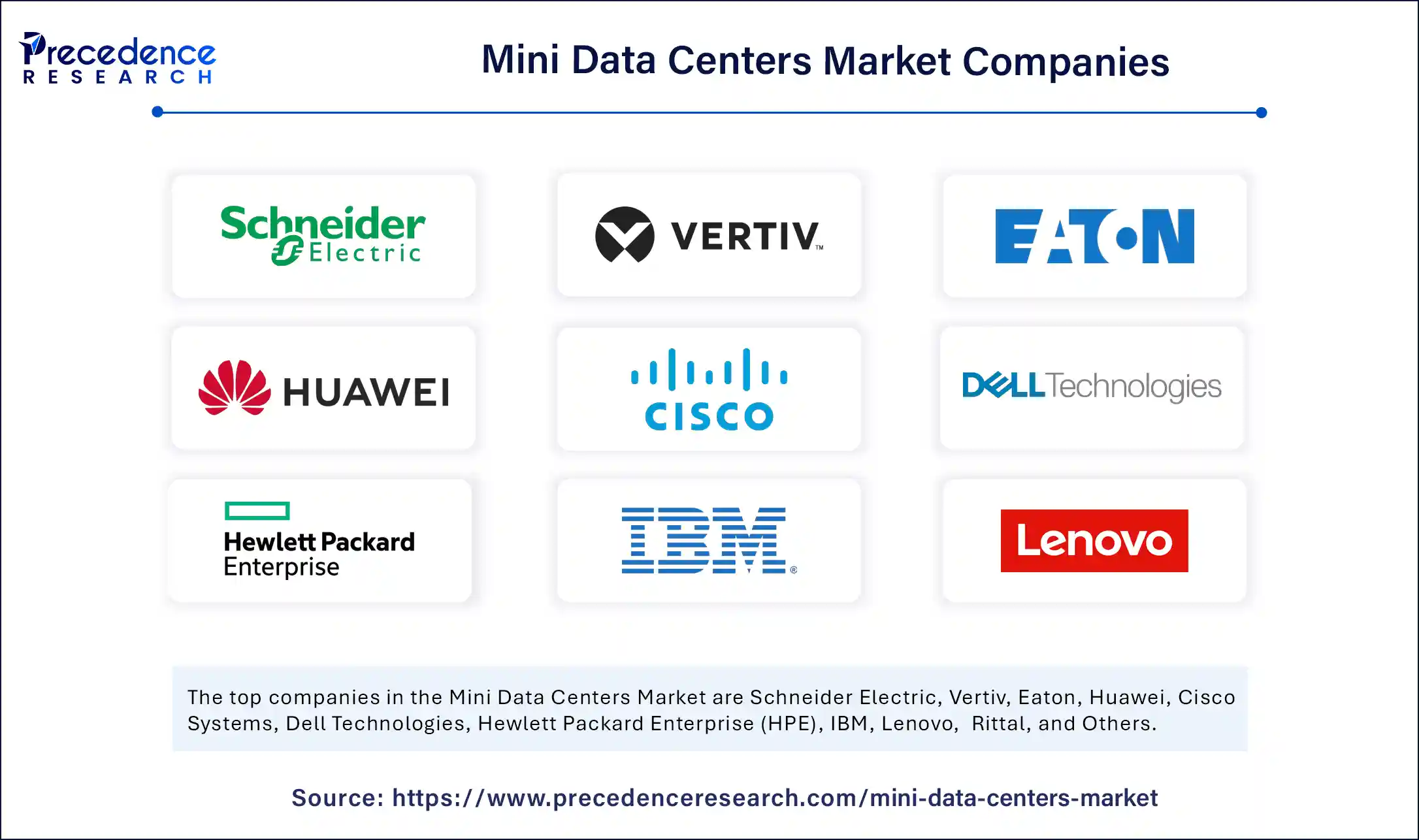
- Schneider Electric
- Vertiv
- Eaton
- Huawei
- Cisco Systems
- Dell Technologies
- Hewlett Packard Enterprise (HPE)
- IBM
- Lenovo
- Rittal
- APC by Schneider
- Panduit
- ABB
- Delta Electronics
- Legrand (Server Technology division)
- Fujitsu
- ZTE Corporation
- EdgeMicro
- Cannon Technologies
- Iceotope
Get Free sample Link @ https://www.precedenceresearch.com/sample/6788
