
 by
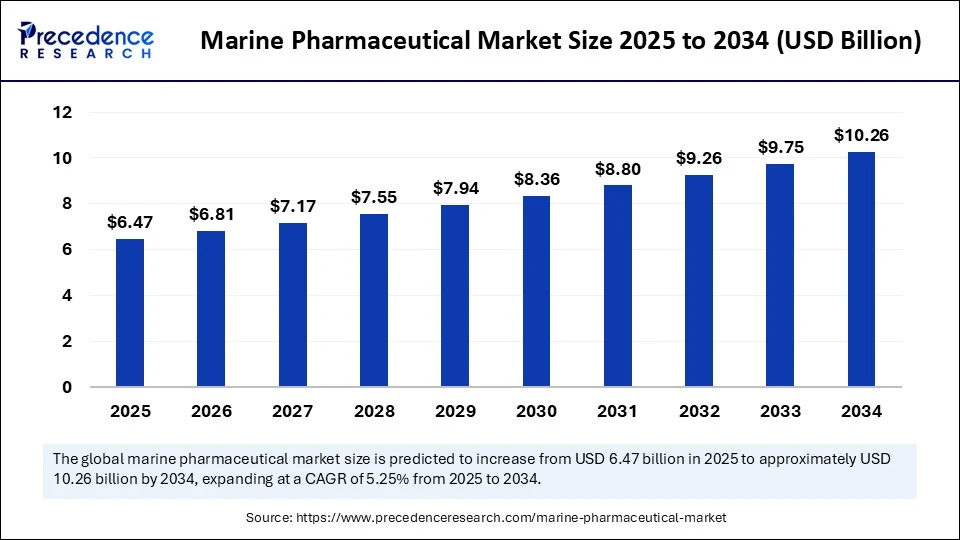
by Precedence Research’s latest market assessment reveals that the global marine pharmaceutical market will climb from USD 6.47 billion in 2025 to USD 10.26 billion by 2034, expanding at a compound annual growth rate (CAGR) of 5.25 %. Demand for novel bioactive compounds from oceans is reshaping drug discovery pipelines, with investors doubling down on marine‑derived therapies for cancer, infections and neurodegenerative diseases. North America dominates the market with 37 % share in 2024, yet Asia Pacific is set to grow the fastest thanks to vast marine biodiversity, proactive government funding and deepening biotech partnerships.
Quick Insights
- Market Value – USD 6.15 billion in 2024; projected to hit USD 10.26 billion by 2034.
- Growth Rate – CAGR of 5.25 % (2025‑2034).
- Top Region – North America held 37 % share in 2024; U.S. market alone is set to rise from USD 1.59 billion (2024) to USD 2.71 billion (2034).
- Fastest‑Growing Region – Asia Pacific, supported by expanding research capabilities and government investment.
- Dominant Source Organism – Marine invertebrates captured 38 % share in 2024.
- Largest Compound Type – Polyketides held 30 % share.
- Leading Therapeutic Area – Oncology, accounting for 42 % share.
- Top Product – Approved drugs represented 47 % share, with Yondelis (trabectedin), Zepzelca (lurbinectedin) and Priel (ziconotide) among key examples.
- Major Player – PharmaMar S.A. and Bristol Myers Squibb lead a growing roster of innovators.
What’s Driving the Surge in Marine‑Derived Pharmaceuticals?
Untapped biodiversity. Oceans host millions of unexplored species that produce bioactive compounds with unprecedented structures. Advances in AI, metagenomics and high‑throughput screening accelerate the identification of these molecules.
Demand for natural therapies. Rising antibiotic resistance and the need for safer oncology treatments are pushing pharma companies to pursue marine‑derived alternatives. Compounds from sponges, tunicates and mollusks exhibit potent anti‑cancer, anti‑viral and neuroprotective properties.
Investment boom. Governments, pharmaceutical giants and venture funds are pouring resources into marine biotech. U.S. and European investors benefit from robust clinical trial networks, while Asia‑Pacific governments scale funding and partnerships.
Opportunity & Trend Spotlight: What’s Next for Marine Pharma?
- AI‑Driven Discovery: AI models forecast pharmacological activity and simulate molecular interactions, allowing scientists to prioritise promising marine molecules and reduce R&D timelines.
- Deep‑Sea Exploration: Advances in submersible technologies open access to extreme habitats, revealing new species and chemical scaffolds. These efforts expand the pipeline of compounds targeting oncology, neurology and infectious diseases.
- Personalised Marine Drugs: Marine peptides and lipids show high specificity and low toxicity, making them attractive for personalised medicine in neurology and metabolic disorders.
- Regulatory Incentives: Orphan‑drug designations and fast‑track approvals for rare diseases encourage the development of marine‑based therapeutics.
Expert Perspective
“Marine biopharma is at the cusp of a renaissance,” said Dr. Ayesha Khan, Principal Consultant at Precedence Research. “Our latest analysis confirms that investors are betting on ocean biodiversity to deliver the next wave of blockbuster drugs. With AI and metagenomics transforming discovery and a growing appetite for natural therapies, marine‑derived compounds are poised to reshape oncology, neurology and infectious disease therapeutics.”
Market Scope
| Report Coverage | Details |
| Market Size by 2034 | USD 10.26 Billion |
| Market Size in 2025 | USD 6.47 Billion |
| Market Size in 2024 | USD 6.15 Billion |
| Market Growth Rate from 2025 to 2034 | CAGR of 5.25% |
| Dominating Region | North America |
| Fastest Growing Region | Asia Pacific |
| Base Year | 2024 |
| Forecast Period | 2025 to 2034 |
| Segments Covered | Source Organism, Compound Type, Therapeutic Area, Product Type, Development Stage, End Use, and Region |
| Regions Covered | North America, Europe, Asia-Pacific, Latin America, and Middle East & Africa |
Read Also: Hydraulic Fracturing Dual Engine Systems Market Size to Surpass USD 872.62 Mn by 2034
Regional & Segment Analysis
North America: With 37 % market share in 2024, North America remains the powerhouse of marine pharmaceuticals. The region’s sophisticated R&D infrastructure, extensive clinical trial networks and strong investment ecosystem accelerate commercialization. The U.S. market is expected to rise from USD 1.59 billion in 2024 to USD 2.71 billion by 2034.
Asia Pacific: The fastest‑growing region owes its momentum to vast marine biodiversity, rising healthcare expenditure and government support for biotech. Countries like China and India are expanding marine exploration and partnering with academia to unlock novel drug candidates.
Source Organism Insights:
- Marine invertebrates (sponges, tunicates, mollusks) generated 38 % revenue share in 2024. Their unique metabolites, such as the anticancer alkaloid trabectedin (Yondelis) derived from tunicates, demonstrate commercial success.
- Marine microorganisms (bacteria, fungi) will grow fastest. Their ease of cultivation and high metabolic potential make them ideal for scalable drug production; metagenomics and synthetic biology enable access to previously unculturable species.
Compound Type Insights:
- Polyketides hold the largest share at 30 % thanks to broad applicability in oncology and infection control.
- Peptides are projected to grow fastest due to their specificity, low toxicity and advancements in peptide synthesis.
Therapeutic Area Insights:
- Oncology dominates with 42 % share. Marine compounds like trabectedin and lurbinectedin exhibit high cytotoxic activity and are approved for cancer treatment.
- Neurology is the fastest‑growing segment as marine peptides show neuroprotective and regenerative effects for Alzheimer’s, Parkinson’s and epilepsy.
Product Type & Development Stage:
- Approved drugs account for 47 % share. Marketed products such as Yondelis, Zepzelca and Priel reinforce investor confidence.
- Pipeline drugs will expand rapidly as AI‑powered screening speeds discovery.
- Clinical trials lead the development stages, capturing 41 % share due to numerous marine-derived compounds advancing into human testing.
- Preclinical programs are growing swiftly as thousands of new bioactive molecules move through toxicity and bioavailability assessment.
End Users:
- Pharmaceutical companies hold 45 % share, leveraging capital and regulatory expertise to commercialize marine compounds.
- Marine biotech startups are expected to post the highest CAGR, thanks to their agility, niche specialization and use of AI and genomics.
Latest Breakthroughs & Industry Moves
- PharmaMar’s clinical pipeline: On 28 April 2025, PharmaMar presented 11 scientific publications at the AACR Annual Meeting, highlighting marine‑derived compounds such as lurbinectedin and ecubectedin. These data demonstrate promising preclinical and clinical results, underscoring the commercial potential of marine oncology drugs.
- Bristol Myers Squibb and Innate Pharma are accelerating marine‑based drug development, while startups like SeaPharm, Sirenas Marine Discovery and GlycoMar expand the discovery pipeline.
Challenges & Cost Pressures
Despite robust growth, the sector faces formidable hurdles. High costs of deep‑sea sampling, compound extraction and replication hamper commercial scalability. Many marine species are difficult to culture, necessitating complex synthetic processes. Regulatory uncertainties – including extra toxicity and efficacy testing and lack of specific guidelines for marine compounds – slow approvals and discourage multinational investment.
Set up a meeting at your convenience to get more insights instantly! https://www.precedenceresearch.com/schedule-meeting
