
 by
by 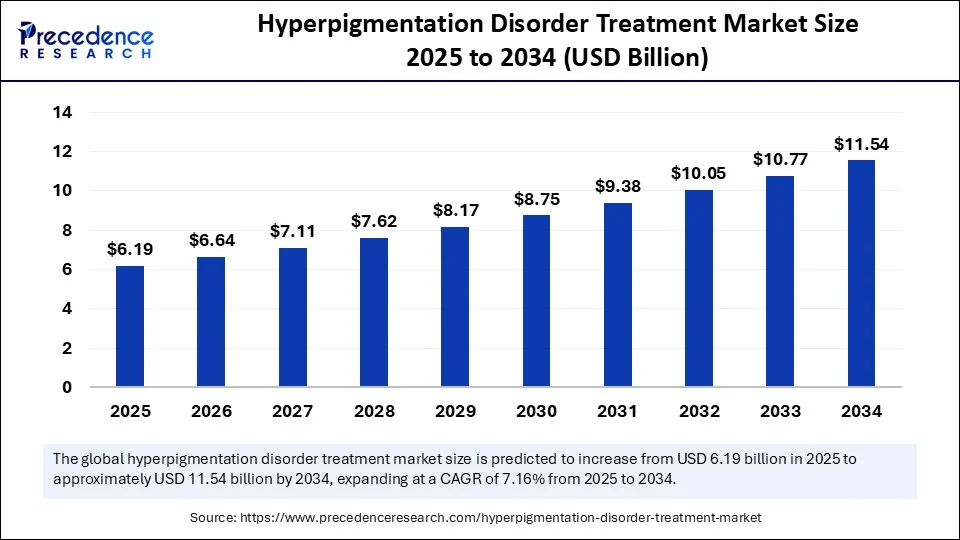
Hyperpigmentation Disorder Treatment Market Key Takeaways
- In terms of revenue, the global hyperpigmentation disorder treatment market was valued at USD 5.78 billion in 2024.
- It is projected to reach USD 11.54 billion by 2034.
- The market is expected to grow at a CAGR of 7.16% from 2025 to 2034.
- North America dominated the hyperpigmentation disorder treatment market with the largest market share of 34.9% share in 2024.
- Asia Pacific is expected to expand at the fastest CAGR between 2025 and 2034.
- By treatment type, the topical treatment segment held the biggest market share of 27.3% in 2024.
- By treatment type, the laser therapy segment is anticipated to grow at a significant CAGR between 2025 and 2034.
- By disorder type, the melasma segment captured the highest market share of 32.1% in 2024.
- By disorder type, the post-inflammatory hyperpigmentation segment is expected to expand at a notable CAGR over the projected period.
- By end user, the dermatology clinics segment generated the major market share of 38.7% in 2024.
- By end user, the home care settings segment is expected to expand at a notable CAGR over the projected period.
- By distribution channel, the prescription-based (Rx) segment accounted for significant market share of 41.5% in 2024.
- By distribution channel, the online retail segment is expected to expand at a notable CAGR over the projected period.
How is AI Reshaping the Hyperpigmentation Disorder Treatment Market?
AI innovations are driving clinical progress in the Hyperpigmentation Disorder Treatment Market. High-accuracy image analysis models (DenseNet121, InceptionResNetV2) have shown performance akin to or exceeding dermatologists for pigmented lesion identification (~86–87% accuracy).
AI tools launched in clinics in 2024 use diverse image libraries to tailor regimen plans and treatment paths especially for under-represented skin types. Generative and predictive AI holds promise in personalized regimen creation and outcome forecasting. However, bias due to insufficient training data diversity remains a significant limitation—closed-loop feedback and multi-ethnic datasets are needed for equitable performance.
Market Overview
The Hyperpigmentation Disorder Treatment Market spans cosmeceutical (limited to mild OTC or prescription z agents), chemical peels, microdermabrasion, phototherapy, laser-based interventions, cryotherapy, and emerging at-home skincare devices. Valued around USD 5.78 billion in 2024, the market is projected to reach USD 11.54 billion by 2034, growing at ~7.1 percent CAGR.
Topical treatments remain dominant due to ease of use and cost; however, clinics continue shifting toward high-efficacy device-based interventions. The market is segmented by condition, with melasma and PIH leading, and by user setting—dermatology centers, hospitals, and home care. Geographic attention is on U.S. and North America, while rapid expansion is seen across Asia Pacific.
Hyperpigmentation Disorder Treatment Market Drivers
Growth in the Hyperpigmentation Disorder Treatment Market is propelled by:
-
Increasing incidence of melasma tied to hormonal shifts and UV sensitivity.
-
Higher skin health awareness via digital media and public health outreach post‑COVID‑19.
-
Technological advances such as picosecond lasers, IPL, fractional RF, nanocarrier-enhanced topical formulations that increase precision and reduce side effects.
-
Surge in minimally invasive aesthetic procedures, accepted in dermatology settings and clinics.
-
Immediate visual gratification and rapid results, driving preference for professional device-based treatments over OTC solutions.
Market Trends
Significant Market Trends include:
-
Rise of picosecond and fractional ablative lasers, as they provide pigment targeting with fewer sessions.
-
Botanical and plant-extracted ingredients: kojic acid, licorice, tranexamic acid, niacinamide favored for their lower irritation risk and broad skin suitability.
-
Home-based LED, microneedling, and light-treatment devices continuing growth in parallel with in-clinic therapy.
-
Influencer-led digital marketing accelerating awareness of hyperpigmentation solutions and visual storytelling.
-
ESG and skin‑diversity activism influencing brand positioning, product formulation, and inclusivity in campaigns.
Opportunities
The Hyperpigmentation Disorder Treatment Market presents opportunities such as:
-
Scaling teledermatology and AI diagnostics, especially for underserved skin tones and remote areas.
-
Nanotechnology‑backed formulations to increase delivery efficiency and reduce adverse effects.
-
Collaborative clinical validation efforts between brands and dermatology centers to support efficacy claims and regulatory acceptance.
-
Localization strategies in Asia Pacific markets, targeting melasma and sun exposure-related pigmentation in specific skin types.
-
Product line expansions combining topical actives and devices, offering a full-spectrum home‑plus‑clinic regimen.
Challenges
Major obstacles in the Hyperpigmentation Disorder Treatment Market include:
-
Safety controversies around hydroquinone use, with risks like exogenous ochronosis and regulatory bans/refinements in several regions.
-
AI bias and performance gaps, especially for darker skin tones due to narrow training data.
-
Treatment affordability, particularly for laser and device therapies in less affluent markets.
-
Counterfeited or unregulated skincare products, contributing to complications and undercutting established brands.
-
Socio-cultural pressures perpetuating unregulated skin‑lightening product use, despite known health risks.
Recent Developments
Recent highlights shaping the Hyperpigmentation Disorder Treatment Market:
-
Indian skincare launches in early 2025, featuring tailored hyperpigmentation serums suitable for darker melanoma-prone skin.
-
Canadian regulatory approval of advanced picosecond lasers in 2023, broadening access in North America.
-
Adoption of AI systems in clinical settings (2024), allowing image-based regimen personalization particularly for complex pigment cases.
-
M&A activity and R&D alliances between skincare companies and dermatology centers to fast-track innovation.
-
Media and public health campaigns warning about unregulated skin-lightening creams, driven by case reports of cancer and ochronosis in regions like Africa
Hyperpigmentation Disorder Treatment Market Companies
- Galderma S.A.
- L’Oréal S.A.
- Allergan (AbbVie Inc.)
- Obagi Cosmeceuticals LLC
- Johnson & Johnson (Neutrogena)
- SkinCeuticals (L’Oréal)
- The Ordinary (DECIEM)
- Beiersdorf AG (Eucerin)
- La Roche-Posay (L’Oréal)
- Pierre Fabre Dermo-Cosmétique
- ISDIN
- PCA Skin
- Uriage Dermatological Laboratories
- Epionce
- Innoaesthetics
- Procter & Gamble Co. (Olay)
- Menarini Group
- Image Skincare
- Sesderma
- Bioderma (NAOS)
Segments Covered in the Report
By Treatment Type
- Topical Treatment
- Hydroquinone
- Retinoids (Tretinoin, Adapalene)
- Corticosteroids
- Azelaic Acid
- Kojic Acid
- Niacinamide
- Vitamin C (Ascorbic Acid)
- Tranexamic Acid
- Botanicals (Licorice Extract, Arbutin, etc.)
- Combination Formulations
- Others
- Laser Therapy
- Q-Switched Nd:YAG Laser
- Fractional CO2 Laser
- Intense Pulsed Light (IPL)
- Picosecond Laser
- Others
- Chemical Peels
- Glycolic Acid Peel
- Salicylic Acid Peel
- Lactic Acid Peel
- Trichloroacetic Acid (TCA) Peel
- Others
- Microdermabrasion
- Oral Treatment
- Tranexamic Acid (Oral)
- Polypodium Leucotomos
- Glutathione
- Others
- Others
- Cryotherapy
- Radiofrequency-based Treatments
By Disorder Type
- Melasma
- Post-Inflammatory Hyperpigmentation (PIH)
- Solar Lentigines (Age Spots)
- Freckles
- Drug-Induced Hyperpigmentation
- Others (e.g., Acanthosis Nigricans, Addison’s Disease-associated pigmentation)
By End User
- Dermatology Clinics
- Aesthetic Clinics
- Hospitals
- Home Care Settings (OTC Use)
- Others
By Distribution Channel
- Prescription-Based (Rx)
- Over-the-Counter (OTC)
- Online Retail
- Dermatology/Aesthetic Clinics
- Others
By Region
- North America
- Europe
- Asia-Pacific
- Latin America
- Middle East and Africa
Get sample@ https://www.precedenceresearch.com/sample/6511
