
 by
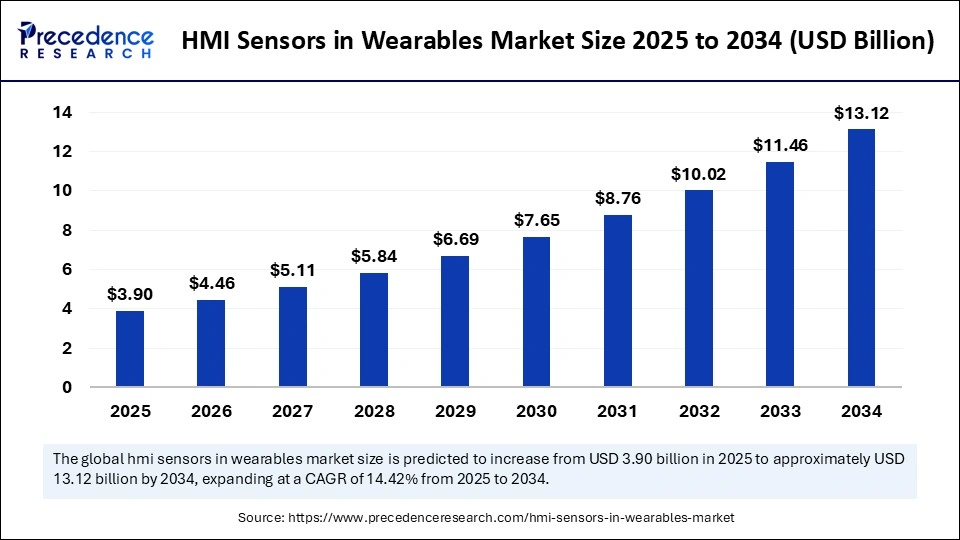
by The global HMI sensors in wearables market size is estimated to attain around USD 13.12 billion by 2034 increasing from USD 3.41 billion in 2024, with a CAGR of 14.42%.
HMI Sensors in Wearables Market Key Points
-
North America led the HMI sensors in wearables market in 2024, accounting for the largest revenue share of 34%.
-
Asia Pacific is projected to register the fastest CAGR of 16.51% during the forecast period.
-
By sensor type, the touch sensors segment captured a significant revenue share of 25% in 2024.
-
The voice and audio sensors segment, by sensor type, is expected to grow at a robust CAGR of 19.5% from 2025 to 2034.
-
By device type, the smartwatches & fitness bands segment dominated the market with the largest share in 2024.
-
The smart glasses/AR glasses segment, by device type, is projected to grow at the fastest CAGR between 2025 and 2034.
-
By application, the health & fitness monitoring segment led the market in 2024.
-
The gaming & immersive experience segment is anticipated to grow at a significant CAGR over the forecast period.
-
By end user, the consumer electronics segment contributed the highest revenue share of 42% in 2024.
-
The healthcare segment, by end user, is expected to expand at the fastest CAGR between 2025 and 2034.
HMI Sensors in Wearables Market Overview
The HMI sensors in wearables market is rapidly evolving, driven by the convergence of advanced sensor technologies, miniaturized electronics, and the growing demand for intuitive, user-friendly interfaces in personal and professional settings. Human-machine interface (HMI) sensors play a crucial role in wearables by enabling seamless interaction between users and devices through inputs such as touch, gesture, voice, and even bio-signals.
These sensors are embedded in a variety of wearable technologies including smartwatches, fitness trackers, smart glasses, medical wearables, AR/VR headsets, and industrial safety gear. As wearables increasingly function not just as accessories but as health monitors, communication hubs, and control interfaces, the integration of responsive and accurate HMI sensors becomes essential. The market is benefiting from rising consumer expectations for personalization, convenience, and immersive experiences, alongside growing enterprise adoption of wearables for health monitoring, workforce safety, and productivity enhancement. This has positioned HMI sensors as a foundational technology in the next generation of wearable computing.
HMI Sensors in Wearables Market Growth Factors
The growth trajectory of the HMI sensors in wearables market is being propelled by multiple technological and behavioral shifts. One of the most influential factors is the booming demand for health and fitness monitoring, where wearable devices equipped with sensors such as accelerometers, gyroscopes, capacitive touch sensors, and bioimpedance electrodes are being widely adopted to track steps, heart rate, sleep patterns, and more. In addition, the rising penetration of smartwatches and smart rings, which rely on advanced HMI capabilities like gesture recognition, touch sensitivity, and voice activation, has broadened consumer awareness and expectation for interactive functionality.
Another critical growth factor is the expansion of wearable use in medical and industrial applications, including remote patient monitoring and worker safety gear. These use cases require reliable HMI sensor integration to ensure real-time data input and feedback for diagnostics, alerts, and environmental sensing. The proliferation of edge computing and 5G connectivity further enhances HMI performance in wearables by enabling faster response times and more immersive experiences in AR/VR systems. Consumer demand for natural, hands-free interactions in wearables also pushes forward the adoption of voice, gesture, and proximity sensors, especially in smart glasses and hearables. Together, these trends are shaping a vibrant and fast-growing market landscape.
Impact of AI on the HMI Sensors in Wearables Market
Artificial Intelligence (AI) is revolutionizing the functionality, adaptability, and intelligence of HMI sensors in wearables, significantly amplifying their utility. AI enhances HMI systems by enabling context-aware and adaptive interactions, where devices learn from user behavior and environmental cues to personalize the experience. For example, AI algorithms in wearables can distinguish between different user gestures, recognize speech patterns more accurately in noisy environments, and filter out false touches or signals, thereby improving sensor accuracy and reliability.
AI also plays a pivotal role in sensor fusion, where data from multiple HMI sensors—such as motion, voice, and biometric inputs—are processed simultaneously to provide a more comprehensive understanding of user intent. This is especially critical in AR/VR wearables and medical devices, where precision and responsiveness are vital. In the healthcare domain, AI-powered HMI wearables are being used to monitor chronic conditions and trigger interventions based on predictive models derived from sensor data.
In industrial settings, AI algorithms embedded in wearable HMI systems help monitor fatigue, stress, or risky movements to prevent accidents. As AI becomes more advanced, it will further blur the line between human intent and machine response, enabling more seamless and intelligent interaction models in wearables.
Market Scope
| Report Coverage | Details |
| Market Size by 2034 | USD 13.12 Billion |
| Market Size in 2025 | USD 3.90 Billion |
| Market Size in 2024 | USD 3.41 Billion |
| Market Growth Rate from 2025 to 2034 | CAGR of 14.42% |
| Dominating Region | North America |
| Fastest Growing Region | Asia Pacific |
| Base Year | 2024 |
| Forecast Period | 2025 to 2034 |
| Segments Covered | Sensor Type, Device Type, Application, End User, and Region |
| Regions Covered | North America, Europe, Asia-Pacific, Latin America, and Middle East & Africa |
Market Drivers
Several robust drivers are propelling the adoption of HMI sensors in wearables. At the forefront is the rising consumer appetite for connected and intuitive technology, as wearables become integrated into everyday life for communication, fitness, entertainment, and health tracking. The growing popularity of AR/VR platforms, especially in gaming, training, and remote collaboration, is another powerful driver—these devices depend heavily on gesture, eye-tracking, and voice sensors for navigation and control. Moreover, the aging global population and increased focus on personal health management are fueling the demand for wearable medical devices that use HMI sensors to track vital signs and deliver real-time feedback.
The enterprise and industrial sectors are also embracing wearable technology to enhance workforce efficiency, safety, and data capture. For instance, smart helmets and wristbands with gesture or voice-activated controls reduce the need for manual interaction in hazardous environments. The technological advancement and cost reduction in MEMS (Micro-Electro-Mechanical Systems) sensors, capacitive touch panels, and miniaturized haptics have made it easier to embed HMI sensors into lightweight, ergonomic wearables. Additionally, growing investments in wearable tech startups and sensor innovation have helped expand the product ecosystem and accelerate market growth.
Opportunities
The market presents multiple high-value opportunities. One significant area is multi-modal HMI systems, which combine touch, gesture, and voice inputs to create richer, more adaptable user experiences. These systems can be particularly valuable in AR/VR headsets used in enterprise training, virtual collaboration, and remote surgery. There is also growing opportunity in AI-enhanced biometric wearables, where HMI sensors support advanced authentication (e.g., ECG-based identity) and continuous health monitoring.
The integration of flexible, printed, or textile-based sensors offers the chance to expand HMI capabilities into clothing and skin-adhered patches, opening new frontiers in unobtrusive wearable interaction. In the automotive space, wearables with HMI sensors are being developed to interact with vehicle infotainment or driver-assistance systems. The convergence of metaverse technologies and wearable HMI components offers another transformative opportunity, where eye-tracking, haptics, and spatial audio sensors will be crucial for immersive interaction. Furthermore, cross-platform ecosystem development (e.g., wearable-to-smartphone-to-smart home integration) is creating demand for seamless HMI interactions across devices and applications.
Challenges
Despite strong momentum, the market faces notable challenges. A primary concern is the technical complexity of sensor integration, especially in compact form factors like rings, earbuds, or patches, where battery life, sensor accuracy, and comfort must be balanced. Ensuring reliable operation in diverse real-world conditions—such as wet hands for touch sensors or noisy environments for voice commands—requires sophisticated calibration and signal processing.
Data privacy and security present another critical challenge, particularly for biometric and health-focused HMI wearables. The risk of sensitive user data being exposed or misused can undermine consumer trust. Additionally, cost sensitivity and differentiation pose hurdles in a highly competitive market, where rapid innovation cycles and consumer expectations push brands to deliver high-performance HMI experiences at affordable price points.
Regulatory and interoperability issues—particularly for medical-grade devices—can delay product approval and market entry. Battery limitations, latency in real-time feedback, and inconsistent sensor performance across body types or skin tones also represent technical barriers. Lastly, there’s a lack of standardized development platforms for HMI sensor integration in wearables, which can slow down time-to-market for new entrants and niche applications.
HMI Sensors in Wearables Market Regional Outlook
North America leads the HMI sensors in wearables market, driven by high adoption of smartwatches, fitness trackers, and AR/VR headsets. The U.S. in particular benefits from strong tech infrastructure, a mature consumer electronics market, and robust R&D investments in AI and sensor technology. Europe follows with substantial growth potential, supported by increasing demand for health-monitoring wearables, aging population needs, and regulatory support for digital health technologies. Countries like Germany, the UK, and the Nordics are key markets.
Asia Pacific is expected to witness the fastest growth, with countries like China, Japan, South Korea, and India driving demand. These nations combine manufacturing dominance, rising consumer tech adoption, and government support for innovation. China, in particular, is both a major producer and consumer of wearable technology, while Japan and South Korea are leaders in advanced sensor development. Latin America and the Middle East & Africa are emerging markets where mobile penetration and health-tech investments are boosting wearable adoption, though affordability and awareness remain key barriers.
HMI Sensors in Wearables Market Companies
- ams-OSRAM AG
- Bosch Sensortec GmbH
- Infineon Technologies AG
- Shenzhen Goodix Technology Co., Ltd.
- Microchip Technology Inc.
- NXP Semiconductors
- STMicroelectronics
- Synaptics Incorporated
Sensirion AG - TDK Corporation
- Texas Instruments Incorporated
- UltraSense Systems Inc.
Segments Covered in the Report
By Sensor Type
- Touch Sensors
- Motion Sensors
- Biometric Sensors
- Voice & Audio Sensors
- Environmental Sensors
- Others
By Device Type
- Smartwatches & Fitness Bands
- Smart Glasses/AR Glasses
- Smart Clothing
- Smart Rings/Wristbands
- Hearables/Earbuds
- Head-Mounted Displays (HMDs)
- Others
By Application
- Health & Fitness Monitoring
- Gesture and Motion Control
- Communication & Voice Interaction
- Ambient Sensing & Personalization
- Gaming & Immersive Experience
- Others
By End User
- Consumer Electronics
- Healthcare
- Enterprise & Industrial Applications
- Others
By Region
- North America
- Europe
- Asia Pacific
- Latin America
- Middle East & Africa
Read Also: Noise Suppression Components Market
Get this report to explore global market size, share, CAGR, and trends, featuring detailed segmental analysis and an insightful competitive landscape overview @ https://www.precedenceresearch.com/sample/6122
You can place an order or ask any questions, please feel free to contact at sales@precedenceresearch.com|+1 804 441 9344
