
 by
by Floating Solar Market Set for Strong Growth from 2025 to 2034
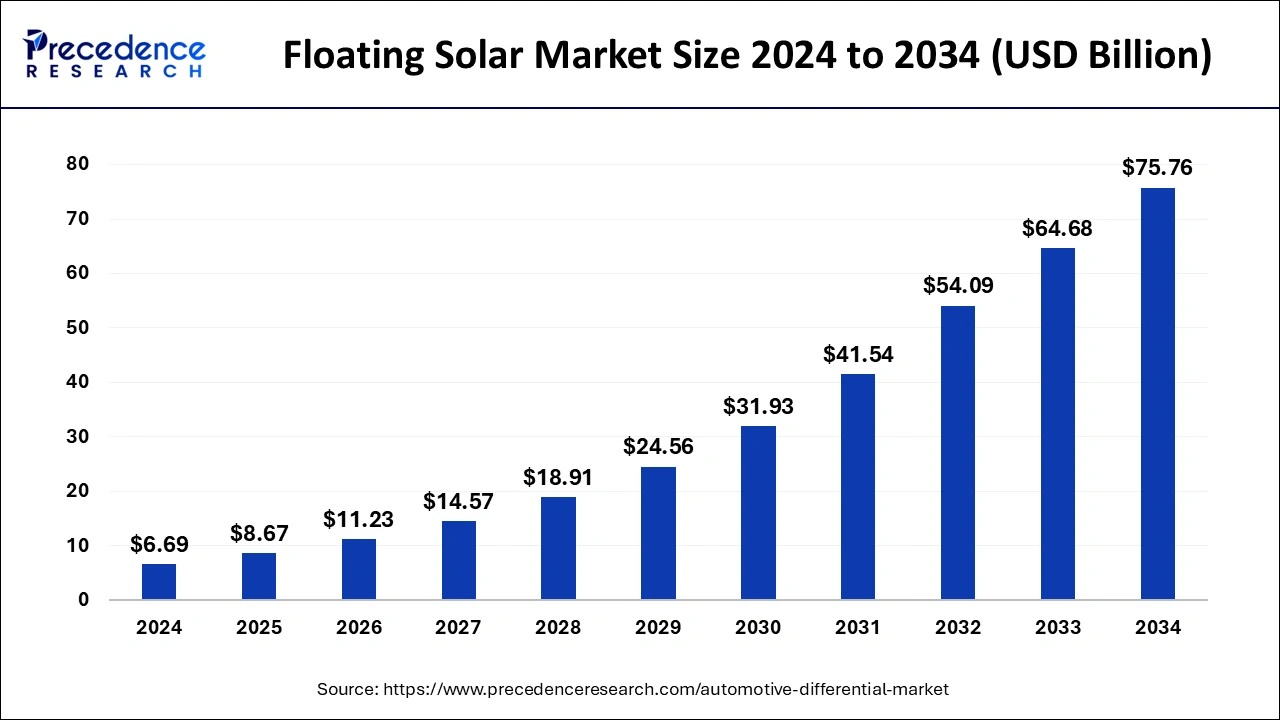
The global floating solar market is projected to grow significantly, with its size estimated at USD 8.67 billion in 2025 and expected to reach approximately USD 75.76 billion by 2034, expanding at a CAGR of 27.47% during the forecast period (2025–2034).
Key Impacts of AI on Floating Solar Projects
Artificial Intelligence (AI) is emerging as a transformative force in the floating solar market, enhancing performance, reliability, and sustainability. By integrating AI into floating solar systems, operators are unlocking new levels of efficiency through data-driven insights and intelligent automation.
One of the most significant applications of AI lies in predictive analytics. Advanced algorithms process historical and real-time data—including weather patterns, sunlight exposure, and water conditions—to optimize energy production and system performance. This data-driven forecasting helps operators make proactive decisions that maximize energy yield while minimizing risks.
AI-powered monitoring systems also play a critical role in boosting the efficiency of floating solar projects. These systems continuously analyze sensor data from the floating platforms to detect inefficiencies, anomalies, or potential failures in real time. Early issue detection not only prevents performance degradation but also extends the lifespan of key components.
Market Overview
Floating solar, also known as floating photovoltaics (FPV), involves installing solar panels on structures that float atop bodies of water such as reservoirs, lakes, irrigation ponds, and canals. This innovative approach offers a sustainable and space-efficient alternative to traditional land-based solar systems, especially in regions where land is scarce or expensive.
One of the key advantages of floating solar is its minimal land footprint. Aside from limited space required for electrical infrastructure and grid connections, floating systems preserve valuable land resources for agriculture, construction, or conservation. Despite their aquatic installation, the cost of floating solar systems remains comparable to ground-mounted counterparts, making them a practical and competitive solution.
Floating PV installations also benefit from the natural cooling effect of water, which can improve solar panel efficiency and reduce water evaporation from reservoirs—an added advantage in water-stressed regions. As a result, this technology is gaining attention as both an environmental and energy-efficient solution.
Globally, the floating solar industry is gaining momentum, with increasing investments in utility-scale projects. Governments and private companies are recognizing its potential to reduce reliance on fossil fuels and lower foreign energy import costs. The scalability and versatility of floating solar systems make them particularly attractive for countries aiming to expand renewable energy generation without compromising land use.
Report Scope
| Report Coverage | Details |
| Market Size by 2034 | USD 75.76 Billion |
| Market Size in 2025 | USD 8.67 Billion |
| Growth Rate from 2025 to 2034 | CAGR of 27.47% |
| Largest Market | Asia Pacific |
| Bae Year | 2024 |
| Forecast Period | 2025 to 2034 |
| Segments Covered | Capacity, Type, Geography |
| Regions Covered | North America, Europe, Asia-Pacific, Latin America, and Middle East & Africa |
Floating Solar Market Companies
- KYOCERA Corporation
- JA SOLAR Technology Co. Ltd
- Yellow Tropus Pvt. Ltd
- Ciel & Terre International
- Trina Solar
- Vikram Solar Limited
- Sharp Corporation
- Yingli Solar
- Sulzer Ltd.
- Hanwha Group
Segments Covered in the Report
By Capacity
- Below 5MW
- 5MW – 50MW
- Above 50MW
By Type
- Stationary Floating Solar Panels
- Tracking Floating Solar Panels
By Connectivity
- On grid
- Off grid
Read Also : Eco-friendly Food Packaging Market
For inquiries regarding discounts, bulk purchases, or customization requests, please contact us at sales@precedenceresearch.com.
