
 by
by 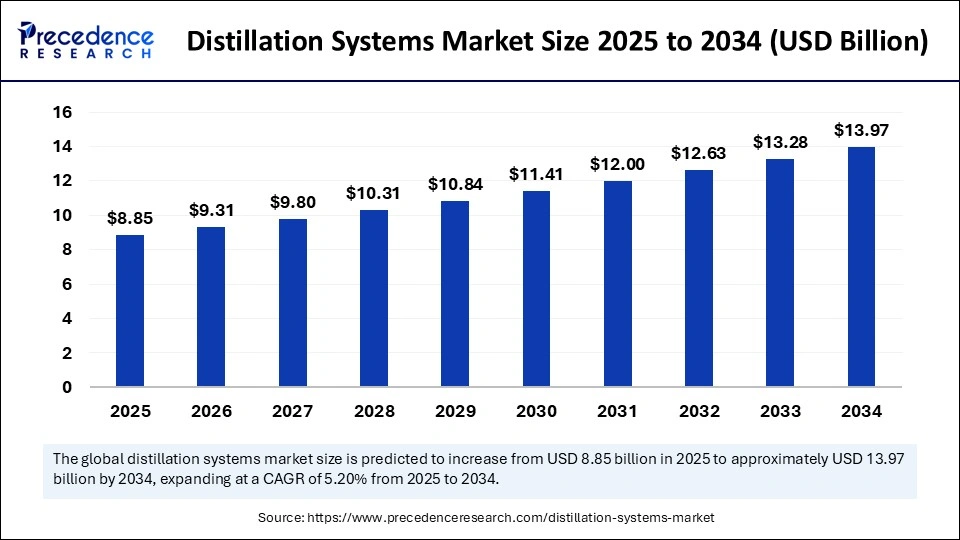
Distillation Systems Market Key Points
- In 2024, North America led the distillation systems market, capturing the largest revenue share of 37%.
- Asia Pacific is projected to experience substantial growth during the forecast period.
- The column shells segment accounted for a notable share of market revenue in 2024,
- The plates & packings segment is anticipated to grow at a considerable rate in the coming years.
- By end-user, the petroleum and biorefinery sector dominated the market in 2024,
- The water treatment segment is expected to register a notable CAGR throughout the forecast period.
Distillation Systems Market Overview
The distillation systems market plays a vital role in multiple industries, including petrochemicals, food and beverages, pharmaceuticals, water treatment, and chemicals. Distillation, as a fundamental separation and purification technique, is used to isolate components based on differences in their boiling points. These systems range from simple batch units to complex continuous and fractional distillation columns used in large-scale refineries. With increasing industrialization, rising demand for high-purity products, and tightening environmental regulations, the market for distillation systems is expanding steadily.
Modern distillation systems are now being designed with greater efficiency, energy recovery capabilities, and integrated automation to reduce operational costs and environmental footprint. In the oil and gas sector, distillation remains essential for refining crude oil into fuels and base chemicals. Similarly, in the water treatment industry, thermal distillation systems offer a reliable solution for desalination and wastewater purification. The global push toward cleaner production processes and resource optimization has further reinforced the importance of advanced distillation technologies in achieving sustainability goals, thus driving the market forward.
Distillation Systems Market Growth Factors
The growth of the distillation systems market is underpinned by several structural and cyclical factors. One of the primary growth drivers is the continuous expansion of the chemical and petrochemical industries, especially in Asia Pacific and the Middle East, which rely heavily on distillation for separation and purification. The increasing global energy demand—driven by industrialization and urbanization—has led to the development of new refineries and expansion of existing plants, where distillation systems are integral to operations.
In addition, the rising need for purified water, especially in arid regions and emerging economies, is fueling the demand for water distillation systems for both municipal and industrial uses. The pharmaceutical and biotech sectors are also significant contributors, requiring highly precise distillation systems for solvent recovery, component isolation, and purity control in drug production. Furthermore, the growth in craft beverage production (e.g., alcohol, spirits, and essential oils) has driven adoption of specialized small- to mid-scale distillation systems. Enhanced R&D investments in sustainable and low-energy distillation methods are expected to create additional momentum for market expansion.
Impact of AI on the Distillation Systems Market
Artificial Intelligence (AI) is increasingly transforming the efficiency, automation, and intelligence of distillation systems across various industries. Through machine learning and predictive analytics, AI enables operators to optimize distillation processes in real-time—adjusting temperatures, pressures, and reflux ratios to maximize yield and purity while minimizing energy consumption. These capabilities are particularly valuable in industries with high throughput and narrow operational margins, such as oil refining and pharmaceutical manufacturing.
AI-integrated systems can also detect early signs of equipment wear, fouling, or inefficiencies, allowing for predictive maintenance and reducing unplanned downtime. By analyzing data from sensors, control valves, and flow meters, AI algorithms help enhance process stability and product consistency, even in complex multi-component distillations. Additionally, AI models support adaptive control strategies, which can respond to variations in feedstock or environmental conditions without manual intervention.
The implementation of digital twins—virtual replicas of physical distillation systems—powered by AI is revolutionizing system design, simulation, and optimization. These models allow engineers to experiment with various configurations and parameters without interrupting production. As AI continues to advance, its integration into distillation technologies will lead to smarter, cleaner, and more cost-effective operations, opening new avenues for innovation and differentiation in the market.
Market Scope
| Report Coverage | Details |
| Market Size by 2034 | USD 13.97 Billion |
| Market Size in 2025 | USD 8.85 Billion |
| Market Size in 2024 | USD 8.42 Billion |
| Market Growth Rate from 2025 to 2034 | CAGR of 5.20% |
| Dominating Region | North America |
| Fastest Growing Region | Asia Pacific |
| Base Year | 2024 |
| Forecast Period | 2025 to 2034 |
| Segments Covered | Component, End-User, and Region |
| Regions Covered | North America, Europe, Asia-Pacific, Latin America, and Middle East & Africa |
Market Drivers
Several key drivers are accelerating the adoption of distillation systems globally. Chief among them is the growing demand for high-purity solvents, fuels, and chemicals across a wide spectrum of industries. As product quality and regulatory standards become more stringent—particularly in pharmaceuticals and food & beverages—the need for precise separation technologies such as distillation intensifies.
Another major driver is the push for water sustainability and environmental protection, which has increased the use of distillation in desalination, industrial wastewater treatment, and zero liquid discharge (ZLD) systems. In the energy sector, despite the rise of renewables, distillation remains indispensable in the refining of fossil fuels, which are still a dominant energy source globally. Additionally, the growing biofuel and bio-based chemical sectors rely on distillation for the purification of ethanol, biodiesel, and fermentation-derived products.
The trend toward modular and mobile distillation units is also boosting demand, especially in disaster recovery, military, and remote industrial applications. Governments and industry bodies encouraging low-carbon industrial processes are further driving R&D into energy-efficient and hybrid distillation technologies, such as pressure-swing distillation and heat-integrated systems.
Opportunities
The distillation systems market presents numerous opportunities for expansion and innovation. The development of energy-efficient and hybrid distillation technologies—such as membrane-assisted distillation, multi-effect distillation (MED), and vapor compression distillation (VCD)—offers an exciting frontier for reducing energy consumption and operational costs, especially in desalination and chemical manufacturing.
There is also growing potential in the biotechnology and green chemistry sectors, where precision distillation is required for extracting and purifying high-value compounds like active pharmaceutical ingredients (APIs), nutraceuticals, and natural fragrances. The emergence of modular skid-based systems offers scalable, plug-and-play solutions for small and medium enterprises (SMEs), laboratories, and on-site processing needs in rural or decentralized locations.
The integration of AI and IoT in distillation systems opens the door to smart factories and Industry 4.0 environments, where real-time optimization, remote monitoring, and autonomous control can significantly enhance productivity and quality. Additionally, as more countries invest in circular economy practices, there’s a rising opportunity for distillation systems to support solvent recovery and chemical recycling initiatives, further enhancing their sustainability profile.
Challenges
Despite promising growth, the distillation systems market faces several challenges. One of the primary limitations is the high energy consumption associated with conventional distillation processes. This makes them expensive to operate and less environmentally friendly compared to alternative separation methods such as adsorption, membrane separation, or chromatography. As energy prices fluctuate and environmental regulations tighten, operators must seek more sustainable process solutions.
Another challenge lies in the capital-intensive nature of industrial-scale distillation systems, which may deter smaller companies or startups from entering the market. Additionally, complex multicomponent mixtures or heat-sensitive substances can require highly specialized and costly system configurations, increasing both technical risk and project timelines.
The market also faces skilled labor shortages, particularly in process design, instrumentation, and maintenance—areas critical to ensuring safe and efficient distillation operations. Furthermore, scaling down industrial technologies for decentralized or mobile applications remains difficult due to size, efficiency, and automation constraints. Finally, inconsistent regulations across regions—especially in emerging markets—can slow adoption and standardization.
Distillation Systems Market Regional Outlook
Asia Pacific dominates the global distillation systems market, accounting for the largest share due to its expansive chemical, petrochemical, and pharmaceutical industries. Countries like China, India, and Japan are leading in both production and consumption of refined products, solvents, and purified water. The region’s strong industrial base, increasing investments in water infrastructure, and government initiatives promoting cleaner production practices support robust market growth.
North America is another significant market, driven by advanced oil refining operations, high adoption of process automation, and the presence of major players in the chemical and biotech sectors. The United States, in particular, leads in technological innovation and the development of AI-integrated and energy-efficient distillation technologies.
Europe follows closely, with growing demand for sustainable industrial processes, especially in Germany, the UK, and France. The region also has a strong focus on environmental compliance and energy recovery, driving interest in hybrid and waste-heat-integrated systems. Europe’s strong pharmaceutical and food processing industries further contribute to consistent demand for high-precision distillation solutions.
Middle East & Africa represents a key emerging market, especially for large-scale desalination and petrochemical applications. Countries like Saudi Arabia and the UAE are investing heavily in water infrastructure and refining capacity, while South Africa is developing its industrial base. Latin America, led by Brazil and Mexico, is gradually adopting distillation technologies in the energy, agrochemical, and beverage industries, though economic volatility and infrastructure gaps pose some constraints.
Distillation Systems Market Companies
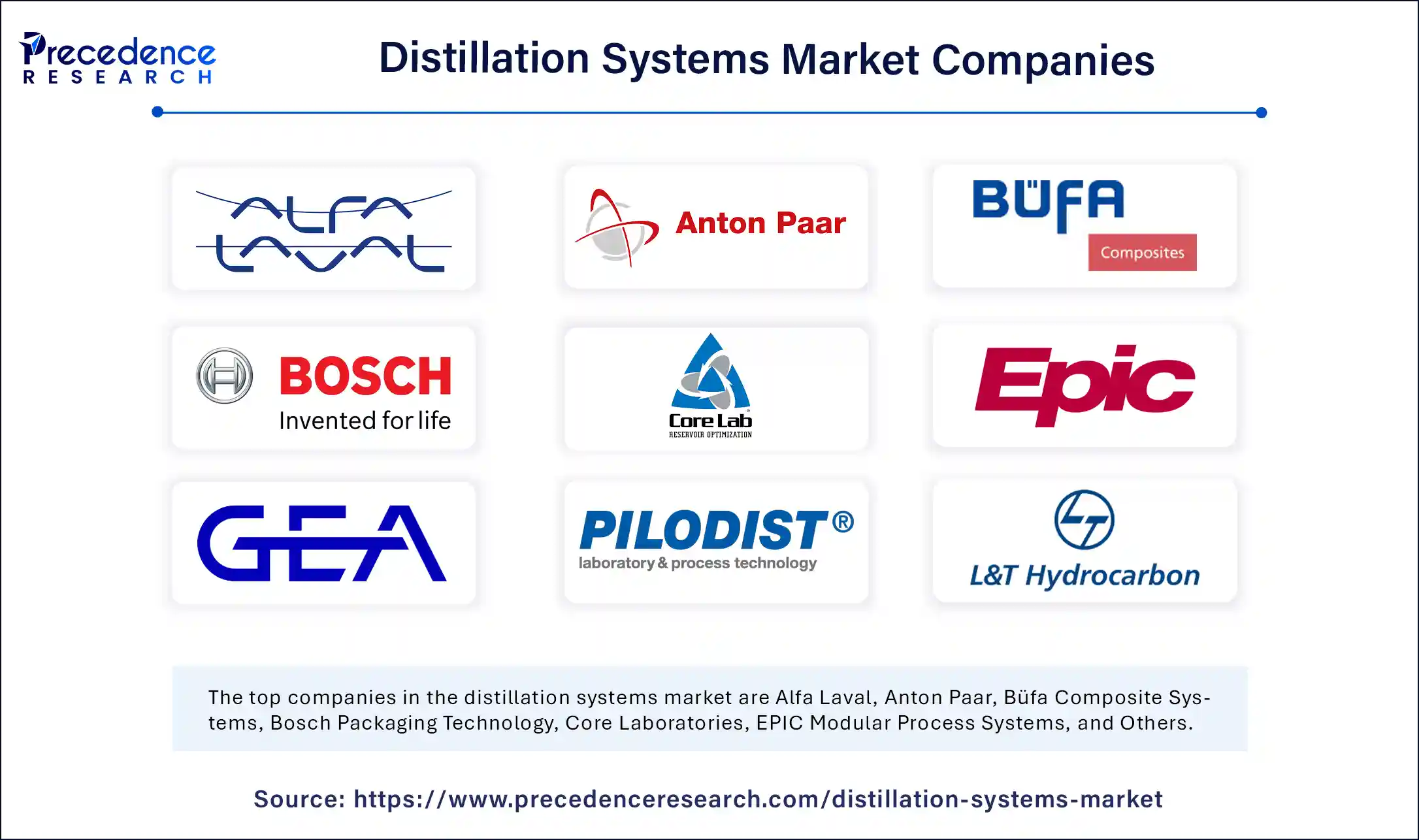
- Alfa Laval
- Anton Paar
- Büfa Composite Systems
- Bosch Packaging Technology
- Core Laboratories
- EPIC Modular Process Systems
- GEA AG
- Pilodist
- L&T Hydrocarbon Engineering
- Praj Industries
Segments Covered in the Report
By Component
- Column Shells
- Plates & Packings
- Reboilers & Heaters
- Condensers
- Others
By End-User
- Petroleum & Biorefinery
- Water Treatment
- Food
- Beverage
- Pharmaceuticals
- Others
By Region
- North America
- Europe
- Asia Pacific
- Middle East & Africa
- Latin America
Also Read: HMI Sensors in Wearables Market
Get this report to explore global market size, share, CAGR, and trends, featuring detailed segmental analysis and an insightful competitive landscape overview @ https://www.precedenceresearch.com/sample/6116
You can place an order or ask any questions, please feel free to contact at sales@precedenceresearch.com|+1 804 441 9344
