
 by
by 
Digital Therapeutics and Connected Care Market Key Takeaways
- North America dominated the digital therapeutics and connected care market in 2024.
- Asia Pacific is expected to expand at the fastest CAGR between 2025 and 2034.
- By application, the diabetes management segment contributed the biggest market share in 2024.
- By application the mental health (e.g., Depression, Anxiety, PTSD) segment is anticipated to grow at a remarkable CAGR between 2025 and 2034.
- By component, the software/apps segment captured the highest market share in 2024.
- By component, the services segment is expected to expand to a notable CAGR over the projected period.
- By therapeutic approach, the cognitive behavioral therapy (CBT)-based solutions segment generated the major market share in 2024.
- By therapeutic approach, the AI-based personalized interventions segment is expected to expand at a notable CAGR over the projected period.
- By business model, the business-to-business (B2B) segment held the largest market share in 2024.
- By business model, the B2B2C segment is expected to expand to a notable CAGR over the projected period.
- By end user, the patients (self-managed care) segment accounted for the highest market share in 2024.
- By end user, the payers (insurers, employers) segment is expected to expand at a notable CAGR over the projected period.
How AI Is Shaping the Digital Therapeutics & Connected Care Market
Artificial Intelligence (AI) is rapidly becoming the cornerstone of digital therapeutics and connected care, enabling healthcare systems to deliver more personalized, proactive, and efficient care experiences. By integrating AI technologies into digital health platforms, healthcare providers are enhancing patient outcomes, optimizing workflows, and redefining standards of care.
One notable example is a February 2025 clinical review, which analyzed 12 trials and found that AI-integrated virtual reality systems significantly improved mobility, cognitive function, and attention in patients with Parkinson’s disease. These results highlight AI’s transformative potential in neurorehabilitation and chronic condition management.
In July 2025, Microsoft unveiled MAI-DxO, an AI-powered diagnostic platform that achieved 85.5% accuracy on complex New England Journal of Medicine (NEJM) cases—surpassing physicians working independently by a factor of four. This represents a major leap forward in AI’s role in clinical decision-making.
Additionally, AI “scribes” such as DAX Copilot have become widely used across U.S. hospitals. By automating clinical documentation, DAX Copilot reduces documentation time by up to 60%, allowing clinicians to focus more on direct patient care, thereby enhancing both productivity and patient satisfaction.
These advancements reflect a broader shift: AI is evolving from a supportive tool to an interpretive agent—central to delivering connected, personalized, and scalable healthcare. As AI capabilities mature, they are enabling a new standard in healthcare delivery—one that is data-driven, efficient, and deeply human-centered.
Market Overview
The Digital Therapeutics (DTx) & Connected Care Market represents a rapidly evolving segment of healthcare that leverages clinically validated, software-driven interventions and connected technologies to prevent, manage, or treat a wide range of medical conditions. Digital therapeutics are evidence-based solutions delivered through mobile apps, sensors, or connected devices, and are designed to function independently or in conjunction with conventional treatments to improve clinical outcomes.
Connected care, on the other hand, enables real-time and remote healthcare delivery through technologies such as telehealth platforms, wearable sensors, and remote patient monitoring systems. These tools facilitate continuous communication and data exchange between patients and providers, empowering more proactive, personalized, and efficient care.
As healthcare systems worldwide continue to shift toward value-based care, the integration of digital therapeutics and connected care solutions is poised to redefine how medical treatment is delivered and managed.
Digital Therapeutics and Connected Care Market Growth Factors
-
Rising Burden of Chronic Diseases: The global increase in chronic conditions such as diabetes, cardiovascular diseases, and mental health disorders is driving the need for continuous, non-invasive, and patient-friendly treatment solutions. Digital therapeutics offer scalable and long-term disease monitoring and management, making them ideal for addressing the complex needs of chronic care.
-
Regulatory and Reimbursement Advancements: Growing support from governments and insurance providers in approving and reimbursing digital therapeutics is boosting market credibility. As regulatory frameworks mature, adoption among healthcare providers and patients is accelerating, paving the way for broader integration into clinical care.
-
Increased Smartphone and Internet Penetration: The widespread use of smartphones and internet connectivity has expanded access to digital health tools. This infrastructure enables greater adoption of app-based therapies, remote patient monitoring, and virtual consultations, particularly in underserved or rural areas across both high- and low-income countries.
-
Shift Toward Value-Based Care: The healthcare industry’s transition from volume-based to value-based care models is amplifying demand for digital solutions that can track real-time health metrics, boost patient engagement, and reduce unnecessary hospital visits. Digital therapeutics and connected care tools are essential for improving outcomes and optimizing healthcare costs.
Opportunity
Insurance Expansion and Policy Support
A major growth opportunity for the digital therapeutics (DTx) and connected care market lies in the expansion of insurance coverage and supportive healthcare policies. In May 2025, the U.S. Congress reintroduced the Access to Prescription Digital Therapeutics (PDT) Act, a legislative effort aimed at allowing Medicare coverage for FDA-cleared digital therapeutics. This marks a significant step toward validating DTx as a legitimate form of care and expanding its accessibility for millions of patients, especially those in underserved populations.
Simultaneously, the Centers for Medicare & Medicaid Services (CMS) and the Office of the National Coordinator for Health IT (ONC) issued a joint Request for Information (RFI) to enhance interoperability and data exchange across digital health platforms. These initiatives reflect a coordinated governmental push to support infrastructure, regulatory clarity, and reimbursement mechanisms for digital therapeutics.
Recent Developments
- In January 2025, Glooko, Inc. and Hedia introduced their interoperable solution, which combines connected care, remote patient monitoring, and digital therapeutic technologies enhancing access for people with Type 1 and Type 2 diabetes requiring advanced bolus insulin dosing support in their daily management.
- In February 2025, Microsoft and Cerebras embarked upon a partnership with the Mayo Clinic to develop AI tools to assist with medical imaging workflows and medical diagnostics.
- In April 2025, the American Telemedicine Association announced acquisition with acquired the Digital Therapeutics Alliance, which aims to drive uptake of software-based healthcare tools. Kyle Zebley, executive director ATA Action and senior vice president of public policy at the ATA stated, “Our goal is to create a unified voice to shape healthcare policies, ensuring that telehealth and digital therapeutics remain integral components of the U.S. healthcare system.”
Also Read: Digital Therapeutics Market
Digital Therapeutics and Connected Care Market Top Companies
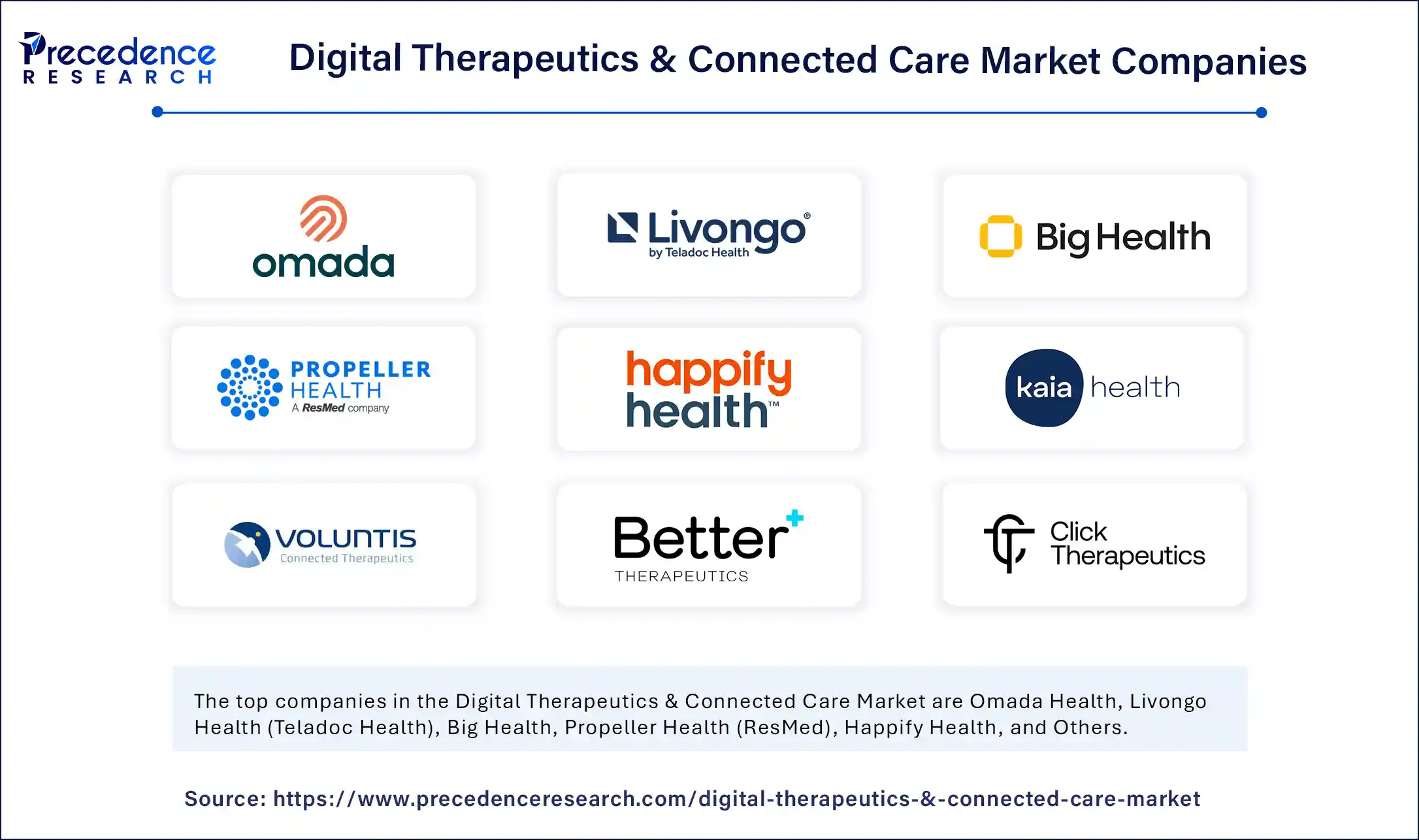
- Omada Health
- Livongo Health (Teladoc Health)
- Big Health
- Propeller Health (ResMed)
- Happify Health
- Kaia Health
- Voluntis (AptarGroup)
- Better Therapeutics
- Click Therapeutics
