
 by
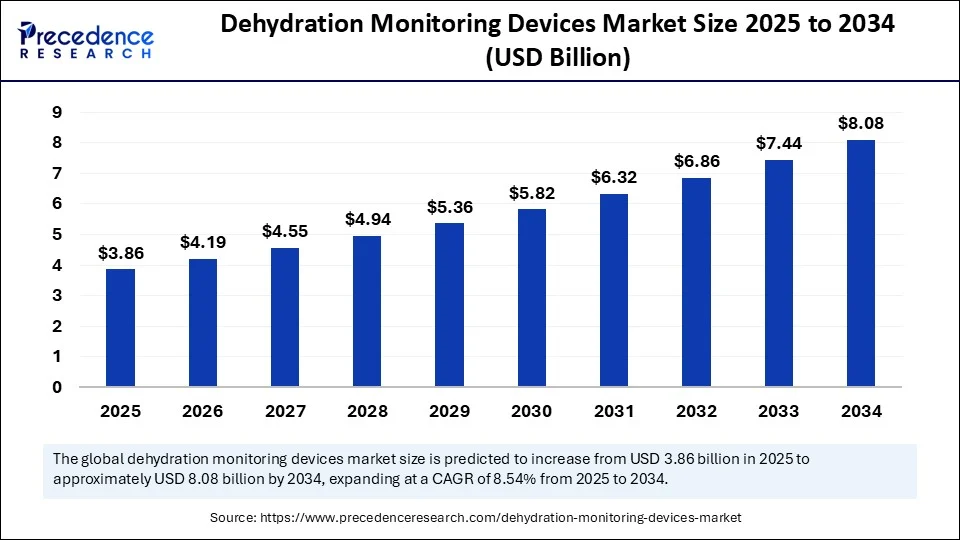
by The global dehydration monitoring devices market is on a strong growth trajectory, with its valuation expected to climb from USD 3.86 billion in 2025 to approximately USD 8.08 billion by 2034, representing a compound annual growth rate (CAGR) of 8.54%.
This upward trend is fueled by increased awareness of the health risks associated with hydration imbalances, especially among elderly and pediatric populations, alongside the rising prevalence of chronic diseases requiring stringent fluid balance management. Moreover, advancements in wearable and non-invasive monitoring technologies, coupled with the growing popularity of fitness and wellness tracking, are accelerating the adoption of dehydration monitoring devices worldwide.
Dehydration Monitoring Devices Market Quick Insights
-
The dehydration monitoring devices market is forecasted to reach USD 8.08 billion by 2034, growing at a CAGR of 8.54%.
-
North America, especially the U.S., leads the market with a significant share, with its market projected to grow from USD 897.12 million in 2024 to USD 2.08 billion by 2034.
-
Key players in the market include GE Healthcare, Philips Healthcare, Medtronic plc, BioIntelliSense Inc., iHealth Labs Inc., Valencell Inc., and Nix Biosensors Inc.
-
Wearable sensors dominate the product type segment due to their convenience in continuous and non-invasive hydration monitoring.
-
Hospitals currently hold the largest end-user market share, followed by growing segments such as home care, sports & fitness, and elderly care.
AI is revolutionizing dehydration monitoring by enabling devices to analyze complex biometric data in real time, offering personalized hydration assessments and proactive alerts. By integrating AI algorithms, these devices can predict dehydration risks before symptoms arise, tailoring recommendations based on an individual’s activity, sleep, and diet patterns. AI enhances device accuracy, optimizing user experience and health outcomes, and supports integration with broader wellness and telehealth platforms for comprehensive health management.
Dehydration Monitoring Devices Market Scope
| Report Coverage | Details |
| Market Size by 2034 | USD 8.08 Billion |
| Market Size in 2025 | USD 3.86 Billion |
| Market Size in 2024 | USD 3.56 Billion |
| Market Growth Rate from 2025 to 2034 | CAGR of 8.54% |
| Dominating Region | North America |
| Fastest Growing Region | Asia Pacific |
| Base Year | 2024 |
| Forecast Period | 2025 to 2034 |
| Segments Covered | Product Type, Application, End User, Technology, Distribution Channel, and Region |
| Regions Covered | North America, Europe, Asia-Pacific, Latin America, and Middle East & Africa |
Driving Forces Behind Dehydration Monitoring Devices Market Growth
The rising prevalence of dehydration-related health conditions—especially among elderly, pediatric, and chronic disease populations—is a chief motivator for market expansion. Moreover, escalating global temperatures and climate change have heightened risks of fluid loss and heat stress, further driving demand. Technological breakthroughs in wearable sensors and mobile hydration analytics facilitate real-time and non-invasive hydration monitoring. Additionally, expanding sports and fitness sectors, coupled with burgeoning awareness about hydration’s critical role in wellness, are boosting consumer and institutional adoption rates.
What Opportunities and Trends Are Shaping the Market Landscape?
-
How will advancements in non-invasive and wearable sensor technologies redefine user convenience?
-
Can AI-powered predictive analytics augment early dehydration detection and intervention?
-
What impacts will the integration of dehydration monitoring into telehealth and remote patient management systems have on healthcare delivery?
-
How might expanding elderly care and pediatric device customization create new market niches?
Dehydration Monitoring Devices Market Regional and Segmentation Analysis
North America maintains a dominant position due to advanced healthcare infrastructure, high healthcare expenditure, and rapid technology adoption.
Meanwhile, the Asia-Pacific region is emerging with promising growth prospects thanks to improving healthcare services and rising disposable incomes.
The market segmentation highlights wearable sensors as the leading product type, serving applications in hospitals, home care, sports & fitness, elderly care, pediatrics, and military sectors. Non-wearable sensors, such as bedside monitors and smart home hydration devices, are also witnessing fast adoption, particularly in clinical and home environments.
Latest Breakthroughs from Top Companies
Key players actively innovating include GE Healthcare, Philips Healthcare, Medtronic plc, BioIntelliSense Inc., iHealth Labs Inc., Valencell Inc., and Nix Biosensors Inc. Recent innovations focus on enhanced sensor accuracy, integration of AI-driven hydration analytics, and user-friendly designs for continuous monitoring. These companies are expanding strategic partnerships and product portfolios to meet rising consumer and healthcare provider demands.
Challenges and Cost Pressures
Despite robust growth, market expansion is impeded by high initial device costs, the need for greater awareness and user education, and regulatory barriers in some regions. Additionally, price competition among manufacturers and the presence of counterfeit products pose risks to market stability. Cost pressures may impact adoption rates, particularly in developing countries with limited healthcare infrastructure.
Case Study: AI-Enabled Wearable Hydration Monitor in Elderly Care
A leading healthcare facility integrated AI-enabled wearable dehydration monitors into its elderly care program, resulting in a 30% reduction in dehydration-related hospital admissions within one year. The personalized alerts and hydration tracking empowered caregivers to intervene promptly, illustrating the potential of advanced dehydration monitoring technologies to improve patient outcomes while reducing healthcare costs.
Read Also: Exosuit Materials Market
You can place an order or ask any questions, please feel free to contact us at sales@precedenceresearch.com |+1 804 441 9344
