
 by
by 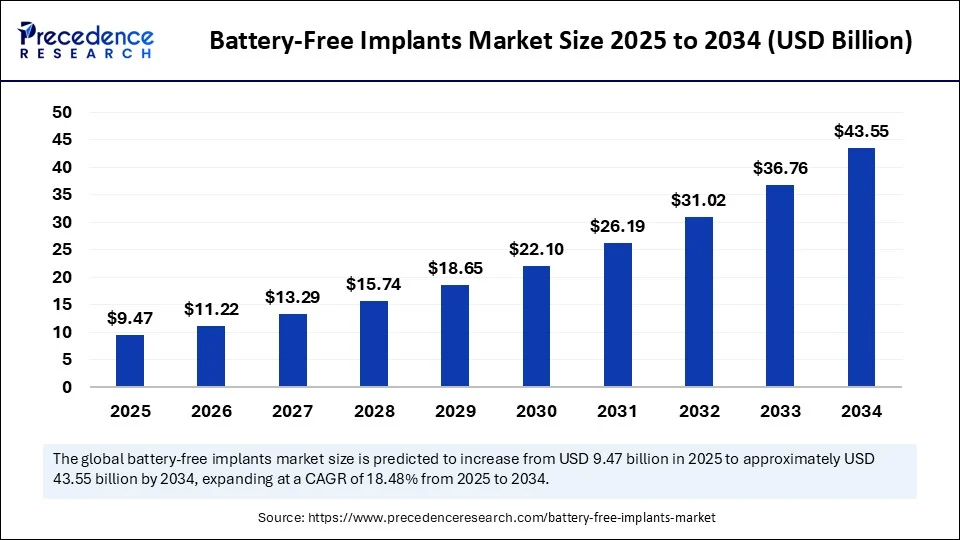
Battery-Free Implants Market Key Takeaways
- In terms of revenue, the global battery-free implants market was valued at USD 7.99 billion in 2024.
- It is projected to reach USD 43.55 billion by 2034.
- The market is expected to grow at a CAGR of 18.48% from 2025 to 2034.
- North America dominated the global battery-free implants market in 2024.
- Asia Pacific is expected to grow at the fastest CAGR from 2025 to 2034.
- By application, the cardiac monitoring and pacing devices segment held the major market share in 2024.
- By application, the orthopedic monitoring devices segment is projected to grow at the highest CAGR between 2025 and 2034.
- By therapeutic area, the cardiology segment contributed the biggest market share in 2024.
- By therapeutic area, the orthopedics segment is expanding at a significant CAGR between 2025 and 2034.
- By energy harvesting technology, the radiofrequency (RF)-based devices segment led the market in 2024.
- By energy harvesting technology, the piezoelectric energy conversion segment is expected to grow at a significant CAGR over the projected period.
- By material, composite materials generated the largest market share in 2024.
- By material, bioresorbable materials segment is expected to grow at a notable CAGR from 2025 to 2034.
- By end user, the hospitals and clinics segment held the major market share in 2024.
- By end user, the homecare settings segment is projected to grow at a significant CAGR between 2025 and 2034
Impact of Artificial Intelligence on the Battery-Free Implants Market
Artificial Intelligence is playing a pivotal role in advancing the battery-free implants market by enabling smarter, faster, and more precise clinical integration. AI-driven modeling and simulation techniques are being used to optimize energy harvesting systems—such as those powered by body heat or movement—ensuring these implants function reliably within complex biological environments.
In clinical applications, AI-powered data analytics helps identify ideal candidates for battery-free implants by analyzing patient-specific data, improving treatment outcomes, and supporting personalized medicine. Additionally, AI accelerates the shift toward more sustainable and minimally invasive implantable technologies by reducing dependency on batteries and enhancing device functionality and lifespan.
Overall, the integration of AI is driving innovation in the battery-free implants space, enabling the development of highly efficient, patient-centric solutions with broad potential for long-term healthcare transformation.
Market Overview
Battery-free implants are innovative medical devices designed to operate without internal batteries, using external energy sources such as radiofrequency (RF), ultrasound, magnetic induction, or bioelectricity. Unlike traditional implants, these devices offer enhanced safety, miniaturization, longer lifespans, and reduced need for replacement surgeries—making them highly suitable for chronic disease management, real-time health monitoring, and targeted therapeutic delivery.
The growing demand for minimally invasive and long-term monitoring solutions is a key driver for the adoption of battery-free implants in modern clinical practice. These implants leverage energy-harvesting technologies, allowing for smaller, lighter, and safer designs that significantly improve patient outcomes and comfort.
Their clinical effectiveness—particularly in neuromodulation and cardiac care—has been validated through multiple FDA approvals, reflecting their rising acceptance and reliability. Moreover, strong government backing, such as the substantial funding from the National Institutes of Health (NIH) in 2024 for body-powered implant research, underscores the increasing focus on advancing battery-free technologies to reduce complications and enhance patient well-being.
Battery-Free Implants Market Growth Factors
- Growing Emphasis on Preventive Healthcare Delivery: Rising demand for early diagnosis and continuous monitoring is driving adoption of maintenance-free implants across clinical pathways.
- Boosting Integration with Telehealth Platforms: Expansion of digital health infrastructure fuels real-time data transmission from battery-free implants to remote care teams.
- Rising Government Support for Medtech Innovation: Increased funding and regulatory acceleration programs are propelling the commercialization of next-generation bioelectronic implants.
- Advancing Precision Medicine Models: Personalized treatment approaches are driving the need for smart implants that operate autonomously and adapt to individual patient profiles.
- Surging Demand in Geriatric and Home-Based Care: Aging populations and the shift to decentralized care models are boosting the deployment of passive, wireless implants in home settings.
- Accelerating Development of Biodegradable Materials: Innovations in eco-friendly and resorbable implant materials are fuelling interest in battery-free systems with zero-extraction requirements.
- Expanding Collaborations Between Academia and Industry: Joint R&D initiatives between universities and medtech companies are driving faster translation of experimental implants into clinical use.
Opportunity
Rising Investments in Bioelectronics
Increasing investments in bioelectronics and wireless medical technologies are creating significant growth opportunities in the battery-free implants market. Public and private sector funding is being directed toward R&D initiatives focused on next-generation implantable devices that harvest energy from biological or external sources, such as body heat, motion, or wireless energy transfer.
Startups and leading MedTech companies are actively exploring innovations in wireless power transfer, energy harvesting circuits, and miniaturized sensors, aiming to enhance implant efficiency, reduce surgical interventions, and improve patient outcomes. In 2024, the U.S. Food and Drug Administration (FDA) approved several Investigational Device Exemptions (IDEs), allowing companies to conduct first-in-human studies for battery-free implants in mood regulation and spinal therapies.
Additionally, government-backed research grants are supporting the development of implantable technologies designed for extended trauma care and remote medical scenarios, where long-duration functionality without batteries is critical. These developments are expected to accelerate commercialization and adoption, opening new avenues for market expansion in the years ahead.
Recent Developments
- In June 2025, University of Arizona researchers introduced a battery-free implant that monitors bone fracture recovery using near-field and far-field wireless power transfer. The device transmits real-time data via Bluetooth Low Energy, showing reduced strain as healing progresses. It eliminates manual charging and supports sustainable, electronic waste-free healthcare.
- In September 2024, UChicago Medicine became the first Illinois center to implant the Revi neuromodulation device for treating urinary urgency incontinence. This battery-free system offers a minimally invasive option for nerve stimulation and long-term symptom relief, marking a key advancement in urologic care.
Also Read: Smart Battery Market
Battery-Free Implants Market Top Companies
- Abbott Laboratories
- Biotronik SE & Co. KG
- Cochlear Limited
- EBR Systems, Inc.
- Medtronic plc
- NeuroPace Inc.
- Pixium Vision
- Profusa Inc.
- Second Sight Medical Products Inc.
- Stimwave Technologies Inc.
