
 by
by ASEAN Semiconductor Market to Surge from USD 105.49 Billion in 2025 to USD 247.32 Billion by 2034, Fuelled by FDI, AI, and Auto‑Electronics Boom
Projected CAGR of 9.93% through 2034; Malaysia currently leads, while Thailand and Vietnam emerge as fastest‑growing hubs
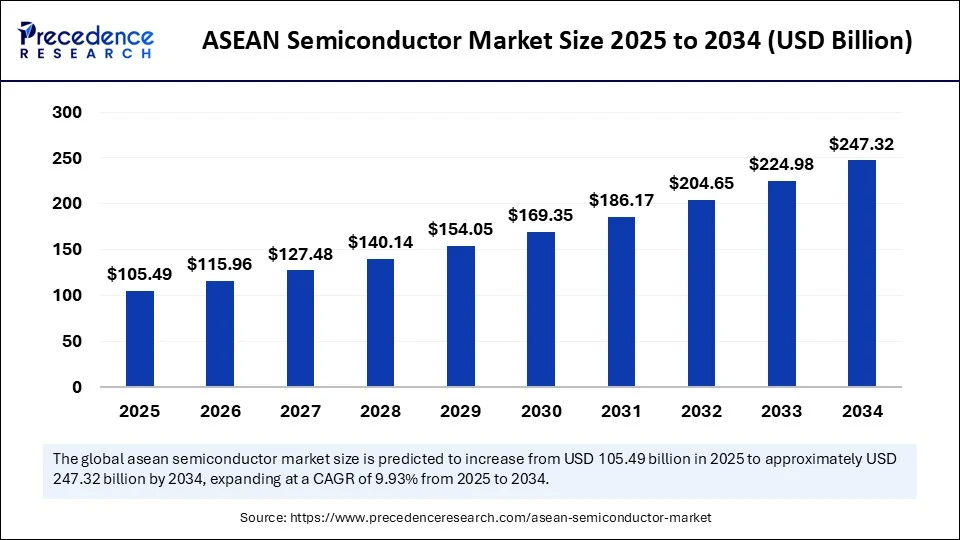
The ASEAN semiconductor market is valued at USD 105.49 billion in 2025 and projected to reach approximately USD 247.32 billion by 2034, expanding at a compound annual growth rate (CAGR) of 9.93%. This remarkable growth trajectory is driven by increasing foreign investments, rapid digitalization across Southeast Asia, rising demand for automotive and consumer electronics, and ASEAN’s strategic emergence as an alternative semiconductor manufacturing hub amid global supply chain shifts.
ASEAN Semiconductor Market Quick Insights
-
The ASEAN semiconductor market was valued at USD 95.96 billion in 2024 and will reach USD 105.49 billion in 2025.
-
Malaysia was the top contributor in 2024, leading with robust OSAT and backend assembly capacity.
-
Thailand and Vietnam are anticipated to post the fastest growth from 2025 to 2034.
-
Memory devices dominated component revenues in 2024, while MCUs (Microcontroller Units) are set to lead future growth.
-
Networking & communications was the top application segment in 2024; automotive electronics will drive upcoming growth.
-
ASEAN nations are becoming favored alternatives to China for global chipmakers, thanks to political neutrality and cost advantages.
ASEAN Semiconductor Market Revenue Breakdown Table
| Year | Market Size (USD Billion) |
|---|---|
| 2024 | 95.96 |
| 2025 | 105.49 |
| 2034 | 247.32 |
By component, memory devices lead the market share, followed by logic devices and microprocessors.
By application, networking & communications remains dominant, with automotive gaining traction.
What’s Fueling the Semiconductor Boom in ASEAN?
What Are the Key Growth Drivers?
-
Strong FDI Inflows: Global chipmakers are pouring billions into Malaysia, Thailand, and Vietnam to diversify supply chains.
-
Rising Demand from EVs and Consumer Devices: Electrification and connected ecosystems are pushing chip usage across mobility and smart appliances.
-
Supportive Government Policies: Incentives, tax breaks, and strategic infrastructure programs are enhancing competitiveness.
-
5G & IoT Expansion: ASEAN’s fast-growing digital economy is accelerating the demand for high-performance and low-power semiconductors.
-
Reshoring Trends: U.S.–China tensions are pushing companies to shift production to more stable, neutral regions.
Read Also: Logic Semiconductor Market
How is AI Transforming ASEAN’s Semiconductor Market?
Is AI the Game-Changer in Design and Yield?
AI-powered Electronic Design Automation (EDA) tools are reshaping chip innovation by cutting design cycles and improving accuracy in layout, testing, and simulation. AI also enables predictive maintenance and yield optimization in fabrication plants, helping ASEAN-based facilities boost production efficiency and reduce defect rates.
Does AI Elevate ASEAN Into Advanced-Node and Application-Specific Markets?
Artificial Intelligence is pushing ASEAN chipmakers to develop customized, application-specific integrated circuits (ASICs) for sectors like autonomous mobility, smart manufacturing, and next-gen telecom. This is unlocking value beyond traditional packaging roles and positioning ASEAN in the advanced logic and AI-chip design space.
ASEAN Semiconductor Market Opportunity & Trend Spotlight
Could ASEAN Replace China as the Next Semiconductor Powerhouse?
The region offers the perfect blend of political stability, lower labor costs, robust digital ecosystems, and increasing investment inflows. Countries like Vietnam and Indonesia are aggressively positioning themselves to capture downstream and design-level semiconductor opportunities in the wake of global trade rebalancing.
ASEAN Semiconductor Market Regional & Segmental View
Malaysia continues to lead the region due to its robust back-end assembly, test facilities, and strong supply-chain integration. Thailand and Vietnam are growing quickly, backed by infrastructure development, skilled labor availability, and rising export incentives. Singapore remains a hub for high-tech innovation and advanced packaging, particularly in logic and system-on-chip (SoC) design.
By component type:
-
Memory Devices dominate the market share due to widespread use in mobile, data centers, and automotive.
-
MCUs and Logic Devices are expected to expand rapidly owing to rising demand in smart consumer appliances and vehicle automation.
By application:
-
Networking & Communications led the 2024 market due to 5G rollout and data infrastructure investments.
-
Automotive Electronics will witness the fastest growth driven by EVs, ADAS, and connectivity modules.
Latest Breakthroughs from Top Companies
Global semiconductor leaders such as Intel, Qualcomm, Broadcom, TSMC, Samsung, SK Hynix, Micron, NXP, and Texas Instruments are expanding into ASEAN, driven by attractive policy frameworks and growing demand. Notably, countries like Indonesia are working on national AI strategies to complement chip development. Regional cooperation forums are also exploring multi-country R&D partnerships and resilient supply chain frameworks.
What Barriers Could Slow Down ASEAN’s Semiconductor Momentum?
What Are the Key Challenges?
-
Infrastructure Disparities: While Malaysia and Singapore are well-developed, others like the Philippines and Indonesia still face logistical and energy challenges.
-
Talent Shortage: A lack of high-skilled engineering talent across the region could limit high-end chip development.
-
Regulatory Fragmentation: Varying policies and inconsistent enforcement across ASEAN nations can deter multinationals from seamless scaling.
-
High Input Costs: Fluctuating raw material and energy prices pose margin pressures, especially for emerging players.
-
Technology Gaps: Most countries remain focused on legacy nodes and backend services, lacking capacity for cutting-edge foundry operations.
Case Example: Regional Supply Chain Collaboration
A recent ASEAN-wide semiconductor workshop held under Malaysia’s 2025 ASEAN chairmanship outlined a multi-year action plan to streamline inter-country chip value chains. Participants emphasized the need for R&D infrastructure, standardized regulations, and investment in STEM education to secure the region’s position in the global chip economy.
Want to explore the full scope of the ASEAN semiconductor opportunity?
📄 Download a sample report https://www.precedenceresearch.com/sample/6456
📞 Book a strategy call with our research analysts
About Precedence Research
Precedence Research is a global market intelligence firm specializing in industry forecasting, competitive landscape mapping, and actionable data across technology, healthcare, energy, and consumer goods sectors.
📧 Email: sales@precedenceresearch.com
🌐 Website: precedenceresearch.com
