
 by
by 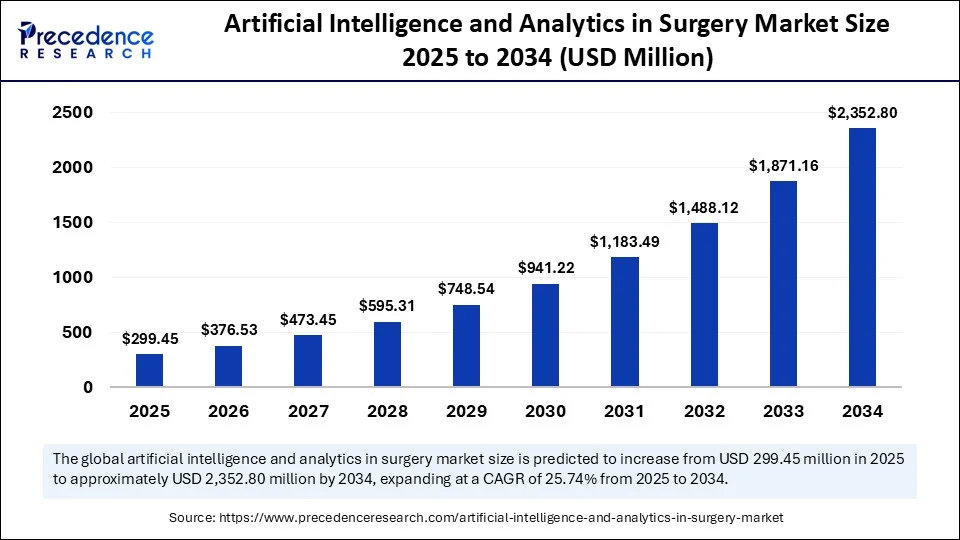
Artificial Intelligence and Analytics in Surgery Market Key Takeaways
- In terms of revenue, the global artificial intelligence and analytics in surgery market was valued at USD 238.15 million in 2024.
- It is projected to reach USD 2,352.8 million by 2034.
- The market is expected to grow at a CAGR of 25.74% from 2025 to 2034.
- North America dominated the global market with the largest market share of 45% in 2024.
- Asia Pacific is expected to witness the fastest CAGR during the foreseeable period.
- By application, the intraoperative guidance and navigation segment held the biggest market of 34% in 2024.
- By application, the surgical workflow and efficiency optimization segment is expected to witness the fastest CAGR during the foreseeable period.
- By technology, the computer vision and image recognition segment captured the highest market share of 38% in 2024.
- By technology, the predictive analytics platform segment is expected to witness the fastest CAGR during the forecast period.
- By surgical specialty, the general surgery segment contributed the major market share of 29% in 2024.
- By surgical specialty, the neurosurgery segment is expected to witness the fastest CAGR during the forecast period.
- By deployment mode, the cloud-based AI platforms segment held the largest market share of nearly 64% in 2024. And the same segment is expected to witness the fastest CAGR during the foreseeable period of 2025-2034.
- By end user, the hospital & surgical centers segment generated the major market share of 61% in 2024.
- By end user, the ambulatory surgical centers segment is expected to witness the fastest CAGR during the forecast period.
Market Overview
The artificial intelligence and analytics in surgery market encompasses AI-enhanced tools and platforms utilized in pre-, intra-, and post-operative surgical phases. This includes predictive analytics for surgical outcomes, computer vision for navigation, robotics with machine learning, surgical workflow optimization, and post-surgery performance analytics.
Hospitals, surgical centers, and device companies increasingly invest in data-rich surgical platforms. With expanding AI adoption across specialties (orthopedics, neurosurgery, general surgery), the market is projected to grow rapidly as clinical validation strengthens and integration with electronic health records (EHRs) and surgical robotics deepens.
Market Drivers
One key driver is demand for improved surgical precision and patient outcomes: AI systems that assist in identifying anatomical structures, planning margins, and reducing intraoperative errors offer promise in reducing complications and readmissions. Growing surgical volume and surgeon shortages: As procedure volumes rise globally, analytics systems that optimize workflow, team coordination, and scheduling deliver efficiency benefits.
Regulatory endorsement and safety frameworks: Regulatory agencies have begun approving AI-based surgical planning and navigational tools, legitimizing clinical deployment. Technological advances in imaging, computer vision, and computation: High-resolution imaging, real-time AI labeling, and edge-computing-enabled surgical platforms allow seamless integration into ORs.
Key Opportunities
Real‑time computer vision for minimally invasive surgery offers platform advantage—AI systems can alert surgeons to critical margins or bleeding risk. Predictive analytics for risk stratification and outcome tracking helps optimize patient selection and personalize perioperative care. AI-powered surgical training and performance evaluation—systems that analyze competent technique and provide feedback—can be adopted widely in teaching and professional development.
Integration with surgical robotics: AI modules that guide robotic arms or provide decision support during procedures expand robotics’ utility beyond mechanical assistance. Post-operative analytics—platforms that analyze EHR, imaging, and outcomes data to benchmark surgical performance across institutions—offer value in quality governance and reimbursement alignment.
Major Challenges
High cost of integration and capital equipment: AI systems require investment in sensors, computing infrastructure, software platforms, and often robotics, making adoption burdensome for smaller hospitals. Data quality, interoperability, and standardization: Surgical data is frequently unstructured; integrating AI across devices, EHRs, and imaging sources remains technically challenging.
Regulatory and liability concerns: Defining responsibility if AI-assisted surgery leads to adverse outcomes remains unsettled. Regulatory frameworks for software-as-a-medical-device continue evolving, delaying full deployment.
Surgeon trust and adoption barriers: Surgical teams may resist reliance on AI decision support, especially in high-risk procedures or unfamiliar systems. Cybersecurity and patient data privacy: Operating theaters are increasingly connected; ensuring protection of sensitive surgical data is critical.
Recent Developments
In the latest period, several AI software providers launched platforms that integrate with laparoscopic imaging systems in real-time, overlaying anatomical structures, cutting planes, and risk zones. Surgical analytics platforms using machine learning have begun providing outcome prediction dashboards—estimating risk of infection, blood loss, or length of stay based on preoperative inputs.
Hospitals piloted AI-based surgical coaching systems: video-recorded laparoscopic procedures analyzed post-hoc for performance metrics and surgeon-specific feedback. Robotics manufacturers added AI modules to existing robotic arms, enabling semi-autonomous suturing and margin detection in cancer resections. Predictive maintenance analytics for surgical robots have been adopted by networks to reduce downtime and service cost.
Academic-industry consortia launched multi-center trials validating computer vision tools in minimally invasive cholecystectomy and colorectal procedures with promising sensitivity and specificity.
Artificial Intelligence and Analytics in Surgery Market Companies
- Medtronic plc (Touch Surgery, AI-based analytics)
- Intuitive Surgical, Inc. (Da Vinci AI)
- Johnson & Johnson (Ethicon + C-SATS)
- Stryker Corporation (Mako Smart Robotics + OrthoLogIQ)
- Siemens Healthineers (AI-Rad Companion, Syngo Carbon)
- Zimmer Biomet (ZBEdge AI Ecosystem)
- Surgical Theater (VR & AI for neurosurgery)
- Activ Surgical (AI-powered surgical vision)
- Caresyntax (AI-Driven OR Analytics)
- Proximie (AI for tele-surgery & collaboration)
- Theator (AI surgical video analytics)
- Digital Surgery (Medtronic-acquired, AI surgical training)
- BrainLAB AG (AI-powered navigation and analytics)
- Augmedics (AR-assisted spine surgery)
- VirtaMed (AI simulation for surgical training)
- Globus Medical (Robotic AI surgical platforms)
- GE HealthCare (AI-enhanced imaging integration)
- Surgical Intelligence GmbH
- Robocath (AI-enhanced robotic catheterization)
- Hyperfine (portable MRI with AI surgical use cases)
Segments Covered in the Report
By Application
- Intraoperative Guidance & Navigation
- Real-time Video Analytics
- Augmented Reality Overlays
- AI-Based Instrument Tracking
- Surgical Workflow & Efficiency Optimization
- OR Scheduling & Staff Coordination
- Turnaround Time Analytics
- Postoperative Outcomes Monitoring
- Preoperative Planning & Risk Stratification
- Surgical Training & Simulation
- AI-based Skill Assessment
- Virtual Reality Training Modules
By Technology
- Computer Vision & Image Recognition
- Machine Learning & Deep Learning Models
- Natural Language Processing (NLP)
- Predictive Analytics Platforms
- Robotic Process Automation (RPA)
- Augmented Reality (AR) / Virtual Reality (VR)
- Edge AI & IoT Integration in Surgery
By Surgical Specialty
- General Surgery
- Orthopaedic & Spine Surgery
- Neurosurgery
- Cardiothoracic Surgery
- Gastrointestinal & Colorectal Surgery
- Urology
- ENT & Ophthalmology
By Deployment Mode
- Cloud-Based AI Platforms
- On-Premises Solutions
- Hybrid Systems
By End User
- Hospitals & Surgical Centers
- Ambulatory Surgical Centers (ASCs)
- Academic Research Institutes
- Surgical Training Facilities
- AI Health Tech Startups & Innovation Labs
By Region
- North America
- Europe
- Asia Pacific
- Latin America
- Middle East & Africa
Get Sample @ https://www.precedenceresearch.com/sample/6501
