
 by
by 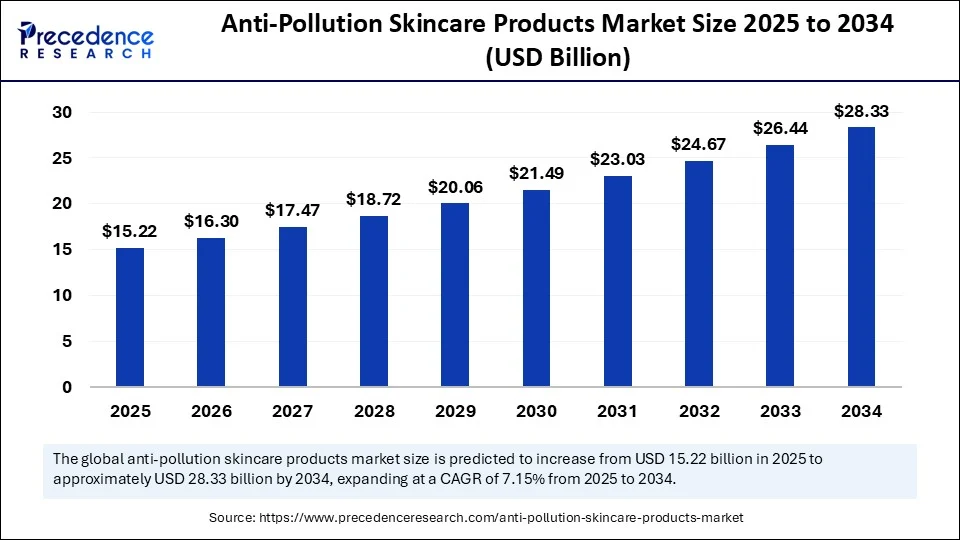
Anti-Pollution Skincare Products Market Key Takeaways
- In terms of revenue, the global anti-pollution skincare products market was valued at USD 14.20 billion in 2024.
- It is projected to reach USD 28.33 billion by 2034.
- The market is expected to grow at a CAGR of 7.15% from 2025 to 2034.
- Asia Pacific dominated the anti-pollution skincare products market with the largest share of 37% in 2024.
- The Middle East & Africa (MEA) is expected to grow at the fastest CAGR from 2025 to 2034.
- By product type, the moisturizers & creams segment contributed the biggest market share in 2024.
- By product type, the serums & essences segment will expand at a significant CAGR between 2025 and 2034.
- By ingredient type, the antioxidants segment captured the highest market share in 2024.
- By ingredient type, the botanical extracts segment will expand at a significant CAGR between 2025 and 2034.
- By skin concern, the anti-aging segment generated the major market share in 2024.
- By skin concern, the sensitive skin/redness segment will grow at the highest CAGR between 2025 and 2034.
- By gender, the women segment led the market in 2024.
- By gender, the men segment will grow at a notable CAGR between 2025 and 2034.
- By distribution channel, the online retail segment contributed the largest market share in 2024.
- By distribution channel, the specialty stores segment will expand at a significant CAGR between 2025 and 2034.
How is AI Impacting the Anti-Pollution Skincare Products Market?
Artificial intelligence is becoming increasingly embedded within the Anti‑Pollution Skincare Products Market through personalized solutions and data-driven marketing. AI-powered skin assessment tools analyze environmental exposure patterns and user skin type to recommend bespoke product routines.
Immersive platforms using extended reality (XR) paired with CNN‑based image analysis claim classification accuracies near 93 percent, enabling tailored product suggestions. Brands are leveraging hyperlocal environmental sensors to suggest formulations aligned with real‑time pollution levels, boosting conversion effectiveness and customer loyalty.
Anti-Pollution Skincare Products Market Drivers
Key growth drivers of the Anti‑Pollution Skincare Products Market include:
-
Rising levels of urban pollution (PM2.5, VOCs, heavy metals) affecting skin health.
-
Increased consumer knowledge about pollution-induced skin issues such as premature aging, sensitivity, pigmentation, and acne.
-
Growth fueled by urbanization in developing economies, where exposure to pollution is more prevalent.
-
Influence of social media, beauty influencers, and educational campaigns raising awareness of pollution skincare solutions.
-
Rising demand for clean, sustainable, multifunctional skincare products that offer protection and benefits like hydration or anti-aging.
Market Trends
Emergent trends shaping the Anti‑Pollution Skincare Products Market include:
-
Movement toward natural, organic, and clean-label formulations, often featuring botanical antioxidants, charcoals, adaptogens, or niacinamide.
-
Growth in multifunctional products, such as moisturizers or serums that combine anti-pollution with brightening, hydration, or SPF.
-
Surge in demand for lightweight serums, facial mists, and detoxifying cleansers.
-
Increased personalization via AI-enabled skincare routines and custom formulations.
-
Sustainability-focused innovations: eco‑friendly packaging, biodegradable masks, refill systems, and green ingredient sourcing are gaining preference among eco-conscious consumers.
Opportunities
The Anti‑Pollution Skincare Products Market faces numerous growth opportunities:
-
Expansion into emerging markets like India, Brazil, Mexico, and African nations where urban pollution levels are rising.
-
Diversification of product formats, including solid masks, waterless serums, and biodegradable single‑use formulations.
-
Collaborations with dermatologists, skincare professionals, and beauty tech platforms to validate efficacy claims and build consumer trust.
-
Offering clean‑beauty promises combined with pollution protection appeals to ethically-conscious consumers.
-
AI‑driven customization platforms and hyper-local pollutant-adaptive formulations offer differentiation and higher conversion rates.
Challenges
Notable challenges for the Anti‑Pollution Skincare Products Market include:
-
High costs of premium formulations, which can deter price-sensitive consumer segments.
-
Lack of consistent regulation or standardized testing for pollution-protection claims, leading to skepticism and confusion.
-
Intense competition from saturated brand landscapes, both global giants and indie/niche players.
-
Limited scientific evidence backing efficacy claims—consumers demand proof, yet formal studies remain scarce.
-
Supply‑chain and ingredient sourcing complexity, especially for organic or biotech-sourced actives, increasing R&D cost and compliance burden.
Recent Developments
Recent highlights shaping the Anti‑Pollution Skincare Products Market:
-
Rapid growth of metal cleanser products noted for detoxifying appeal; this sub‑segment is rising faster than traditional creams and masks.
-
Serums and moisturizers infused with botanical antioxidants, activated charcoal, and SPF are dominating consumer preference in urban centres.
-
Brands are increasingly combining pollution filtering technology with clean-label positions—leading with ingredient transparency and refillable packaging.
-
AI‑enabled online tools offering skin analysis, environment-based recommendations, and subscription models are gaining traction.
-
Biotechnology and biotechnology‑derived ingredients are entering the field, as sustainability and performance‑oriented solutions converge.
Anti-Pollution Skincare Products Market Companies
- L’Oréal Group
- Procter & Gamble Co.
- Unilever plc
- Shiseido Company
- Estée Lauder Companies Inc.
- Beiersdorf AG
- Johnson & Johnson
- Coty Inc.
- Clarins Group
- Kao Corporation
- Amorepacific Corporation
- The Body Shop International
- Innisfree Corporation
- Dr. Barbara Sturm
- Himalaya Global Holdings Ltd.
- Mamaearth (Honasa Consumer)
- The Ordinary (DECIEM)
- Forest Essentials
- Paula’s Choice
- Herbivore Botanicals
Segment Covered in the Report
By Product Type
- Cleansers & Face Washes
- Moisturizers & Creams
- Serums & Essences
- Masks & Peels
- Sunscreens
- Toners & Mists
- Others (e.g., exfoliants, BB creams, overnight treatments)
By Ingredient Type
- Activated Charcoal
- Antioxidants (e.g., Vitamin C, E, Niacinamide)
- Botanical Extracts (e.g., Green Tea, Ginseng, Moringa)
- Marine Extracts (e.g., Algae, Seaweed)
- Fermented Ingredients
- Barrier Repair Agents (e.g., Ceramides, Hyaluronic Acid)
- Others
By Skin Concern
- Anti-Aging
- Dryness & Dehydration
- Hyperpigmentation
- Acne & Breakouts
- Sensitive Skin / Redness
- Dullness & Fatigue
- Others
By Gender
- Women
- Men
- Unisex
By Distribution Channel
- Online Retail
- Supermarkets & Hypermarkets
- Specialty Stores
- Pharmacies & Drugstores
- Salon & Spa Channels
- Others (e.g., direct sales, pop-ups)
By Region
- North America
- Europe
- Asia Pacific
- Latin America
- Middle East & Africa (MEA)
Get Sample Link@ https://www.precedenceresearch.com/sample/6519
