
 by
by What is the Multi-Cloud Computing Market Size in 2026?
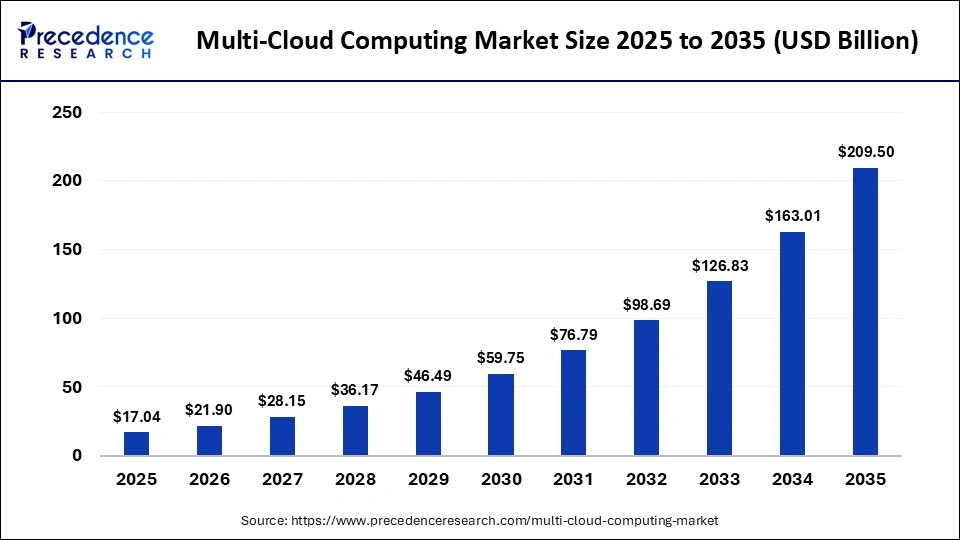
The global multi-cloud computing market size was calculated at USD 17.04 billion in 2025 and is expected to increase from USD 21.90 billion in 2026 to approximately USD 209.50 billion by 2035, expanding at a remarkable CAGR of 28.52% from 2026 to 2035. Market expansion is driven by organizations seeking operational flexibility, cost efficiency, enhanced resilience, and reduced vendor lock-in risks through the adoption of multiple cloud service providers.
Read also: Managed DNS Services Market
Key Takeaways
-
North America dominated the market with a 40% share in 2025.
-
Asia Pacific is expected to grow at the fastest CAGR during the forecast period.
-
By deployment type, the hybrid cloud segment led the market in 2025.
-
The private cloud segment is expected to grow at a significant CAGR.
-
By component, cloud services dominated the market in 2025.
-
Cloud management tools are projected to grow at the fastest CAGR.
-
By service model, software-as-a-service (SaaS) led in 2025.
-
Infrastructure-as-a-service (IaaS) is expected to grow at the fastest CAGR.
-
Large enterprises dominated in 2025, while SMEs are projected to grow at the fastest rate.
What is Multi-Cloud Computing?
Multi-cloud computing refers to the strategic use of two or more public or private cloud providers within a unified operational framework. Organizations adopt this model to:
-
Reduce dependency on a single vendor
-
Improve cost efficiency
-
Enhance system reliability
-
Optimize workload distribution
-
Strengthen negotiation leverage
Multi-cloud networking integrates separate cloud platforms into a coordinated infrastructure, enabling seamless connectivity, consistent performance, and centralized governance.
Industries actively adopting multi-cloud strategies include:
-
IT & IT-enabled services
-
Banking & Financial Services
-
Retail & E-commerce
-
Healthcare & Life Sciences
-
Manufacturing
-
Media & Entertainment
-
Energy & Utilities
Impact of Artificial Intelligence on Multi-Cloud Computing
Artificial Intelligence (AI) is transforming multi-cloud ecosystems by enabling intelligent workload orchestration and proactive security management.
Key AI Contributions:
-
Real-time anomaly detection
-
Predictive analytics for system failures
-
Automated resource allocation
-
Cost optimization
-
Compliance monitoring
-
Intelligent workload placement
AI-driven automation simplifies provisioning, configuration management, and governance, significantly reducing downtime while enhancing service reliability.
Multi-Cloud Computing Market Trends
Growing Adoption of Multi-Cloud Strategies
Organizations increasingly deploy multi-cloud models to enhance scalability, resilience, and regulatory compliance while minimizing vendor lock-in risks.
Sustainability Integration
Enterprises are aligning cloud strategies with ESG goals by prioritizing energy efficiency, reducing electronic waste, and improving hardware lifecycle management.
Startup Ecosystem Innovation
Startups are accelerating innovation in cloud security, containerization, compliance, and application portability, further boosting multi-cloud adoption.
Acceleration of Digital Transformation
Rapid modernization initiatives across enterprises and startups are increasing demand for agile and scalable multi-cloud platforms.
Security & Risk Management Focus
With distributed sensitive data, organizations prioritize encryption governance, compliance monitoring, and advanced identity access management (IAM).
Expansion of Edge Computing & IoT
Edge computing and IoT generate massive real-time data streams. Multi-cloud platforms ensure seamless integration between edge systems and centralized cloud environments.
Segment Insights
Deployment Type Analysis
Why Did Hybrid Cloud Dominate in 2025?
The hybrid cloud segment led the market in 2025 due to its ability to combine public and private cloud benefits.
Key advantages include:
-
Improved cost management
-
Enhanced scalability
-
Better compliance support
-
Disaster recovery readiness
-
Seamless workload management
Private Cloud – Fastest Growing Segment
Private cloud adoption is rising due to:
-
Enhanced data control
-
Regulatory compliance requirements
-
Customizable infrastructure
-
Secure integration with public cloud environments
Public Cloud Growth
Public cloud solutions continue expanding due to cost efficiency, scalability, and digital transformation initiatives across major economies.
Component Analysis
Cloud Services – Dominant Segment
The cloud services segment led the market in 2025, offering scalable, on-demand resources such as:
-
Infrastructure-as-a-Service (IaaS)
-
Platform-as-a-Service (PaaS)
-
Software-as-a-Service (SaaS)
Remote work expansion and enterprise digitization further strengthened this segment.
Cloud Management Tools – Fastest Growing
Organizations managing complex multi-cloud environments require:
-
Centralized monitoring
-
Governance frameworks
-
Cost optimization solutions
-
Security automation
This complexity is driving rapid growth in advanced cloud management tools.
Service Model Analysis
Why Did SaaS Lead the Market?
SaaS dominated in 2025 because it provides:
-
Ready-to-use applications
-
Reduced IT infrastructure costs
-
Rapid deployment
-
Global accessibility
The rise of digital collaboration tools and enterprise software adoption strengthened SaaS leadership.
IaaS – Highest CAGR Forecast
IaaS enables:
-
Flexible resource scaling
-
Cost optimization
-
High-performance computing
-
Big data analytics support
Growing enterprise IT modernization and digital transformation are fueling IaaS growth.
End-User Analysis
Large Enterprises – Market Leaders
Large enterprises dominate due to:
-
Strong financial resources
-
Complex IT ecosystems
-
Regulatory compliance requirements
-
Advanced AI-driven cloud management
These organizations operate across multiple cloud providers to ensure resilience and business continuity.
SMEs – Fastest Growing Segment
SMEs are rapidly adopting multi-cloud strategies due to:
-
Affordable SaaS platforms
-
Managed cloud services
-
Simplified governance tools
-
Increasing need for digital competitiveness
Regional Analysis
North America Multi-Cloud Computing Market
North America accounted for 40% of the global market in 2025. The regional market was valued at USD 6.82 billion in 2025 and is projected to grow at a CAGR of 28.67% through 2035.
Why North America Leads?
-
Mature cloud infrastructure
-
Early AI, IoT, and blockchain adoption
-
Strong presence of hyperscalers such as Google, Microsoft, and Amazon Web Services
-
Strong regulatory frameworks
U.S. Multi-Cloud Computing Market
The U.S. market was valued at USD 5.11 billion in 2025 and is projected to reach USD 64.06 billion by 2035, growing at a CAGR of 28.77%.
Key drivers include:
-
AI-driven automation adoption
-
Containerization technologies such as Kubernetes
-
Strong digital connectivity infrastructure
-
Cost optimization initiatives
Asia Pacific – Fastest Growing Region
Asia Pacific is emerging as the fastest-growing region due to:
-
Rapid IT infrastructure development
-
Expanding startup ecosystems
-
Government-backed digital economy initiatives
-
Growing cloud migration across enterprises
India Market Outlook
India is experiencing strong growth due to:
-
Large-scale digital transformation programs
-
Expanding fintech and e-commerce sectors
-
Rapid startup ecosystem development
China Market Outlook
China remains a major contributor, driven by:
-
Industrial IoT growth
-
Telecom infrastructure modernization
-
Regulatory-driven cloud adoption
Competitive Landscape
Key players operating in the global multi-cloud computing market include:
-
Flexera Software LLC
-
CloudBolt Software Inc.
-
Citrix Systems Inc.
-
CoreStack Inc.
-
Dell Technologies Inc.
-
VMware Inc.
-
Oracle Corp.
-
Juniper Networks Inc.
-
Cloudflare Inc.
-
Nutanix Inc.
-
Microsoft Corp. (Azure Arc)
-
Amazon Web Services Inc.
-
Google Cloud Platform
-
IBM Corp. (Turbonomic)
-
Cisco Systems Inc.
-
HashiCorp Inc.
-
Platform Systems
For inquiries regarding discounts, bulk purchases, or customization requests, please contact us at sales@precedenceresearch.com
