
 by
by What is the Zero Gravity Entertainment Market Size in 2026?
The global zero gravity entertainment market was valued at USD 2.47 billion in 2025 and is expected to increase from USD 2.85 billion in 2026 to approximately USD 10.48 billion by 2035, registering a robust CAGR of 15.55% from 2026 to 2035.
Market growth is primarily driven by:
-
Rising interest in space tourism
-
Growing demand for immersive microgravity simulations
-
Rapid advancements in virtual reality (VR) and augmented reality (AR) technologies
-
Expanding experiential entertainment industry.
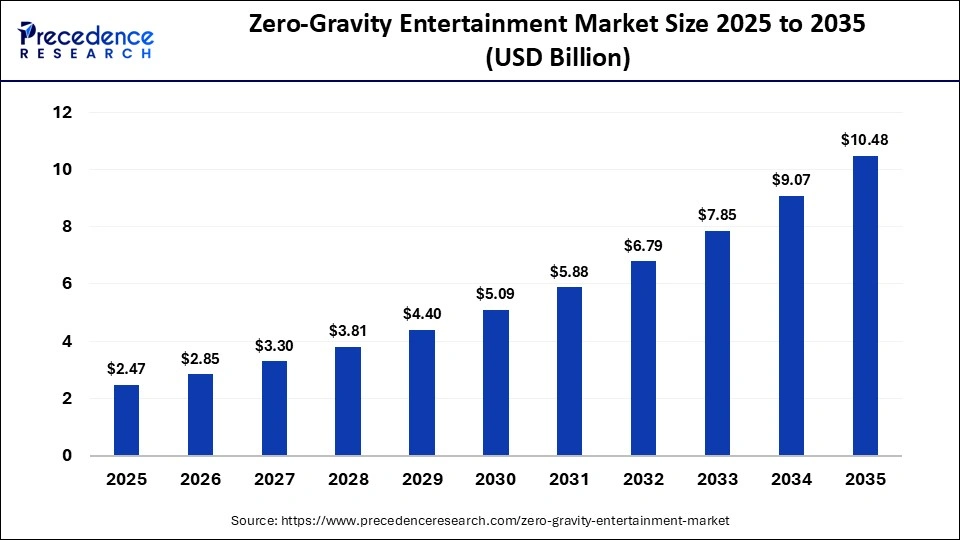
Zero-Gravity Entertainment Market Size 2025 to 2035
Market Overview
The zero-gravity entertainment market focuses on delivering simulated weightlessness experiences using advanced technological systems. These include:
-
VR and AR-based immersive environments
-
Motion-based simulation systems
-
Microgravity recreation platforms
These technologies replicate the sensation of space-like microgravity in controlled environments such as:
-
Amusement parks
-
Gaming centers
-
Science museums
-
Specialized experience venues
High-resolution VR headsets, improved motion-sensing systems, and real-time physics engines are significantly enhancing user realism and immersion.
Additionally, the growing integration of zero-gravity simulations into STEM education programs is broadening the market’s application scope.
Read Also: In-App Advertising Market
Key Takeaways
-
North America held the largest market share in 2025.
-
Asia Pacific is projected to witness the fastest growth during the forecast period.
-
By product type, Virtual Reality Experiences dominated in 2025.
-
Zero-gravity sports are expected to grow significantly over the forecast period.
-
By application, Amusement Parks led in 2025.
-
Gaming centers are projected to grow at a strong CAGR.
-
By age group, Children held a major share in 2025.
-
Adults are expected to grow at the fastest rate.
-
By distribution channel, Online platforms dominated in 2025.
-
Offline stores are expected to grow significantly during the forecast period.
How AI is Transforming Zero-Gravity Entertainment
Artificial Intelligence (AI) is significantly enhancing zero-gravity experiences by improving realism, personalization, and operational efficiency.
Key AI Contributions:
-
AI-driven motion control systems adjust simulator parameters in real time
-
Computer vision tracking synchronizes user movements with virtual environments
-
Adaptive storytelling creates personalized space missions
-
Optimized haptic feedback enhances physical realism
-
Predictive analytics improves operational efficiency
AI integration allows operators to offer customized experiences, increasing user satisfaction and repeat visits.
Zero-Gravity Entertainment Market Trends
1. Advanced VR and AR Adoption
The rising use of immersive VR and AR technologies is creating highly realistic zero-gravity simulations accessible across entertainment hubs.
2. Strategic Partnerships with Space Tourism Providers
Collaborations between entertainment firms and space tourism companies are increasing consumer interest in microgravity experiences.
3. Compact Motion Platforms
Cost-effective and compact motion platforms are enabling malls and theme parks to offer zero-gravity attractions without heavy infrastructure investment.
4. Experiential Entertainment Demand
Consumers are increasingly preferring interactive, high-tech attractions, fueling innovation in:
-
Haptic feedback
-
Motion tracking
-
Multi-sensory simulation systems
Segment Insights
By Product Type
Why Did Virtual Reality Experiences Dominate?
The Virtual Reality Experiences segment led the market in 2025 due to:
-
High immersion and realism
-
Lower operational costs compared to real zero-gravity environments
-
Scalable and flexible content updates
-
Easy integration into entertainment venues
VR offers space-like experiences at a fraction of the infrastructure investment required for real microgravity setups.
Why is Zero-Gravity Sports Growing Rapidly?
The Zero-Gravity Sports segment is expected to grow significantly because:
-
Consumers prefer physically active entertainment
-
Advancements in safety systems and controlled gravity simulation
-
Growing investments in specialized sports facilities
By Application
Why Did Amusement Parks Lead?
Amusement parks dominated in 2025 due to:
-
High visitor footfall
-
Investment capacity
-
Focus on immersive thrill-based attractions
-
Established infrastructure
Zero-gravity simulators seamlessly integrate into park ecosystems.
Why Are Gaming Centers Expanding Rapidly?
Gaming centers are projected to grow strongly due to:
-
High-throughput operational models
-
Familiarity with immersive technologies
-
Frequent content updates
-
Multiple revenue streams
Growth in Educational Institutions
Educational institutions are increasingly integrating zero-gravity simulations into STEM programs for:
-
Physics
-
Engineering
-
Space science
Interactive learning and academic collaborations are expanding this segment.
By Age Group
Why Did the Children Segment Dominate?
The Children segment held a significant share in 2025 due to:
-
Attraction toward novelty-driven experiences
-
Safe and educational engagement
-
Parental willingness to invest in learning-based entertainment
Why Are Adults Growing Fastest?
The Adults segment is expected to grow fastest due to:
-
Rising disposable income
-
Interest in experiential tourism
-
Corporate team-building programs
-
Wellness and adventure-based recreation
By Distribution Channel
Why Did Online Platforms Lead?
Online platforms dominated in 2025 due to:
-
Convenient booking
-
Secure payment systems
-
Dynamic pricing
-
Data-driven promotions
-
Mobile integration
Offline Stores Growth
Offline stores are expected to grow rapidly because:
-
Experiential retail preference
-
In-person demonstrations
-
Guided consultations
-
Tourist destination expansion
Regional Insights
Why Did North America Lead?
North America dominated the market in 2025 due to:
-
Early adoption of VR, AR, and AI technologies
-
Strong presence of entertainment tech firms
-
High consumer purchasing power
-
Growing interest in space-themed attractions
Companies such as SpaceX, Blue Origin, and Virgin Galactic have contributed to increased public interest in microgravity and space experiences.
Why is Asia Pacific Growing Fastest?
Asia Pacific is projected to grow at the fastest CAGR due to:
-
Rising middle-income population
-
Expanding disposable incomes
-
Urbanization and smart entertainment infrastructure
-
Government initiatives supporting digital innovation
Countries like China, Japan, and South Korea are investing heavily in immersive simulation technologies.
Europe Market Outlook
Europe is expected to grow significantly, supported by:
-
Strong tourism sector
-
Integration into museums and science centers
-
Government innovation programs
-
Digital transformation initiatives
For inquiries regarding discounts, bulk purchases, or customization requests, please contact us at sales@precedenceresearch.com
