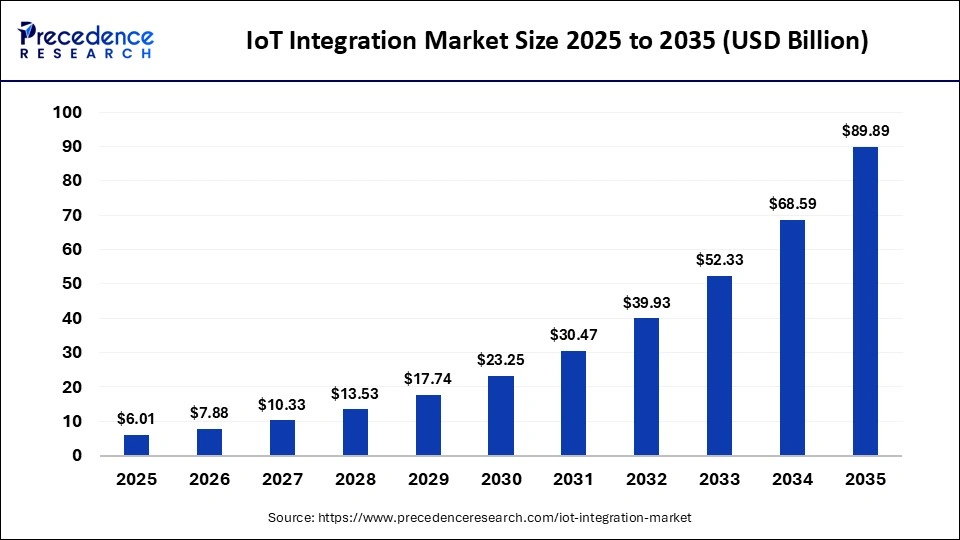
Market Overview
The IoT integration market is advancing rapidly as organizations increasingly depend on connected ecosystems to drive automation, real-time insights, and operational efficiency. IoT integration focuses on seamlessly connecting devices, platforms, applications, and backend systems using cloud services, middleware, data orchestration tools, API management, and device lifecycle management solutions. Effective integration ensures interoperability, secure communication, and scalability across diverse IoT environments, supporting a wide range of industries including manufacturing, healthcare, energy, retail, transportation, and smart cities.
Market growth is fueled by the rapid expansion of connected devices, the acceleration of Industry 4.0 initiatives, and the growing reliance on predictive analytics and automation. The adoption of cloud and edge computing architectures is further improving the flexibility and scalability of IoT systems. Organizations are increasingly investing in IoT integration to streamline operations, enhance customer experiences, reduce operational costs, and enable remote monitoring and predictive maintenance. Strong adoption in healthcare and smart city projects where IoT supports real-time diagnostics, asset tracking, and efficient service delivery continues to expand the market. Ongoing technological innovation is making IoT ecosystems more intelligent, connected, and business-critical.
Key AI-Driven Technological Shifts in the IoT Integration Market
Artificial intelligence is playing a central role in advancing IoT integration by adding intelligence, automation, and advanced decision-making capabilities to connected systems. The combination of AI and IoT enables organizations to analyse massive volumes of real-time data, detect patterns, predict equipment failures, and trigger automated responses with minimal human involvement. Use cases such as predictive maintenance, anomaly detection, and adaptive process optimization are transforming operations across manufacturing, healthcare, smart energy, and transportation sectors.
AI-driven digital twins are further enhancing IoT integration by enabling virtual representations of physical systems for continuous monitoring, simulation, and performance optimization. As IoT deployments scale in complexity and size, AI enhances operational efficiency, strengthens security intelligence, lowers costs, and improves overall system reliability and user experience, positioning AI-enabled IoT integration as a key driver of next-generation digital transformation.
Market Trends in the IoT Integration Market
- Rising Adoption of AI-Enabled IoT Platforms: Organizations are increasingly embedding AI and machine learning into IoT integration platforms to enable predictive maintenance, anomaly detection, and automated decision-making across connected systems.
- Shift Toward Edge Computing Integration: To reduce latency and bandwidth costs, enterprises are integrating edge computing with IoT architectures, enabling real-time data processing closer to devices.
- Growth of Digital Twins: Digital twin technology is gaining traction for monitoring, simulation, and optimization of assets, particularly in manufacturing, energy, and smart infrastructure projects.
- Increased Focus on Interoperability and Standardization: With diverse IoT ecosystems in place, businesses are prioritizing middleware, APIs, and standardized protocols to ensure seamless integration across platforms and devices.
- Heightened Emphasis on Security and Data Privacy: As connected environments expand, IoT integration solutions increasingly incorporate AI-driven security analytics, encryption, and compliance-focused data management.
- Expansion of IoT in Healthcare and Smart Cities: Demand is growing for integrated IoT solutions that support remote patient monitoring, intelligent traffic systems, smart utilities, and public safety applications.
Regional Insights
North America leads the IoT integration market due to early adoption of advanced technologies, strong cloud infrastructure, and significant investments in AI, Industry 4.0, and smart city initiatives. The presence of major technology providers and widespread deployment across manufacturing, healthcare, and transportation further supports market growth in the region.
Europe represents a mature and steadily growing market, driven by strong regulatory frameworks, digital transformation programs, and increasing adoption of IoT in smart energy, industrial automation, and urban infrastructure projects. Emphasis on data privacy and sustainability also shapes IoT integration strategies across the region.
Asia Pacific is expected to witness the fastest growth, supported by rapid industrialization, expanding smart city projects, and large-scale adoption of IoT in manufacturing, logistics, and healthcare. Countries such as China, India, Japan, and South Korea are investing heavily in digital infrastructure, 5G connectivity, and AI-enabled IoT platforms.
Latin America is experiencing gradual growth as enterprises adopt IoT integration to improve operational efficiency in sectors such as utilities, agriculture, and transportation. Government-backed digital initiatives and increasing cloud adoption are contributing to market expansion.
The Middle East & Africa region is emerging as a promising market, driven by smart city developments, energy optimization projects, and infrastructure modernization. Investments in connected utilities, transportation systems, and industrial automation are expected to accelerate IoT integration adoption in the coming years.
IoT Integration Market Key Players
- Infosys
- Cognizant
- Capgemini
- Deloitte
- HCL Technologies
- Tech Mahindra
- Cisco Systems
- SAP SE
- Oracle Corporation
- Microsoft
- ATOS
Recent Developments
- In January 2025, Accenture acquired a digital twin technology system platform at Percipient as part of its banking modernization solutions. It is estimated that this acquisition will help financial institutions to easily transform to a core system and accelerate innovation without disrupting operations.
- In April 2024, Microsoft declared a strategic alliance with the leading companies in the industrial sector to build AI-driven industrial data integration. Its collaboration aims at using AI to get actionable insights on complex industrial data that enhance predictive maintenance, automation, and operational efficiency.
- In October 2023, Amazon Web Services released the general availability of its new Software Package Catalog, a fully managed cloud service feature that is intended to be used by large-scale orchestrating IoT devices. This service enables companies to quickly and cost-effectively increase, view, and control software deployments through a single dashboard of interconnected device ecosystems.
Get Sample Link : https://www.precedenceresearch.com/sample/7220

 by
by