
 by
by 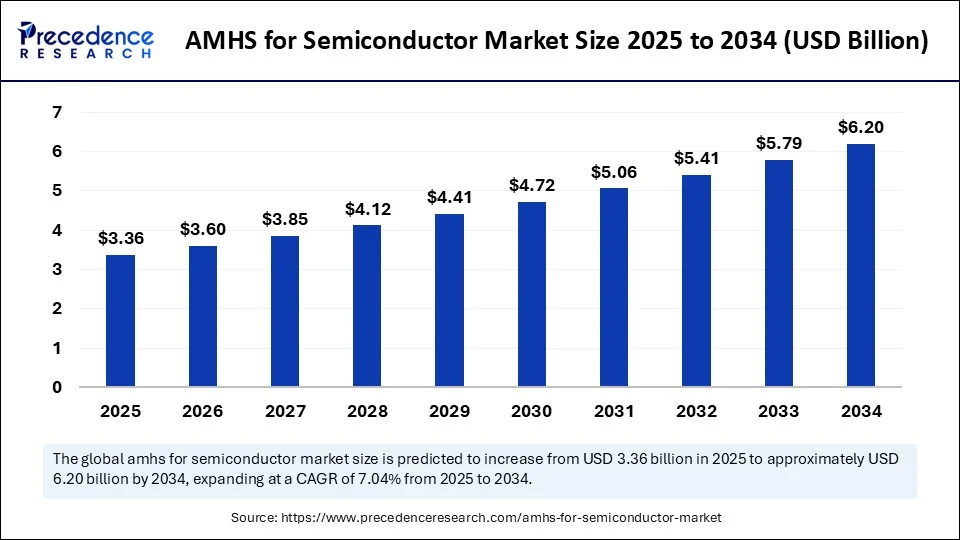
AMHS for Semiconductor Market Key Takeaways
- In terms of revenue, the global AMHS for semiconductor market was valued at USD 3.14 billion in 2024.
- It is projected to reach USD 6.20 billion by 2034.
- The market is expected to grow at a CAGR of 7.04% from 2025 to 2034.
- Asia Pacific dominated the global AMHS for semiconductor market with the largest share of 50% in 2024.
- North America is expected to grow at a notable CAGR from 2025 to 2034.
- By component type, the robotic systems segment held the major market share of 45% in 2024.
- By component type, the AHMS segment is expected to grow at the highest CAGR between 2025 and 2034.
- By technology, the robotics-based AHMS segment dominated the market, holding a 55% share in 2024 and is expected to sustain the growth in the coming years.
- By end-use industry, the semiconductor fabrication segment captured the biggest market share of 60% in 2024.
- By end-use industry, the semiconductor assembly and packaging segment is expected to grow at a significant CAGR over the projected period.
- By system type, the wafer handling systems segment contributed the highest market share of 40% in 2024.
- By system type, the material transfer systems segment is expected to grow at a notable CAGR from 2025 to 2034.
- By deployment type, the on-site deployment segment generated the major market share of 70% in 2024.
- By deployment type, the cloud-based systems segment is expected to grow at a notable CAGR from 2025 to 2034.
- By application, the wafer processing segment accounted for the significant market share of 50% in 2024.
- By application, the chip packaging and final assembly segment is projected to grow at a significant CAGR between 2025 and 2034.
Impact of Artificial Intelligence on the AMHS for Semiconductor Market
AI is a game‑changer within the AMHS for Semiconductor Market—enabling real‑time route optimization, congestion prediction, and equipment coordination to minimize cycle times. Machine learning enables predictive maintenance, continuously tracking wear and tear to reduce unexpected downtime. In smart fabs, AI-based logistics adapt dynamically to shifting production loads, contamination risks, and throughput bottlenecks. This integration of smart, automated decision-making is a defining Industry 4.0 shift within the AMHS ecosystem, offering substantial operational gains.
Drivers
Several key forces propel the AMHS for Semiconductor Market growth:
-
Surging semiconductor demand across AI platforms, data centers, electric vehicles, and IoT devices.
-
Shrinking device geometries (< 5 nm) impose contamination risks—necessitating ultra‑clean automated wafer flow.
-
Rising wafer fab investments supported by incentives (e.g. the U.S. CHIPS Act and Asia‑Pacific smart fab initiatives).
-
Labor shortages and high labor costs accelerate automation adoption in fabs.
Market Trends
Emerging trends shaping the AMHS for Semiconductor Market include:
-
The rapid scale-up of 300 mm wafer fabs, which demand high‑speed automated logistics.
-
A shift from conveyors and semi‑automated systems toward robotics and AGVs for flexibility and scalability.
-
Modular and cloud‑ready AMHS designs that enable scalable deployments across sites.
-
Increased deployment of digital‑twin simulations to plan logistics and fab layouts before implementation.
-
Enhanced focus on energy‑efficient and low‑footprint systems, aligning with sustainable manufacturing mandates.
Opportunities
The AMHS for Semiconductor Market is ripe with opportunity:
-
AI‑driven smart transport systems and digital‑twin diagnostics to boost fab efficiency.
-
Tailored, modular AMHS offerings designed for small to mid‑scale fabs, especially in emerging markets.
-
Green AMHS solutions with reduced power consumption meeting environmental regulations.
-
Tapping rapid fab build-out in emerging Asia‑Pacific markets—including India, ASEAN nations, and Eastern China—where new fabs require modern AMHS.
Challenges
Key challenges confronting the AMHS for Semiconductor Market are:
-
High upfront capital costs and long payback periods deter smaller operators.
-
Complex system integration with legacy infrastructure and strict cleanroom standards.
-
Skilled technician shortages hinder deployment, operation, and maintenance.
-
Supply‑chain disruptions and tariffs (e.g. 2025 U.S. duties on imported automation parts) add procurement complexity.
-
Rapid technology cycles require continuous upgrades to avoid obsolescence and preserve ROI.
Recent Developments
Recent notable events include:
-
Tokyo Electron Limited introduced a next‑generation AMHS in October 2023, integrating robotics with AI‑powered flow control to streamline wafer logistics and reduce cycle time.
-
Daifuku Co., Ltd. completed acquisition of a European logistics automation firm in September 2023, expanding its AMHS technology footprint.
-
KUKA AG entered a strategic partnership in August 2023 with a leading chipmaker to co‑develop bespoke robotics solutions for AMHS environments.
-
Applied Materials, Inc. released machine‑learning-enabled predictive maintenance upgrades for its AMHS products in July 2023, reducing unplanned downtime.
-
ASM International N.V. secured regulatory approval in June 2023 for an ultra‑high‑purity AMHS design suitable for the strictest semiconductor clean‑room protocols.
Also Read@ https://www.dailytechbulletin.com/artificial-intelligence-and-analytics-in-surgery-market/
AMHS for semiconductor Market Companies
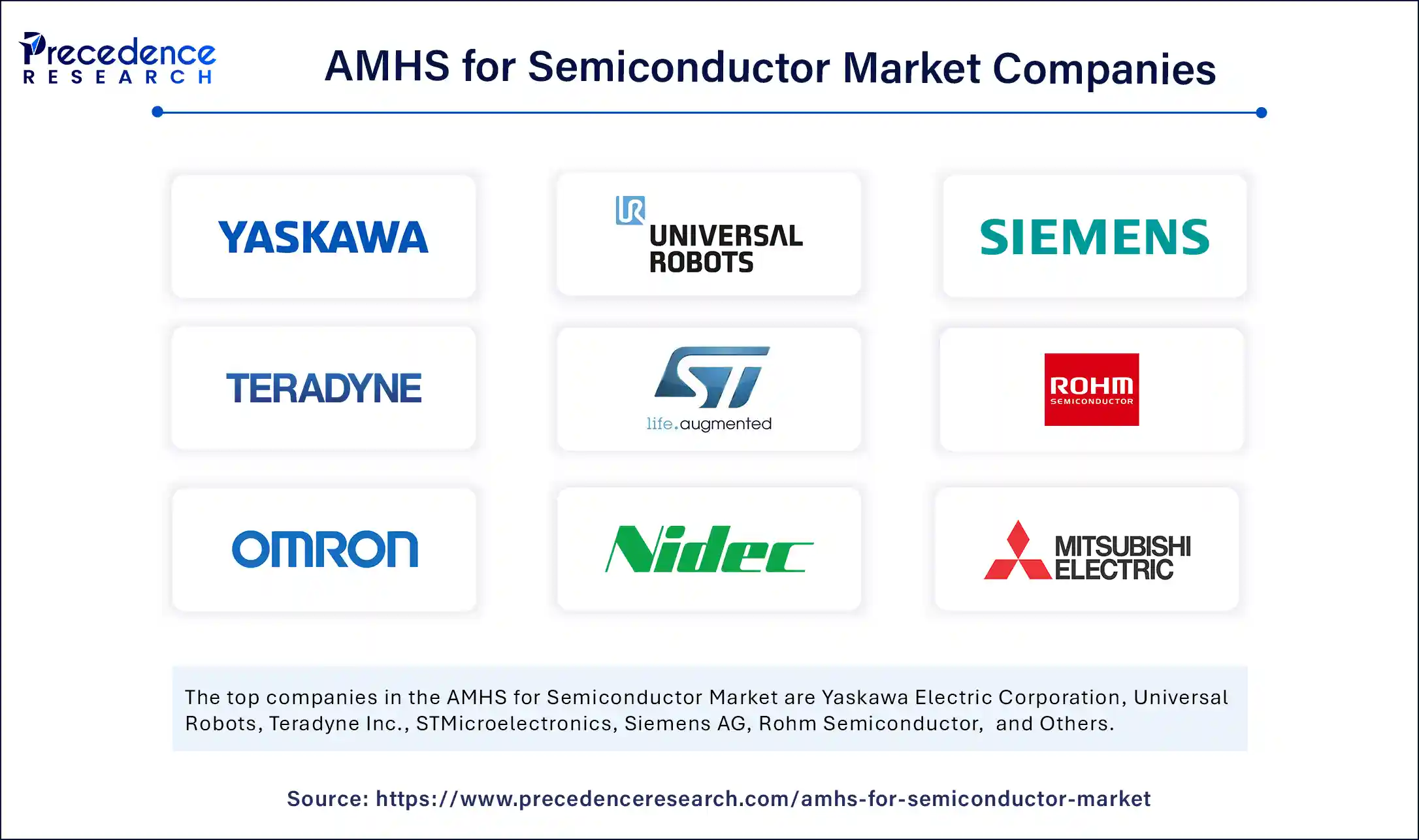
- Yaskawa Electric Corporation
- Universal Robots
- Teradyne Inc.
- STMicroelectronics
- Siemens AG
- Rohm Semiconductor
- Omron Corporation
- Nidec Corporation
- Mitsubishi Electric Corporation
- KUKA AG
- Keyence Corporation
- HIMA Paul Hildebrandt GmbH
- Festo AG & Co.
- FANUC Corporation
- Denso Corporation
- Cognex Corporation
- Brooks Automation, Inc.
- Autodesk, Inc.
- Applied Materials, Inc.
- ABB Ltd.
Segments Covered in the Report
By Component Type
- Robotic Systems
- Articulated Robots
- Cartesian Robots
- SCARA Robots
- Delta Robots
- Automated Material Handling Systems (AMHS)
- Overhead Hoists
- Automated Guided Vehicles (AGVs)
- Conveyor Systems
- Control Systems
- Centralized Control Systems
- Distributed Control Systems
By Technology
- Robotics-based AHMS
- Collaborative Robots (Cobots)
- Autonomous Mobile Robots (AMRs)
- Automated Transport Systems
- Conveyor Belt Systems
- Vacuum Lifts
- Vision and Inspection Systems
- Optical Inspection Systems
- 3D Visual Inspection
By End-Use Industry
- Semiconductor Fabrication
- Semiconductor Assembly & Packaging
- Wafer Handling
- Other (Testing, Sorting)
By System Type
- Wafer Handling Systems
- Die Handling Systems
- Material Transfer Systems
- Packaging and Assembly Systems
- By Deployment Type
- On-Site Deployment
- Cloud-based Systems
By Application
- Wafer Processing
- Wafer Transport
- Testing and Inspection
- Chip Packaging and Final Assembly
By Region
- North America
- Europe
- Asia Pacific
- Latin America
- Middle East & Africa
Get Sample Link@ https://www.precedenceresearch.com/sample/6518
