
 by
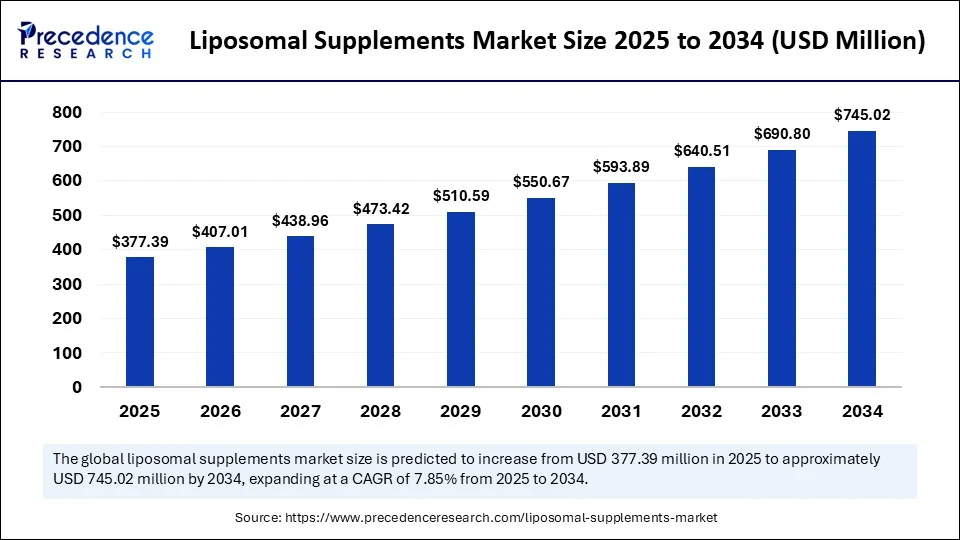
by The global liposomal supplements market size was evaluated at USD 349.92 million in 2024 and is predicted to reach around USD 745.02 million by 2034, growing at a CAGR of 7.85%.
Liposomal Supplements Market Key Takeaways
- In terms of revenue, the global liposomal supplements market was valued at USD 349.92 million in 2024.
- It is projected to reach USD 745.02 million by 2034.
- The market is expected to grow at a CAGR of 7.85% from 2025 to 2034.
- North America dominated the liposomal supplements market with the largest share of about 42.3% in 2024.
- Asia Pacific is expected to grow at the fastest CAGR from 2025 to 2034.
- By product type, the vitamins segment led the market, under which the vitamin C sub-segment held a 18.7% market share in 2024.
- By product type, the antioxidants segment is expected to grow at the fastest rate, under which the glutathione segment is likely to lead the charge between 2025 and 2034.
- By application, the immune health segment contributed the biggest market share of 24.2% in 2024.
- By application, the cognitive support and brain health segment is expanding at a significant CAGR between 2025 and 2034.
- By formulation type, the liquid segment contributed the highest market share of 41.5% in 2024.
- By formulation type, the capsules/softgels segment is expected to grow at a significant CAGR over the projected period.
- By distribution channel, the online retail (third party) segment held the largest market share of 36.9% in 2024.
- By distribution channel, the direct-to-consumer subscription segment is expected to grow at a notable CAGR from 2025 to 2034.
- By end user, the adults segment generated the major market share of 59.4% in 2024.
- By end user, the athletes/fitness enthusiasts segment is expected to grow at a notable CAGR from 2025 to 2034.
Impact of Artificial Intelligence on the Liposomal Supplements Market
AI contributes significantly to the Liposomal Supplements Market, especially in formulation science and personalization. Machine learning models help predict optimal liposomal payload ratios, phospholipid types, particle size distributions, and stability parameters. AI-assisted bioassay and consumer data analysis enables creation of personalized blends targeting specific biomarkers.
AI also streamlines quality control—identifying encapsulation deficiencies, particle uniformity, or oxidation risk early in production. By predicting consumer preferences and efficacy signals, AI shapes targeted marketing and product assortment across immune, cognition, anti‑aging, and wellness segments.
Market Overview
The Liposomal Supplements Market encapsulates nutrients—vitamins, antioxidants like glutathione, botanicals such as curcumin and quercetin—inside nanosized lipid vesicles that mimic cell membranes, shielding payloads from intestinal degradation and enhancing absorption into circulation. As consumer emphasis shifts from raw dosage to delivery efficacy, particularly in elder care, immune support, sports nutrition, and brain health, liposomal delivery is favored over tablets, softgels, or gummies for its high bioavailability and dose economy.
Drivers
Major forces propelling the Liposomal Supplements Market include:
-
Efficacy demand: Scientific recognition of poor absorption in standard forms pushes consumers towards liposomal formats that promise up to ~90 percent systemic availability.
-
Health trends: Rising chronic disease rates, aging demographics, immunity concerns post-pandemic, and interest in preventive nutrition create demand for high‑performance supplements.
-
Technological enhancement: Progress in encapsulation methods—microfluidization, sonication, reverse-phase evaporation, PEG-coating, stealth liposomes—improves product reliability, bio-stability, and multi-active loading.
-
Clean-label and vegan shifts: Use of plant-derived phospholipids and allergen-free ingredients aligns with modern consumer ethics.
-
Channel transformation: Online platforms, D2C subscription models, and influencer-led education enhance reach and acceptance, especially among younger or wellness-curious demographics.
Opportunities
-
Innovative combos: Development of multi‑active liposomal formulations—e.g. vitamin C + curcumin, B‑complex + L‑theanine, glutathione + resveratrol—address compound health goals like immune + cognitive, antioxidant + detoxification.
-
Emerging region expansion: Fastest growth in Asia Pacific presents potential in markets like China, India, Japan, where increasing incomes and healthcare investment support upscale supplement uptake.
-
Personalization: AI and genetic/lifestyle profiling allow creation of customized liposomal supplement packs tailored to individual nutrient gaps or wellness objectives.
-
Novel delivery forms: Worth exploring are emulsions, sachets, pouches, cold‑chain ready packaging, improved texture and taste formats to overcome sensory resistance.
-
Clinical validation: Publishing substantiated trials showing superior absorption and physiological effects (immune markers, oxidative stress reduction, cognitive performance) will validate product claims and build trust among both consumers and health professionals.
Also read @ https://www.pharma-geek.com/nucleic-acid-aptamers-market/
Challenges
-
Premium pricing barrier: Production complexity and material costs make liposomal supplements 3–5× more expensive than conventional pills; only ~12 percent of regular supplement consumers are willing to pay the premium without perceived benefit.
-
Low literacy: A significant proportion of users and many health practitioners are unfamiliar with liposomal science—surveys show high confusion associating liposomes with pharmaceuticals rather than supplements—which limits word‑of‑mouth and professional recommendation.
-
Regulatory uncertainty: Inconsistent standards across countries, lack of required proof for bioavailability or encapsulation claims, and unclear labeling rules impede market trust and product differentiation.
-
Quality variability: Not all products deliver expected encapsulation efficiency. Taste/texture issues—some products are described as slimy or oily, fishy aftertaste in omega‑3 liposomal—deter repeat purchase.
-
Supply chain complexity: Product sensitivity to heat and oxidation requires cold‑chain or controlled storage; many retailers limit shelf space due to slow turnover.
-
Competitive threats: Nanoemulsions, microsphere formulations, peptide supplements, IV nutrient therapies, and conventional high‑dose capsules offer alternative strategies that may compete on cost or perception.
Recent Developments
-
June 2024: Sudeep Nutrition (India) introduced its “Lipoboost” product line featuring thirteen liposomal active ingredients (vitamins C, D3, B12, magnesium, curcumin, CoQ10, glutathione), targeting superior absorption and consumer convenience.
-
Multiple product launches across global brands expanded antioxidant and botanical liposomal offerings—especially glutathione, curcumin, CBD, quercetin, B‑complex blends.
-
R&D progress facilitated use of plant‑based phospholipids, PEGylated liposomes, stealth delivery systems and improved nanoscale uniformity of batch quality.
-
Distributors expanded liposomal supplements availability through cross‑border e‑commerce channels and subscription services.
-
Asia Pacific uptake grew substantially as health awareness rose in markets like India, China, and Southeast Asia, supported by digital marketing and influencer education campaigns.
-
Companies invested in educational marketing around liposomal science to reduce awareness gaps and support claims about absorption, stability, and clinical plausibility.
Liposomal Supplements Market Companies
- Altrient (by LivOn)
- Amandean
- Aurora Nutrascience
- BioCeuticals
- Core Med Science
- Cymbiotika
- DaVinci Laboratories
- Designs for Health
- Dr. Mercola
- Elyptol
- Empirical Labs
- LipoLife
- LivOn Labs
- Nutrivene
- Pure Encapsulations
- Quicksilver Scientific
- Seeking Health
- SMP Nutra
- Thorne HealthTech
- Valimenta Labs
Segments Covered in the Report
By Product Type
- Vitamins
- Vitamin C (Ascorbic Acid)
- Vitamin D3
- Vitamin B12
- Multivitamins
- Others
- Minerals
- Magnesium
- Zinc
- Iron
- Others
- Antioxidants
- Glutathione
- Coenzyme Q10 (CoQ10)
- Alpha Lipoic Acid
- Others
- Herbal Extracts
- Curcumin
- Ashwagandha
- Ginseng
- Others
- Fatty Acids & Oils
- Omega-3 (DHA/EPA)
- Phosphatidylcholine
- Others
- Amino Acids & Peptides
- L-Carnitine
- L-Theanine
- Glutamine
- Others
- Cannabinoids
- Liposomal CBD
- Others
- Probiotics & Enzymes
- Others (e.g., Melatonin, NAD+, NMN, Resveratrol)
By Application
- General Health & Wellness
- Immune Health
- Anti-Aging & Skin Health
- Cognitive Support & Brain Health
- Cardiovascular Health
- Sports Nutrition & Recovery
- Stress & Sleep Management
- Digestive Health
- Others
By Formulation Type
- Liquid
- Gel
- Powder (Reconstitutable)
- Capsules / Softgels
- Sprays / Oral Pump Dispensers
- Others
By Distribution Channel
- Online Retail
- Brand-owned E-commerce
- Third-party E-commerce (Amazon, iHerb, etc.)
- Offline Retail
- Health & Wellness Stores
- Pharmacies / Drugstores
- Supermarkets / Hypermarkets
- Others
- Practitioner / Clinic-Based Sales
- Direct-to-Consumer (DTC) Subscriptions
By End User
- Adults
- Geriatric Population
- Pediatrics
- Athletes / Fitness Enthusiasts
- Pregnant & Lactating Women
- Others
By Region
- North America
- Europe
- Asia Pacific
- Latin America
- Middle East & Africa
Get sample link @ https://www.precedenceresearch.com/sample/6510
