 by
by 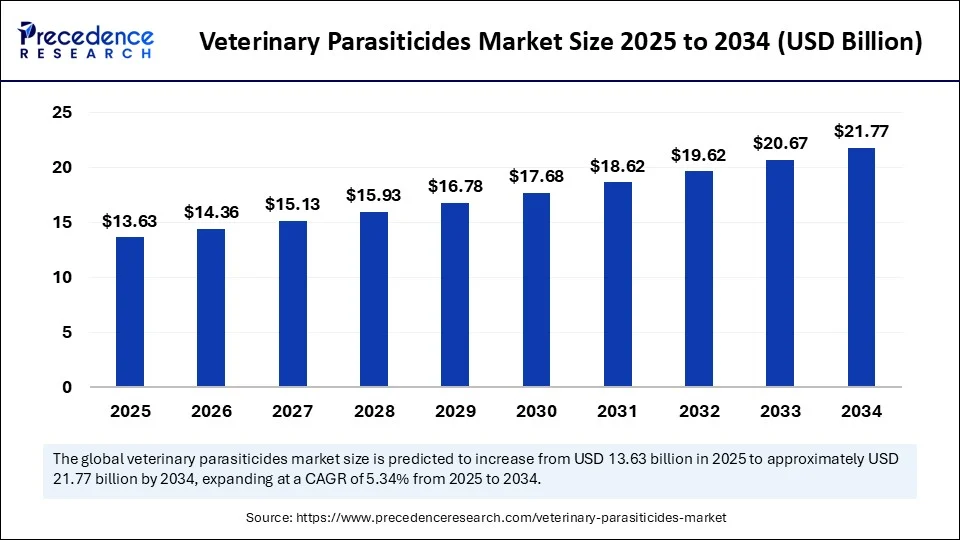
Veterinary Parasiticides Market Key Takeaways
- In terms of revenue, the global veterinary parasiticides market was valued at USD 12.94 billion in 2024.
- It is projected to reach USD 21.77 billion by 2034.
- The market is expected to grow at a CAGR of 5.34% from 2025 to 2034.
- North America led the veterinary parasiticides market with 33% share in 2024.
- Asia Pacific is expected to expand at the fastest CAGR in the market between 2025 and 2034.
- By product type, the end parasiticides segment held 41% of market share in 2024.
- By product type, the endectocides segment is anticipated to grow at a remarkable CAGR between 2025 and 2034.
- By animal type, the livestock animals segment captured 61% of market share in 2024.
- By animal type, the companion animals segment is expected to expand at a notable CAGR over the projected period.
- By mode of administration, the oral segment held 47% of market share in 2024.
- By mode of administration, the topical segment is expected to expand at a significant CAGR over the forecast period.
- By distribution channel, the veterinary clinics/hospitals segment held 51% market share in 2024.
- By distribution channel, the online pharmacies segment is expected to expand at the fastest CAGR over the projected period.
- By end user, the farmers & livestock owners segment held 57% of market share in 2024.
- By end user, the pet owners segment is expected to expand to the highest CAGR over the projected period.
Impact of AI in the Veterinary Parasiticides Market
Artificial Intelligence (AI) is increasingly influencing the veterinary parasiticides market by revolutionizing both drug development and diagnostics. AI accelerates the discovery of novel parasiticide drug targets through advanced data analysis and machine learning algorithms, enabling faster and more efficient research. It also enhances diagnostic accuracy, making parasite detection more precise and timely.
Recent advancements presented at industry events such as VMX 2025 have showcased AI-powered diagnostic tools like IDEXX analyzers and DAISY AI. These technologies support early parasite detection and enable remote monitoring, reducing the need for in-clinic visits. Veterinary clinics are also adopting AI-based image analysis tools, including those for fecal egg counts and predictive models, to improve diagnostic capabilities.
The integration of AI into veterinary practices aligns with the One Health initiative, which promotes a holistic approach to human, animal, and environmental health. AI aids in accurately identifying parasitic infections, thereby helping to reduce parasite resistance, minimize environmental impact, and lower the frequency of veterinary interventions.
From smartphone-based diagnostics to AI-driven drug discovery platforms, AI is playing a pivotal role in advancing precision treatments and enhancing the effectiveness of parasitic control in animals.
Market Overview
The veterinary parasiticides market consists of pharmaceutical products designed to control or eliminate internal and external parasites in animals. These parasiticides play a crucial role in safeguarding animal health, improving livestock productivity, and reducing the risk of zoonotic disease transmission to humans.
Veterinary parasiticides are broadly categorized into three types:
-
Endoparasiticides, which target internal parasites such as worms,
-
Ectoparasiticides, which target external parasites like fleas and ticks, and
-
Endectocides, which are effective against both internal and external parasites.
These products are used across both companion animals and livestock, administered through various routes including oral, injectable, topical, or other methods depending on the species and the nature of the infestation.
Distribution channels for veterinary parasiticides include veterinary hospitals, retail pharmacies, and increasingly, online platforms, reflecting the growing demand for accessible and convenient animal healthcare solutions. As awareness of animal welfare and disease prevention rises, the market continues to expand and evolve.