
 by
by 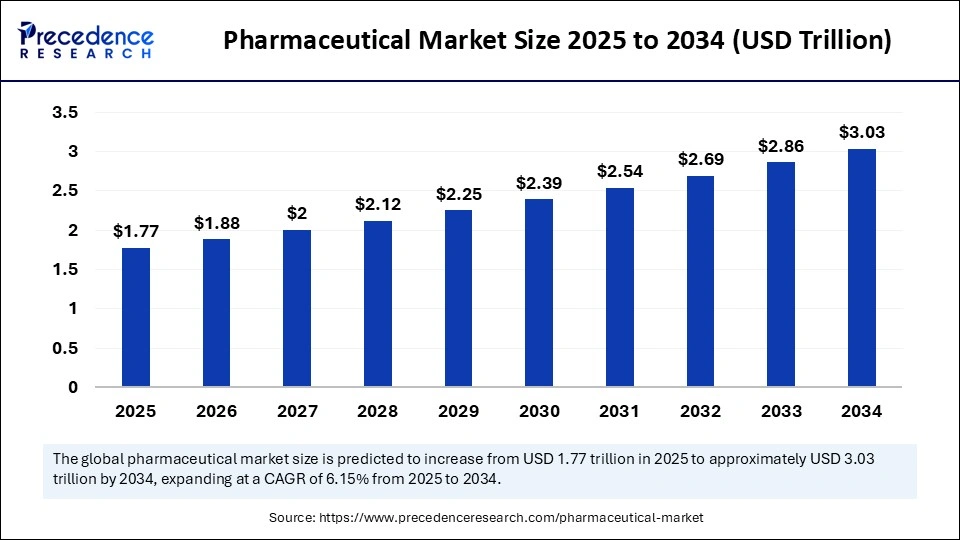
Pharmaceutical Market Key Takeaways
- In terms of revenue, the pharmaceutical market is valued at $1.77 trillion in 2025.
- It is projected to reach $3.03 trillion by 2034.
- The market is expected to grow at a CAGR of 6.15 % from 2025 to 2034.
- North America dominated the global market with the largest revenue share of 42% in 2024.
- Asia Pacific is expected to grow at the fastest CAGR from 2025 to 2034.
- By type, the prescription segment held the major market share of 87% in 2024.
- By type, the over-the-counter (OTC) segment is expected to grow at the fastest CAGR in the coming years.
- By molecule type, the conventional drugs (small molecules) segment contributed the biggest market share of 55% in 2024.
- By molecule type, the biologics and biosimilars (large molecules) segment is expected to grow at the highest CAGR between 2025 and 2034.
- By product, the branded segment captured the highest market share of 87% in 2024.
- By product, the generic segment is expected to grow at the fastest CAGR during the forecast period.
- By disease, the cancer segment generated the biggest revenue share of 19% in 2024.
- By disease, the obesity segment is expected to expand at a significant compound annual growth CAGR between 2025 and 2034.
- By route of administration, the oral segment accounted for the largest market share 58% in 2024.
- By route of administration, the parenteral segment is expected to expand at a significant CAGR between 2025 and 2034.
- By age group, the adults segment captured the highest market share of 64% in 2024.
- By age group, the geriatric segment is expected to grow at a significant CAGR in the upcoming period.
- By distribution channel, the hospital pharmacies segment dominated the market with major market share of 54% in 2024.
- By distribution channel, the retail pharmacies segment is expected to grow at the fastest rate over the projection period.
Impact of Artificial Intelligence (AI) on the Pharmaceutical Industry
Artificial Intelligence (AI) is transforming the pharmaceutical industry by accelerating innovation, reducing operational costs, and improving patient outcomes. One of the most significant contributions of AI is in optimizing drug discovery and development. By rapidly analyzing massive datasets, AI helps identify promising drug candidates more efficiently. It also enhances clinical trial processes by identifying suitable patient cohorts, thereby increasing the chances of trial success and reducing timelines.
The rise of Pharma 4.0 is further propelling the adoption of AI technologies across pharmaceutical companies and drug manufacturers. AI is also playing a key role in predicting future demand, optimizing supply chain operations, and lowering drug production costs, which collectively contribute to improved profitability and agility in the pharmaceutical sector.
By FY 2025, AI is projected to contribute to 30% of all new drug discoveries. It is also expected to significantly reduce costs and speed up the development of personalized treatments. In preclinical stages, AI has shown the potential to cut drug discovery downtimes and costs by 25% to 50%.
Pharmaceutical companies are ramping up investments in AI to drive faster innovation and shorten drug development timelines. Around 85% of biopharma firms are expected to invest heavily in AI, data, and digital technologies for R&D by 2025. Technologies such as generative AI, machine learning, multimodal data analysis, and longitudinal data integration are playing a critical role in enhancing efficiency across research, drug development, and the production of personalized medicines. Overall, global investments in AI for healthcare are projected to reach $188 billion by 2030.
Market Overview
The pharmaceutical market is undergoing significant transformation, driven by several key factors. The increasing incidence of chronic diseases, a rapidly aging global population, and the growing prevalence of age-related health conditions are major contributors to market expansion. Government initiatives and increased investments in research and development are also playing a crucial role in advancing the pharmaceutical sector.
In addition, the widespread adoption of biologics and biosimilars, along with rising healthcare expenditure, is further fueling market growth. Pharmaceutical companies are increasingly embracing advanced technologies such as Artificial Intelligence (AI) to enhance drug production, streamline operations, and accelerate innovation.
The rising burden of life-threatening diseases has amplified the demand for personalized medicine and digital health solutions. These trends are pushing the industry toward more patient-centric and data-driven approaches. Furthermore, strategic collaborations between pharmaceutical and healthcare organizations, supported by favorable government policies, are promoting the development of novel and more effective therapies. Together, these factors are shaping a dynamic and rapidly evolving pharmaceutical landscape.
Key Trends in the Pharmaceutical Market
- Rising Prevalence of Chronic Diseases: The growing incidence of chronic conditions such as cancer, cardiovascular diseases, diabetes, and obesity is increasing the demand for targeted and innovative treatments. This trend is accelerating the shift toward personalized medicine and advanced drug therapies.
- Aging Global Population: As the global population ages, the occurrence of age-related illnesses is also on the rise. This demographic shift is fueling the demand for specialized and effective medications tailored to the health needs of older adults.
- Advancements in Biologics, Biosimilars, and Personalized Medicine: The need for more precise and effective therapies has led to rapid innovation in biologics, biosimilars, and gene-targeted treatments. These advancements are improving patient outcomes and contributing to the evolution of precision medicine.
- Increasing Healthcare Spending: Governments and private sectors are ramping up healthcare investments, especially in R&D and infrastructure. Public support for domestic active pharmaceutical ingredient (API) manufacturing is also strengthening local pharmaceutical ecosystems and reducing reliance on imports.
- Focus on Drug Pricing and Reimbursement Policies: With the rising cost of advanced therapies, drug pricing and reimbursement policies are becoming more critical. Governments and regulatory bodies are working toward fair pricing structures and improved access to essential medicines, influencing market dynamics across regions.
Recent Developments
- In March 2025, Daiichi Sankyo introduced its Datroway (datopotamab deruxtecan) in Japan for the treatment of adult patients with hormone receptor (HR) positive, HER2 negative (IHC 0, IHC 1+ or IHC 2+/ISH-) unresectable or recurrent breast cancer after prior chemotherapy.
- In February 2025, Medexus Pharmaceuticals announced the availability of GRAFAPEX (treosulfan) for Injection in the U.S. After one month of FDA approvals, the company has achieved commercial launch in early 2025.
- In January 2025, AstraZeneca Pharma India Limited launched Breztri Aerosphere, marking a significant step forward in the treatment options available for COPD patients in the country.
Pharmaceutical Market Key Players
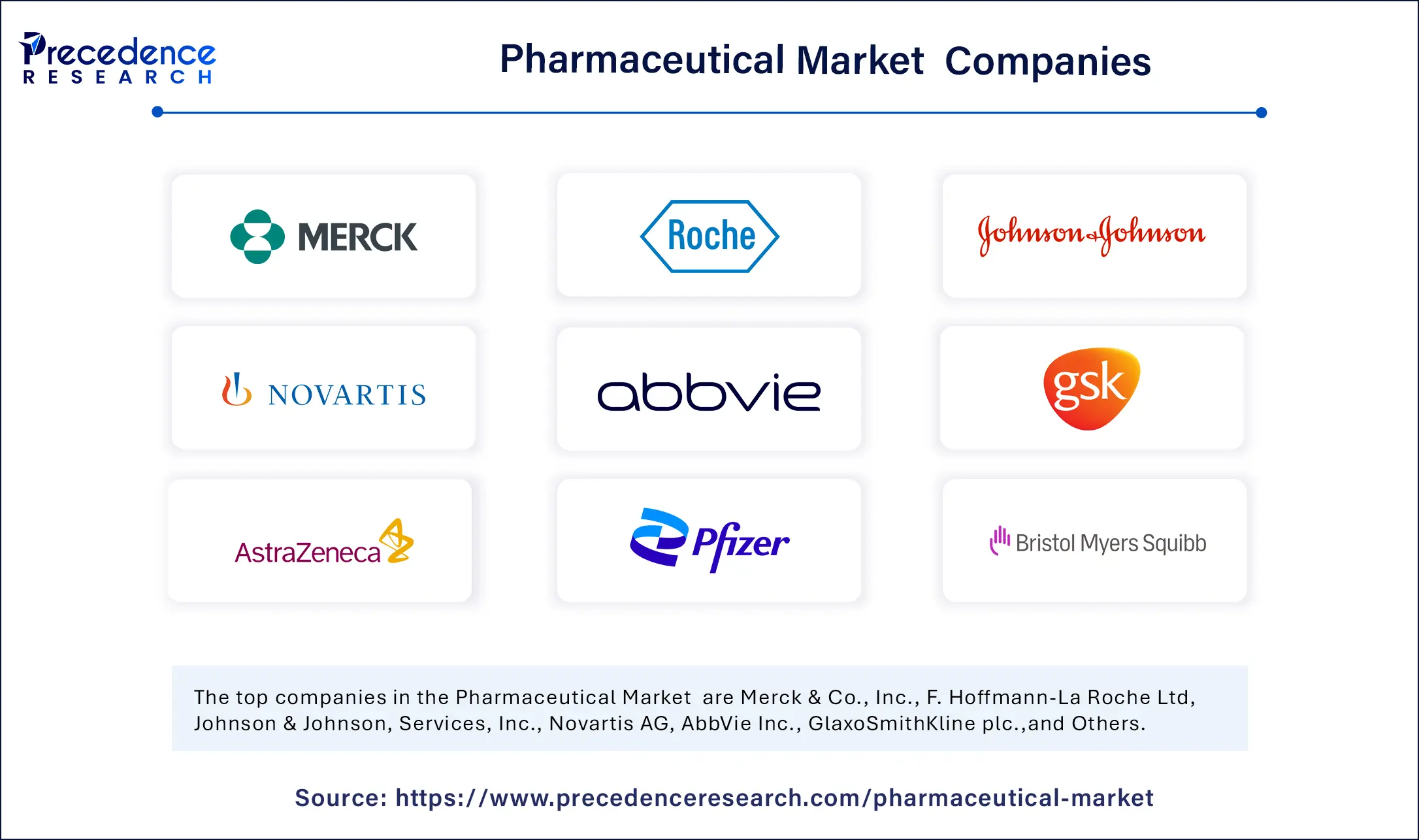
- Merck & Co., Inc
- F. Hoffmann-La Roche Ltd
- Johnson & Johnson Services, Inc.
- Novartis AG
- AbbVie Inc.
- GlaxoSmithKline plc.
- AstraZeneca
- Pfizer Inc.
- Bristol-Myers Squibb Company
- Sanofi
- Takeda Pharmaceutical Co., Ltd.
Also Read : Pharmaceutical Packaging Market
