
 by
by 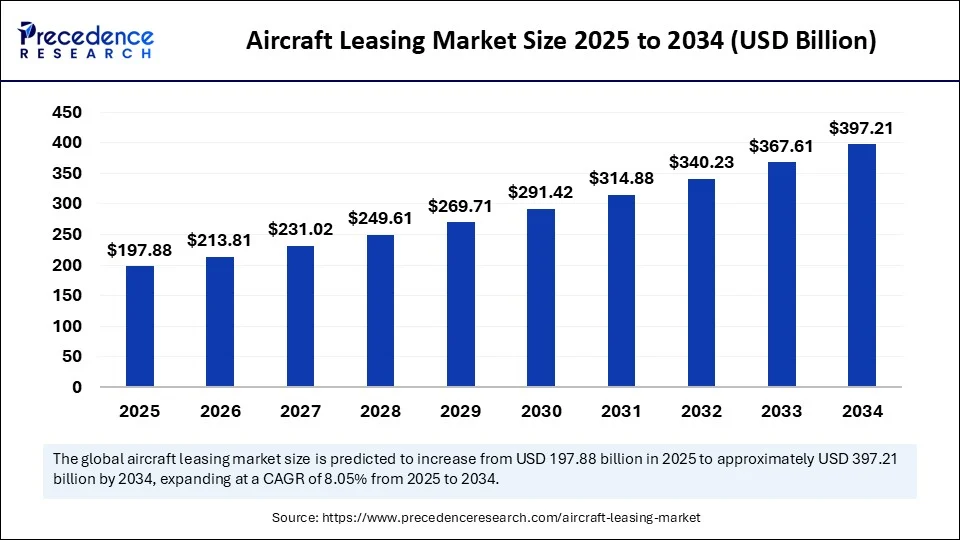
Aircraft Leasing Market Key Takeaways
- In terms of revenue, the global aircraft leasing market was valued at USD 183.13 billion in 2024.
- It is projected to reach USD 397.21 billion by 2034.
- The market is expected to grow at a CAGR of 8.05 % from 2025 to 2034.
- North America dominated the aircraft leasing market with the largest share of 41% in 2024.
- Asia Pacific is expected to grow at the fastest CAGR from 2025 to 2034.
- By lease type, the dry lease segment held the major market share in 2024.
- By lease type, the wet lease segment is projected to grow at a significant CAGR between 2025 and 2034.
- By aircraft type, the narrow-body segment contributed the biggest market share in 2024.
- By aircraft type, the wide-body segment is expected to grow at a significant CAGR between 2025 and 2034.
- By lease term, the long-term leases segment led the market in 2024.
- By lease term, the short-term leases segment is expected to grow at the highest CAGR over the projected period.
- By lessee type, the commercial airlines segment captured the biggest market share in 2024.
- By lessee type, the cargo operators segment is expected to grow at the fastest CAGR from 2025 to 2034.
Impact of Artificial Intelligence on the Aircraft Leasing Market
Artificial Intelligence (AI) is increasingly shaping the aircraft leasing industry by enabling data-driven decision-making and enhancing operational efficiency. Leading leasing firms are leveraging AI-powered tools to analyze aircraft performance metrics, optimize lease structures, and accurately forecast market demand.
Machine learning algorithms are now replacing traditional financial models to predict residual aircraft value, allowing companies to better assess asset risk and make more informed investment decisions. AI also strengthens portfolio management by providing real-time insights into key operational indicators such as flight hours, fuel consumption, and utilization trends.
Furthermore, AI plays a critical role in predictive maintenance, helping identify wear patterns and potential failures in aircraft components before issues arise. This proactive approach minimizes unscheduled downtime, improves aircraft availability, and ultimately boosts the overall reliability of leased fleets.
Market Overview
The aircraft leasing market has witnessed substantial growth, driven by the increasing need for airlines to expand and modernize their fleets in a cost-effective and flexible manner. Instead of purchasing aircraft outright, many airlines are opting for leasing models that allow them to scale operations according to evolving business demands.
Aircraft leasing typically involves two primary models: dry leasing, which includes the aircraft only, and wet leasing, which encompasses the aircraft along with crew, maintenance, and insurance. These options enable airlines to tailor fleet management strategies based on both short-term surges and long-term operational goals.
Rising demand for next-generation narrow- and wide-body aircraft, such as the Airbus A320neo and Boeing 787, is further propelling market growth. Airlines are increasingly turning to leasing companies for access to these fuel-efficient models without the burden of upfront capital investment.
Aircraft Leasing Market Growth Factors
- Rising Demand for Fleet Modernization: Airlines are replacing aging aircraft to meet emission targets and improve fuel efficiency, driving demand for leased next-generation jets.
- Growing Adoption of ACMI Lease Models: Airlines are increasingly utilizing wet lease (ACMI) solutions to manage seasonal surges and temporary route expansions, fueling short-term leasing activity.
- Boosting Demand from Startup Carriers: The emergence of new low-cost and regional airlines, particularly in emerging markets, is driving aircraft leasing as a scalable entry strategy.
- Driving Fleet Expansion in Cargo Aviation: The accelerated growth of e-commerce logistics and air freight is driving leasing interest among dedicated cargo operators.
- Expanding Use of Sale-and-Leaseback Agreements: Airlines are leveraging sale-and-leaseback deals to unlock capital, boosting liquidity and operational flexibility.
Opportunity
Why Are Airlines Shifting to Asset-Light Models in the Aircraft Leasing Market?
The growing adoption of asset-light business models by airlines is opening significant opportunities within the aircraft leasing market. As financial pressures mount, more carriers are choosing to lease rather than purchase aircraft, aiming to maintain operational flexibility and reduce capital-intensive investments.
Leasing enables airlines to quickly adjust their fleet composition in response to fluctuating fuel prices, evolving regulatory conditions, and shifting passenger demand. This model allows operators to maintain a leaner balance sheet, redirecting capital toward core operational priorities and customer service enhancements.
In March 2024, aircraft leasing company Avolon reported a rising share of lease agreements driven by airlines transitioning to asset-light strategies—largely due to interest rate pressures and the need for financial agility.
Additionally, in regions with volatile fuel price environments, airlines increasingly rely on flexible leasing options to protect their operating margins. As this trend continues, leasing companies are well-positioned to benefit from the expanding demand for scalable and adaptable fleet solutions.
Recent Developments
- In June 2025, AIP Capital partnered with Monroe Capital to acquire an aircraft leasing portfolio valued up to US$1 billion. The portfolio focuses on mid-life commercial aircraft on long-term leases with global airlines. Monroe will supply the capital, while AIP will serve as asset service and manage airline relationships. To initiate the venture, Monroe secured a US$500 million warehouse facility from Deutsche Bank and Fifth Third Bank.
- In May 2024, Hanwha has launched Hanwha Aviation, an engine leasing platform with a global strategy across Singapore, Ireland, and the U.S. The platform targets new-generation engine assets, backed by Hanwha’s expertise in manufacturing and MRO services.
It aims to deliver flexible, innovative leasing solutions for both aircraft and engines worldwide. - In May 2025, BeauTech Power Systems has acquired four Embraer E175 aircraft under lease with LOT Polish Airlines. The purchase represents its first deal with Altavair and reinforces BeauTech’s E-Jet portfolio. This move highlights the firm’s focus on mid-life, income-generating aircraft assets. The deal strengthens BeauTech’s position in the global engine and aircraft leasing market.
Also Read : Aircraft Maintenance Market
Aircraft Leasing Market Key Players
- AerCap (GECAS)
- Air Lease Corporation
- Avolon
- BBAM
- BOC Aviation
- Boeing Capital Corporation
- DAE Capital
- ICBC Leasing
- Nordic Aviation Capital
- SMBC Aviation Capita
