
 by
by 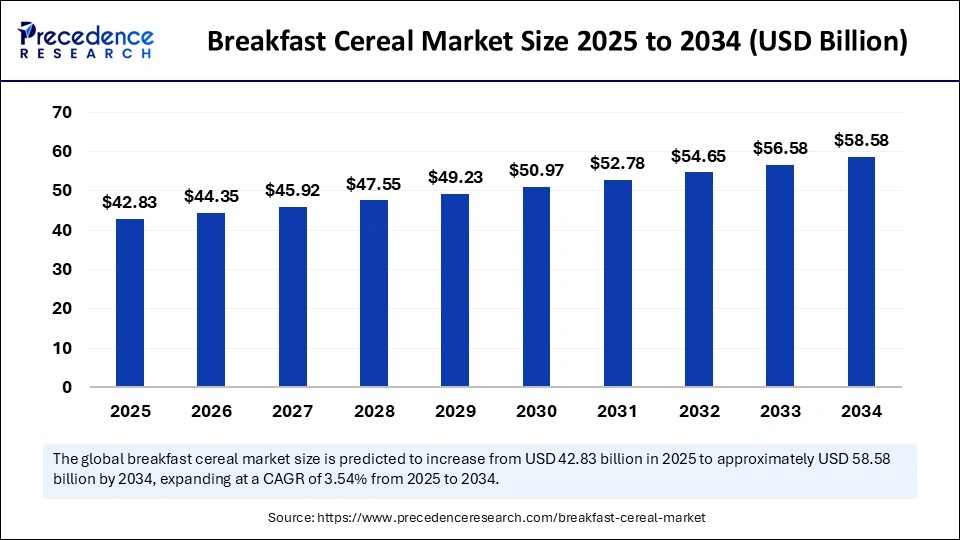
Breakfast Cereal Market Key Points
- North America captured the highest revenue share of 40% in the breakfast cereals market in 2024.
- Asia Pacific is projected to register a notable CAGR of 5.42% between 2025 and 2034.
- By product, the ready-to-eat segment dominated the market with an 88% revenue share in 2024,
- while the hot cereals segment is anticipated to grow at a significant CAGR of 4.92% during the forecast period.
- In terms of distribution, supermarkets and hypermarkets accounted for the largest market share of 50% in 2024,
- whereas the e-commerce segment is forecasted to grow at a CAGR of 5.52% from 2025 to 2034.
Breakfast Cereal Market Overview
The breakfast cereal market is a dynamic and highly competitive segment of the global food and beverage industry, catering to a diverse range of consumer preferences and dietary needs. Breakfast cereals, which include ready-to-eat (RTE) options like flakes, puffs, and granola, as well as hot cereals like oatmeal and porridge, have become a staple in many households across developed and emerging economies. The market has experienced sustained demand due to the growing awareness of the importance of a healthy breakfast, rising disposable incomes, and increasing urbanization which fuels demand for quick and convenient meal solutions.
Traditionally dominated by large multinational brands, the landscape is witnessing the emergence of niche players offering cereals with clean labels, organic ingredients, gluten-free options, and functional health benefits. Consumers are shifting toward cereals that not only provide energy but also support digestive health, weight management, and immunity. The introduction of protein-enriched cereals, keto-friendly varieties, and plant-based alternatives is further expanding market reach. Additionally, changing lifestyles and the rise of snackification trends have led breakfast cereals to evolve beyond the morning meal, now consumed throughout the day as a snack or dessert ingredient, driving consistent market growth.
Breakfast Cereal Market Growth Factors
Several structural trends are propelling the growth of the breakfast cereal market. First, increasing health consciousness is encouraging consumers to opt for cereals with fortified nutrients, natural ingredients, low sugar content, and high fiber. This shift has resulted in higher demand for cereals containing oats, quinoa, seeds, dried fruits, and superfoods. In tandem, the growing working population and time-constrained lifestyles are pushing consumers to prioritize convenience, thereby boosting demand for RTE cereals that are both fast and nutritious.
Rising urbanization, especially in emerging economies, is fostering a cultural shift toward Western-style breakfast habits, thereby increasing the consumption of packaged cereals. Expanding supermarket and e-commerce retail channels have made a wide range of cereal options accessible to a broader audience. The trend of personalized nutrition and the growing prevalence of dietary restrictions—such as gluten intolerance and dairy sensitivity—are also supporting the development of specialized cereal offerings. Moreover, increased marketing efforts, brand collaborations with health influencers, and attractive packaging innovations are enhancing product visibility and consumer engagement across all demographics.
Impact of AI on the Breakfast Cereal Market
Artificial Intelligence (AI) is playing an increasingly transformative role in the breakfast cereal market by optimizing product development, marketing strategies, and supply chain efficiency. In product innovation, AI enables brands to analyze vast amounts of consumer data from online reviews, purchasing behavior, and social media interactions to identify emerging taste trends, ingredient preferences, and dietary needs. This allows manufacturers to develop data-driven, consumer-tailored cereal formulations with a higher probability of market success.
AI is also revolutionizing targeted marketing and personalization. By leveraging machine learning algorithms, brands can segment audiences more effectively and deliver hyper-personalized promotional campaigns through digital platforms, increasing conversion rates and customer loyalty. On the operational side, AI enhances demand forecasting, inventory management, and distribution logistics, helping brands reduce waste, ensure product availability, and improve shelf-life planning.
In the realm of product customization, AI-powered digital platforms are enabling consumers to create personalized cereal mixes based on their nutritional goals or taste preferences. This direct-to-consumer model, supported by AI, aligns with rising expectations for customization and healthy living. As AI continues to evolve, it will deepen its role in predictive analytics, pricing optimization, and sustainability efforts, making it a strategic asset for cereal manufacturers worldwide.
Market Scope
| Report Coverage | Details |
| Market Size by 2034 | USD 58.58 Billion |
| Market Size in 2025 | USD 42.83 Billion |
| Market Size in 2024 | USD 41.37 Billion |
| Market Growth Rate from 2025 to 2034 | CAGR of 3.54% |
| Dominating Region | North America |
| Fastest Growing Region | Asia Pacific |
| Base Year | 2024 |
| Forecast Period | 2025 to 2034 |
| Segments Covered | Product, Distribution Channel and Region |
| Regions Covered | North America, Europe, Asia-Pacific, Latin America, and Middle East & Africa |
Market Drivers
Key drivers of the breakfast cereal market include the increasing emphasis on health and wellness, particularly in post-pandemic consumer behavior. Shoppers are more interested in foods that offer immune-boosting, anti-inflammatory, and digestive benefits. Whole grains, probiotics, and plant-based proteins are becoming core features of modern cereal offerings. Another major driver is convenience, as consumers across all age groups seek quick and portable breakfast options that require minimal preparation.
Changing dietary patterns and breakfast habits, particularly among millennials and Gen Z, are influencing demand for novel textures, flavors, and formats, such as granola bars, on-the-go cereal cups, and overnight oats. Moreover, the growing number of dual-income households and busy family schedules are pushing breakfast cereal consumption as a fast, family-friendly meal option.
Brands are also increasingly leveraging celebrity endorsements, co-branded products, and social media campaigns to target younger audiences and foster deeper brand engagement. With digital grocery shopping becoming mainstream, product visibility and accessibility across online platforms have significantly enhanced market penetration. The introduction of limited-edition flavors, nostalgia-themed products, and functional food claims further supports strong consumer interest and repeat purchases.
Opportunities
There are substantial opportunities in the breakfast cereal market, particularly in areas of functional and fortified cereals. The rising demand for products supporting gut health, weight control, mental wellness, and sports nutrition provides ample room for innovation. Launching cereals fortified with vitamins, minerals, adaptogens, and plant-based protein can help brands appeal to health-focused consumers.
There’s also opportunity in regional and ethnic cereal variants, especially in multicultural markets or regions where traditional breakfast options are being adapted into cereal formats. Additionally, the development of organic, non-GMO, and clean-label products is gaining traction, offering premiumization opportunities for brands targeting environmentally and health-conscious consumers.
E-commerce and subscription-based models are also opening new revenue streams, especially for boutique and artisanal cereal brands. Offering customizable, home-delivered cereal boxes with monthly updates and seasonal flavors can foster brand loyalty and customer retention. Expanding into developing economies, where Western dietary habits are gradually being adopted, represents another significant growth opportunity for global players.
Challenges
Despite favorable trends, the breakfast cereal market faces several challenges. Rising health concerns over sugar content and highly processed ingredients have led to skepticism about traditional cereal offerings, particularly among health-conscious consumers. This has put pressure on established brands to reformulate legacy products and balance taste with nutritional value.
Another challenge is intense market competition, both from within the cereal category and from alternative breakfast options such as smoothies, protein bars, yogurt, and eggs. Differentiating products in a saturated market requires significant innovation, brand building, and agility. Furthermore, price sensitivity and inflationary pressures have led to increased scrutiny over food spending, especially in price-sensitive regions, which may limit the growth of premium or specialty cereal products.
Regulatory challenges, particularly around health claims, nutritional labeling, and packaging waste management, add to the operational complexity. Also, adapting to shifting consumer behavior across cultures and age groups requires constant market research and flexible product strategies. Supply chain disruptions, particularly for imported ingredients or packaging materials, remain a logistical and cost-related hurdle for manufacturers.
Regional Outlook
North America holds a dominant position in the breakfast cereal market, with the United States being one of the largest consumers globally. High product availability, brand loyalty, and a strong culture of packaged food consumption drive consistent demand. However, the market is maturing, and growth is being driven more by innovation, health trends, and premiumization rather than volume.
Europe represents a robust market with diverse consumer preferences. Countries like the UK, Germany, and France show strong demand for both traditional cereals and organic, natural alternatives. The region is also seeing increased regulation around sugar content and sustainability, prompting brands to innovate responsibly.
Asia Pacific is the fastest-growing region, with countries like China, India, Japan, and Australia driving demand. Rapid urbanization, rising disposable incomes, and changing breakfast habits are key growth enablers. Western cereal brands are gaining popularity, while local manufacturers are also creating cereal products tailored to regional tastes.
Latin America and the Middle East & Africa are emerging markets for breakfast cereals, supported by growing middle-class populations and greater retail accessibility. However, challenges such as economic instability and price sensitivity may moderate growth, creating opportunities primarily for low-cost and value-oriented products.
Segments Covered in the Report
By Product
- Hot Cereals
- Ready-to-Eat
By Distribution Channel
- Supermarkets & Hypermarkets
- Convenience Stores
- E-commerce
- Others
By Region
- North America
- Asia Pacific
- Europe
- Latin America
- Middle East & Africa
Read Also: Distillation Systems Market
Get this report to explore global market size, share, CAGR, and trends, featuring detailed segmental analysis and an insightful competitive landscape overview @ https://www.precedenceresearch.com/sample/6115
You can place an order or ask any questions, please feel free to contact at sales@precedenceresearch.com|+1 804 441 9344
